


How to Winterize a Lithium Marine Battery
Winterizing a lithium battery is easier than winterizing lead-acid. There’s no sulfation to fight, no water to check and no need for a maintainer running all winter. But there are a few lithium-specific rules, especially about charge level and cold temperatures, that protect your investment. This guide explains how to winterize a lithium marine battery.
Why lithium is easier to store
- Low self-discharge. LiFePO4 often loses only 2% to 3% per month, so it can sit for months without charging.
- No sulfation. Sitting partly charged doesn’t harm it.
- No watering or equalization.
- Lighter, making removal for indoor storage easy.
Step 1: Charge to storage level
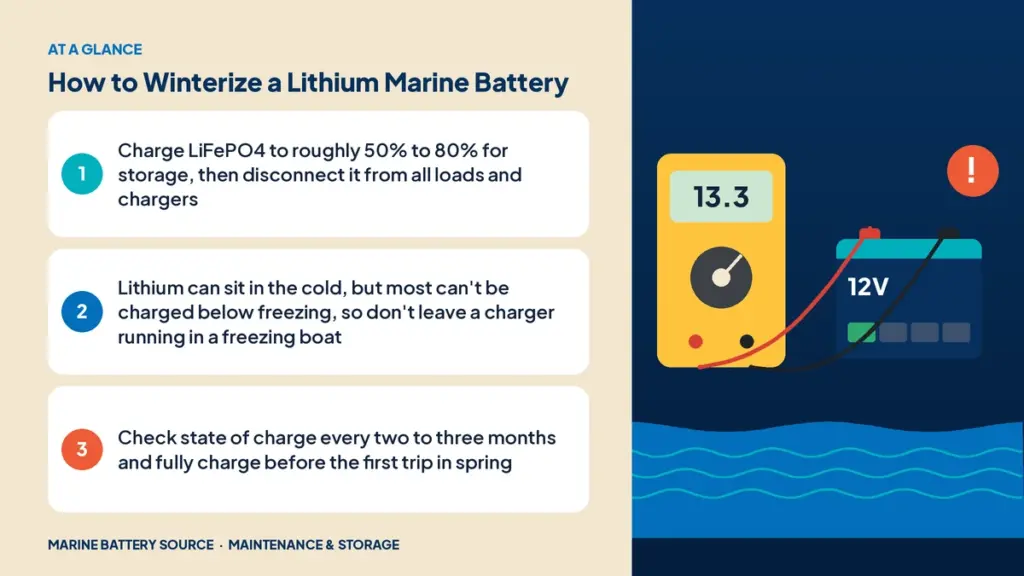
Most manufacturers recommend storing LiFePO4 batteries at partial charge, often 50% to 80%. Storing at 100% for long periods, especially in warm conditions, can slightly accelerate aging. Storing at 0% risks the battery dropping below the BMS cutoff over time.
- Charge fully first so the BMS can balance the cells.
- Discharge to the storage level by running a load, or simply use the boat until you reach it, then stop.
- Check the level in the battery app or with a battery monitor.
If you’re not sure, follow the battery maker’s guidance; some say it’s fine to store at full charge.
Step 2: Disconnect
Disconnect the battery from all loads and chargers. Even small parasitic drains like a stereo’s memory or a bilge pump float switch can slowly drain a lithium battery over months. Options:
- Turn off the battery switch (if nothing bypasses it)
- Disconnect the negative cable
- Use the battery’s sleep or storage mode if it has one
Step 3: Decide where to store it
In the boat
Lithium can stay in the boat if:
- It’s disconnected
- Temperatures won’t drop far below the battery’s storage limit (often around -4°F / -20°C; check the maker’s spec)
- You won’t try to charge it while it’s below freezing
Indoors
Removing it to a garage or basement keeps it in a moderate temperature and makes checking easy. See removing a boat battery for winter.
Step 4: Don’t charge below freezing
Most LiFePO4 batteries can’t safely accept charge below 32°F (0°C). Charging in the cold can cause lithium plating, which permanently damages the cells. Many BMS units block charging at low temperature, but don’t rely on it. If you leave a charger connected in an unheated boat, make sure the battery has heating or low-temperature charge protection.
Heated batteries like the Dakota Lithium 135Ah heated dual-purpose or the ECO Battery 12V 120Ah heated warm themselves before charging.
Step 5: Check every few months
Check state of charge every two to three months. If it’s dropped significantly, charge back to the storage level, in a warm place if possible.
Step 6: Spring startup
- Bring the battery to room temperature if it was stored cold.
- Charge fully with a lithium charger.
- Inspect terminals and cables.
- Reinstall and reconnect.
- Check the app for alerts.
See spring boat battery commissioning.
Trolling motor lithium batteries
For 24V and 36V lithium trolling batteries, follow the same steps. Disconnect the trolling motor and charger, charge to storage level and store the battery where temperatures are moderate. See storing trolling motor batteries.
How self-discharge and parasitic drains add up
Even with very low self-discharge, small loads matter over a long winter. Consider a 12V 100Ah lithium battery stored at 60%:
- Self-discharge at about 3% per month takes it to roughly 45% after five months. That’s fine.
- Add a stereo memory drawing 0.03A, and the battery loses about 22Ah a month. After three months, it’s near empty.
- If the BMS cuts off at low voltage and the battery keeps sitting, it can drift far enough that some chargers won’t recognize it in spring.
That’s why disconnecting matters more than the exact storage percentage. A switch that leaves nothing connected, or a removed negative cable, keeps the math simple.
Winterizing in warm climates
In southern states where boats are used year-round, lithium batteries often stay in service through the winter. If a boat will sit for more than a month, the same principles apply: store at partial charge, disconnect loads and keep the battery shaded. Heat is the bigger enemy than cold in Florida or Texas, so avoid leaving a fully charged lithium battery in a closed, sun-baked console for months.
Common mistakes
- Storing at 0%. Self-discharge can drop the battery below the BMS cutoff.
- Leaving it connected to parasitic loads.
- Charging below freezing without heating.
- Forgetting to check for months on end.
- Using a lead-acid maintainer with high float or desulfation modes.
Lead-acid comparison
Lead-acid batteries need a full charge and a maintainer through the winter to avoid sulfation and freezing. See storing lead-acid batteries off-season and can a marine battery freeze?.
Mixed systems
If your boat has a lead-acid starting battery and a lithium house or trolling battery, winterize each according to its chemistry. Keep the lead-acid battery on a maintainer and the lithium battery disconnected at storage charge.
Example winterizing plan
A bass angler in Ohio with a 36V lithium trolling battery and a lead-acid starting battery:
- After the last trip in October, charges the lithium battery fully, then runs the trolling motor in the driveway to bring it to about 60%.
- Disconnects the motor and charger leads and removes the lithium battery to the basement.
- Charges the starting battery fully and connects a maintainer in the garage.
- Checks the lithium battery in January and tops it up to 60% if needed.
- In March, fully charges both batteries and reinstalls them.
Lithium battery storage tips
- Store away from flammable materials.
- Keep it off wet floors; a shelf is best.
- Keep the terminals covered so nothing can short them.
- Store in the original box if you still have it.
For the full storage guide covering all battery types, see winter storage for marine batteries, our marine battery maintenance guide and the seasonal boat battery calendar. Browse our lithium marine batteries.
Frequently asked questions
What charge level should I store a lithium battery at?
Often 50% to 80%, depending on the maker’s recommendation.
Can I leave my lithium battery in the boat over winter?
Yes, if it’s disconnected and temperatures stay within the maker’s storage range. Don’t charge it below freezing without heating.
Do I need a maintainer for lithium batteries?
Usually not. LiFePO4 self-discharges slowly. Check it every few months and recharge if needed.
Can lithium batteries freeze?
They can be stored in cold temperatures within the maker’s limits, but most shouldn’t be charged below 32°F (0°C).
What should I do in spring?
Warm the battery to room temperature, charge it fully, inspect connections and reinstall it.