


Should You Remove Your Boat Battery for Winter?
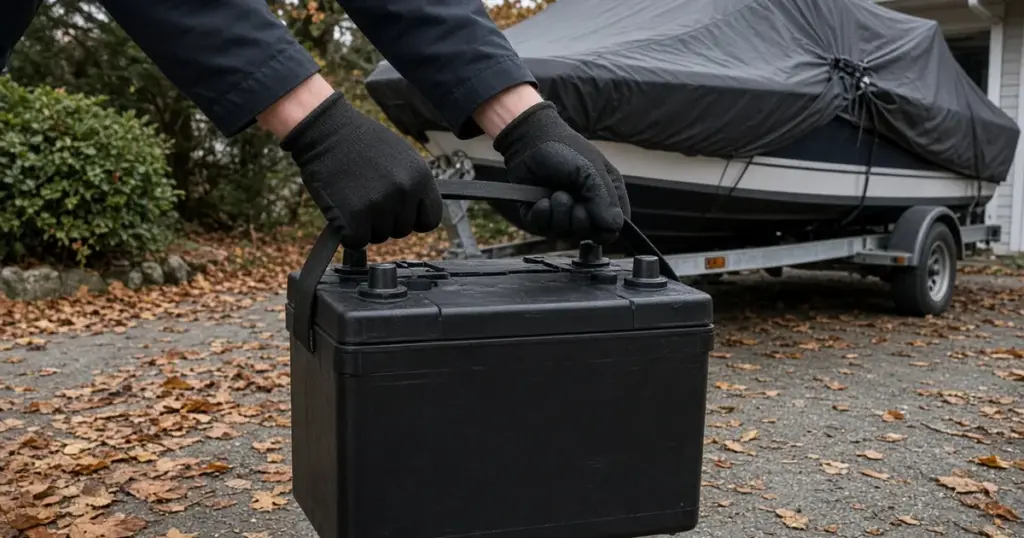
Every fall, boat owners face the same question: should the battery come out for winter, or can it stay in the boat? The answer depends on where the boat is stored, how cold it gets and whether you have power available. Removing the battery isn’t always required, but it often makes winter care easier and safer. This guide explains when and how to remove your boat battery for winter.
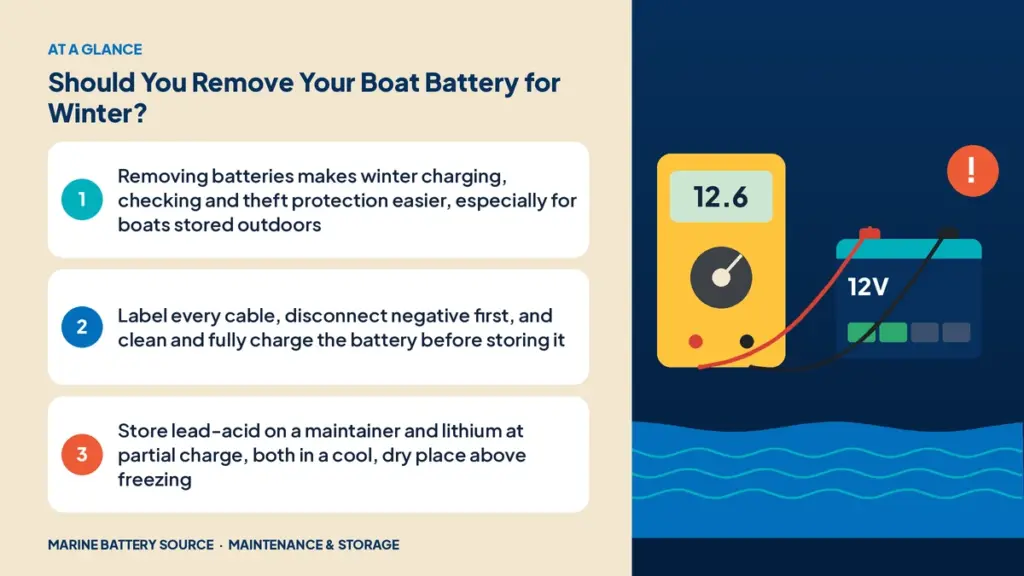
Reasons to remove the battery
- Easier charging. A battery in your garage or basement can stay on a maintainer without running cords to the boat.
- Freezing protection. Indoors, the battery stays warmer, and you can keep an eye on its charge.
- Theft protection for boats stored outdoors.
- Easy checks. Monthly voltage and water checks take a minute instead of a trip to the storage yard.
- No parasitic drains from the boat’s electronics.
Reasons to leave it in
- Shore power available at a covered storage facility, with an onboard charger to maintain the battery.
- Heavy batteries that are hard to remove, such as large house banks.
- Lithium batteries that are disconnected and stored at partial charge within temperature limits.
- Mild climates where freezing isn’t a concern.
If you leave batteries in, disconnect them or use a maintainer. See trailer boat battery storage and boat lift and slip battery care.
What you need
- Wrenches for terminal nuts
- Masking tape and marker, or labels
- Safety glasses and gloves
- Battery carrier strap
- Baking soda, water and a wire brush
- Terminal protectant
Step-by-step removal
- Turn off the battery switch and all loads.
- Label every cable with its terminal and battery. Take photos, too.
- Disconnect the negative cable first, then the positive.
- Disconnect accessory leads and charger leads.
- Remove the hold-down and keep the hardware together.
- Lift the battery out with a carrier strap, using your legs. Keep flooded batteries upright.
- Protect the cable ends in the boat by covering them with plastic bags or tape so they don’t corrode or short.
Prepare the battery for storage
Lead-acid
- Clean terminals and the case.
- Charge fully.
- Top up water (flooded).
- Connect a smart maintainer, or plan to recharge every four to six weeks.
See storing lead-acid batteries off-season.
Lithium
- Charge to the maker’s recommended storage level, often 50% to 80%.
- Store disconnected.
- Check every two to three months.
See how to winterize a lithium battery.
Where to store it
- Cool, dry and above freezing, ideally 40°F to 60°F
- Ventilated (especially flooded batteries on a maintainer)
- Away from sparks, flames and flammables
- Out of reach of children and pets
- On a shelf or workbench
Charging during storage
A smart maintainer keeps lead-acid batteries fully charged without overcharging. Set it for flooded or AGM. For lithium, no maintainer is usually needed; check and top up if the charge drops. Self-discharge rates vary by chemistry; see battery self-discharge rates.
Reinstalling in spring
- Fully charge the battery.
- Inspect and clean the cable ends in the boat.
- Reinstall the battery and hold-down.
- Connect the positive first, then the negative, following your labels.
- Torque terminals and apply protectant.
- Test voltage and start the engine.
See spring boat battery commissioning.
Trolling motor batteries
For series trolling banks, label each battery and series link. Remove the motor and charger leads before removing the batteries. Store and maintain each battery individually. See storing trolling motor batteries.
Protecting the boat while the battery is out
With the battery removed, the automatic bilge pump won’t run. That’s fine on a trailer under cover, but it’s a real risk for a boat left in the water or under a cover that can collect rain. Make sure the boat is stored where water can’t accumulate, or leave a battery connected only to the bilge circuit with a maintainer.
Common mistakes
- Not labeling cables, leading to wiring mistakes in spring
- Storing discharged lead-acid batteries
- Leaving cable ends exposed in the boat
- Lifting incorrectly and straining your back
- Storing on a cold porch where the battery can freeze
Should you replace it now?
Fall is a good time to test batteries. If yours struggled last season, replacing it now means you’ll start spring with a fresh battery. Lithium options like the EPOCH 12V 105Ah LiFePO4 are much lighter, making future removal easy. Browse our lithium marine batteries and cranking batteries.
Making removal easier next year
- Install quick-disconnect terminals or wing nuts (properly tightened) on simple setups.
- Keep a labeled cable map in your boat’s documentation.
- Use a battery box with a strap that’s easy to release.
- Consider lithium to cut the weight in half or more.
Removing batteries from a boat on a lift or in the water
Boats on lifts or in slips need extra care. Bring a bucket or bag for tools so nothing goes overboard, and use a carrier strap when stepping from the boat to the dock. If the battery is heavy, have a helper on the dock to take it from you. Never lift a battery while balancing on a gunwale. For boats that stay on the lift all winter, see boat lift and slip battery care.
Getting rid of old batteries
If a battery is at the end of its life, winter removal is the perfect time to recycle it. Lead-acid batteries can be returned to most battery retailers and auto parts stores, often for a core refund. Don’t store dead batteries in the garage indefinitely; leaking or swollen batteries are a hazard.
For the full storage guide, see winter storage for marine batteries, our marine battery maintenance guide and the seasonal boat battery calendar.
Frequently asked questions
Should I take my boat battery out for winter?
It’s often easier to maintain indoors, especially for boats stored outside in cold climates. If you have shore power and an onboard charger, leaving it in is fine.
Which cable do I remove first?
Remove the negative first, then the positive.
Where should I store my boat battery over winter?
In a cool, dry, ventilated place above freezing, on a shelf, away from sparks.
Do I need to charge my battery over winter?
Lead-acid batteries need a maintainer or regular charging. Lithium batteries usually only need a check every few months.
Can I leave my lithium battery in the boat?
Yes, if it’s disconnected, at storage charge, and temperatures stay within the maker’s limits.