


Keeping Batteries Healthy on a Boat Lift or in a Slip
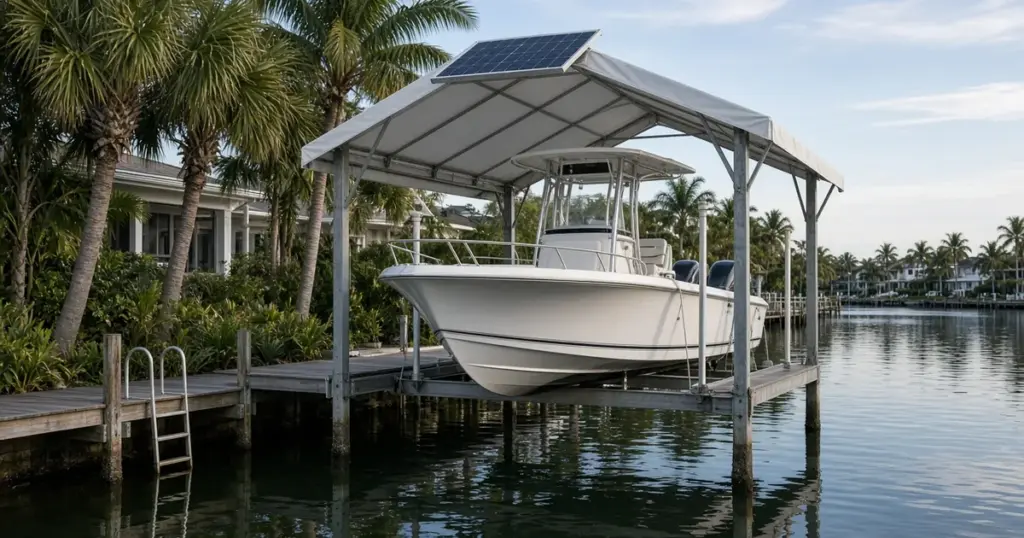
A boat that lives in a slip or on a lift is always ready to go, but its batteries face challenges that trailered boats don’t. Small electronics drains, bilge pump cycles after rain, and weeks between trips can all pull batteries down. Without a charging plan, you’ll find a dead battery right when you want to head out. This guide covers boat lift and slip battery care.
The challenges
- Parasitic drains: stereos, chartplotters, radios and monitors draw small currents even when off.
- Bilge pump cycling: rain and minor leaks trigger the automatic pump, which draws several amps each time.
- Heat: boats on lifts in sunny climates can see very high compartment temperatures, speeding up self-discharge and aging.
- Long gaps: boats used only on weekends or occasionally may sit for weeks.
- Storms: heavy rain can make the bilge pump work hard for hours.
Option 1: Shore power and an onboard charger
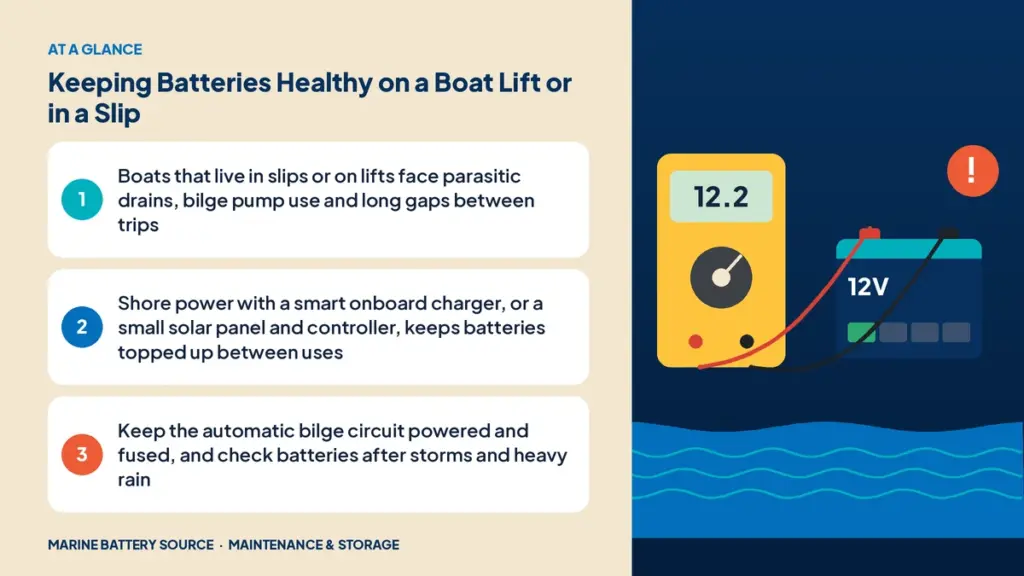
If your slip has shore power, a smart onboard charger is the best solution. It keeps every battery fully charged, handles bilge pump cycling and maintains the batteries indefinitely.
- Use a multi-bank charger with one output per battery, like the EPOCH 4-bank charger.
- Set each bank for the battery’s chemistry.
- Plug into a GFCI-protected dock pedestal outlet with a proper marine shore cord.
Option 2: Solar
Boats on lifts without shore power often use a small solar panel to keep batteries topped up. A 20W to 50W panel is usually enough to offset parasitic drains and occasional bilge pump use on a typical boat. Larger panels help boats with fridges or more electronics.
- Mount the panel on a hardtop, T-top or the lift canopy.
- Use a charge controller set for the battery chemistry.
- Fuse the controller output near the battery.
Option 3: Lift motor power
Some lifts run on 12V batteries charged by solar. Keep the lift battery separate from the boat’s batteries, and check it regularly. A dead lift battery can leave the boat stuck in the water or out of it.
Keep the bilge pump powered
The automatic bilge pump circuit should be wired directly to the battery through its own fuse, so it runs even when the main battery switch is off. On a boat in a slip, this is a critical safety system. Check:
- The float switch works (lift it to test)
- The fuse is intact
- The battery is charged enough to run the pump during a long rain
Turning off the battery switch
When you leave the boat, turn off the main battery switch to stop parasitic drains, unless your charger needs it on. The automatic bilge pump should still have power through its dedicated circuit.
Battery choice for slip and lift boats
- Lithium has low self-discharge, handles partial charge without damage and tolerates heat better than lead-acid. A battery like the EPOCH 12V 105Ah LiFePO4 is a good fit.
- AGM has lower self-discharge than flooded and no water to check.
- Flooded works with a charger but needs regular water checks, especially in heat.
Heat management
Boats on lifts in sunny climates can get very hot inside. Heat shortens lead-acid life significantly. To reduce it:
- Use a canopy or cover on the lift
- Keep compartments ventilated
- Consider lithium, which tolerates heat better
Checking batteries
- Weekly or every visit: check voltage or the battery app
- Monthly: inspect terminals, cables and water levels (flooded)
- After storms: check battery voltage and bilge pump operation
Storm preparation
Before a storm:
- Make sure batteries are fully charged
- Confirm the bilge pump works
- Secure shore power cords, or disconnect them if flooding is expected
- If the boat will be lifted high or removed, plan for battery care
Seasonal storage on a lift
If the boat stays on the lift through the off-season:
- Keep batteries charged with shore power or solar
- Or remove batteries and store them indoors. See removing a boat battery for winter.
- In freezing climates, lead-acid must stay fully charged. See can a marine battery freeze?.
Trailered boats are different
If you trailer your boat, see trailer boat battery storage.
Common mistakes
- No charging plan for a boat that sits in the water
- Bilge pump on the main switch, so it won’t run when the switch is off
- Undersized solar that can’t keep up with drains
- Lead-acid batteries left in hot compartments without charging
- Not checking after storms
Spring and seasonal checks
At the start of each season, go through a full commissioning. See spring boat battery commissioning. Self-discharge and drains vary by battery; see battery self-discharge rates.
Example: weekend boat on a lift with solar
A 24-foot center console sits on a lift in a canal and is used most weekends. It has a lead-acid starting battery and a lithium house battery. The owner installs a 30W panel on the lift canopy wired through a small charge controller to the house battery, with a DC-DC charger feeding the starting battery when the engine runs. The automatic bilge pump is fused directly at the house battery. Between weekends, the solar panel replaces the electronics standby draw and the occasional bilge cycle. The owner checks the battery app each visit and finds the house battery near full every time.
Shore power safety
Dock electrical systems can be dangerous if they’re faulty. Use a marine-rated shore cord in good condition, inspect the plug and pedestal outlet for burn marks, and never swim near a marina with shore power connected. Electric shock drowning is a real risk around docks with faulty wiring. If you notice tingling in the water or on the boat, get out and report it immediately.
For a complete storage overview, see winter storage for marine batteries and our marine battery maintenance guide. Browse our marine battery chargers.
Frequently asked questions
How do I keep my boat battery charged on a lift?
Use shore power with a smart onboard charger, or a small solar panel with a charge controller.
Should I turn off the battery switch on a boat in a slip?
Yes, to stop parasitic drains, as long as the automatic bilge pump is wired directly to the battery through its own fuse.
What size solar panel do I need for a boat on a lift?
Often 20W to 50W is enough to offset parasitic drains and occasional bilge pump use.
Are lithium batteries good for boats on lifts?
Yes. They have low self-discharge and tolerate heat and partial charge better than lead-acid.
How often should I check batteries on a boat in a slip?
Every visit for voltage, monthly for a full inspection, and after storms.