


Charge Profiles Explained: Lithium vs AGM vs Flooded
Most modern marine chargers let you choose a charge profile: flooded, AGM, gel, lithium and sometimes custom. That setting matters more than many boaters realize. The wrong profile can leave batteries chronically undercharged, overcharge them or shorten their life. This guide explains battery charge profiles, how they differ for lithium, AGM and flooded batteries, and how to choose the right one.
What a charge profile is
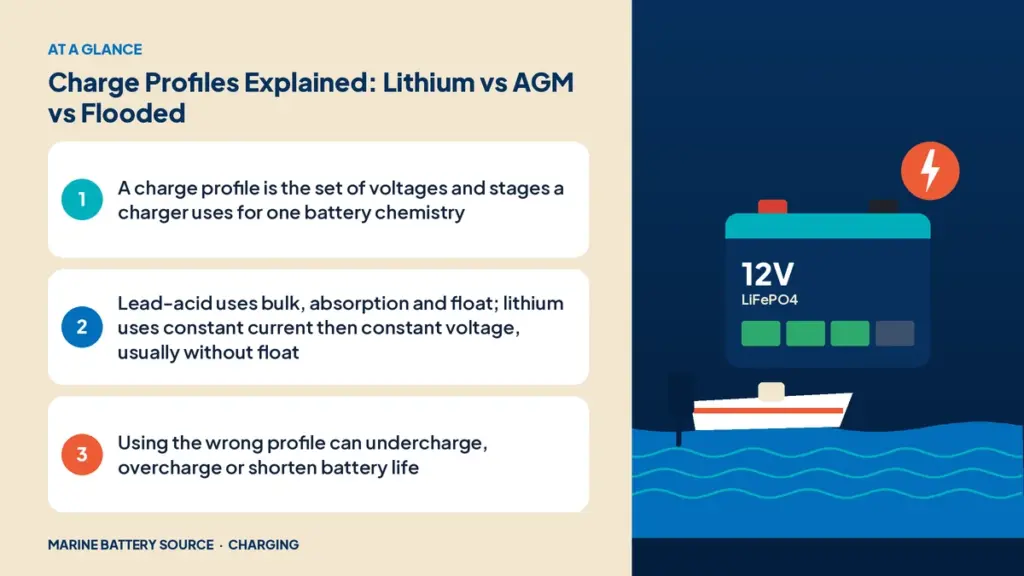
A charge profile is the sequence of stages and voltages a charger uses. It controls how much current flows at each stage, what voltage the charger holds, how long it holds it, and what it does when the battery is full.
The lead-acid stages
Bulk
The charger delivers its maximum current until the battery reaches the absorption voltage. Most of the charge goes in during bulk.
Absorption
The charger holds a set voltage while current gradually tapers. This stage completes the charge and can take a few hours.
Float
The charger drops to a lower voltage to keep the battery full without overcharging. Lead-acid batteries benefit from float during storage.
Equalization (flooded only)
Some chargers periodically apply a controlled higher voltage to flooded batteries to mix the electrolyte and reduce sulfation. Never equalize AGM, gel or lithium batteries unless the maker specifically allows it.
How flooded and AGM profiles differ
AGM and flooded batteries use similar stages but different voltages and limits. Typical values at 12V and room temperature:
| Stage | Flooded | AGM |
|---|---|---|
| Absorption | About 14.4–14.8V | About 14.4–14.7V |
| Float | About 13.2–13.5V | About 13.5–13.8V |
| Equalize | Periodic, if recommended | Not used |
Values vary by maker; always use the battery’s spec sheet. Temperature compensation adjusts these voltages in hot and cold conditions.
The lithium profile
Lithium (LiFePO4) batteries charge differently:
- Constant current (CC): the charger delivers steady current until the battery reaches its target voltage, typically around 14.2V to 14.6V for a 12V battery.
- Constant voltage (CV): the charger holds that voltage briefly while current tapers, then stops.
- No traditional float in many profiles, or a low float voltage below the full-charge level. Lithium batteries don’t need to be held at full voltage.
- No equalization. Equalization voltages can trigger the battery’s protection or cause harm.
Lithium chargers like the EPOCH 12V 15A and EPOCH 24V 15A use dedicated LiFePO4 charging profiles.
Why the wrong profile is a problem
- Lead-acid profile on lithium: may undercharge, apply float continuously or attempt equalization. See charging lithium with a lead-acid charger.
- Lithium profile on lead-acid: may not hold absorption long enough, leaving lead-acid undercharged and prone to sulfation.
- Flooded profile on AGM: may overcharge or equalize, drying out the AGM.
- AGM profile on flooded: usually works but may skip helpful equalization.
Temperature compensation
Lead-acid charging voltages should rise in cold weather and fall in heat. Many chargers include a temperature sensor or internal compensation. Lithium batteries don’t need voltage compensation, but most shouldn’t be charged below about 32°F unless heated.
Custom profiles
Some chargers let you set custom voltages. That’s useful when a battery maker specifies exact values. Use the maker’s absorption, float and maximum voltages, and disable equalization unless required.
Multi-bank chargers and profiles
On multi-bank chargers, some apply one profile to all banks; others let you set each bank separately. If you combine lithium and lead-acid, you need per-bank profiles. See the multi-bank charger guide.
Choosing the right profile
- Find the battery’s chemistry and spec sheet.
- Select the matching profile on the charger.
- Check that the charger’s voltages match the maker’s recommendations.
- Disable equalization for AGM, gel and lithium.
- Confirm temperature compensation for lead-acid in extreme climates.
Charging underway
Alternators and DC-DC chargers also follow charge profiles. Many alternators use fixed voltage regulation designed for lead-acid. DC-DC chargers can apply proper lithium or AGM profiles. See charging on the water and charging lithium batteries on a boat.
Charge rate and profile together
The profile sets voltages; the charger’s amp rating sets how fast the battery fills. See the charger amp rating guide and how long it takes to charge a marine battery.
Example: switching a boat to lithium
An owner replaces two flooded trolling batteries with lithium batteries but keeps a flooded cranking battery. The onboard charger’s lithium-capable banks are switched to the lithium profile, and the cranking battery bank stays on the flooded profile. Equalization is disabled on the lithium banks. Now each battery charges to its own correct voltage.
Gel batteries
Gel batteries are less common on boats today but still found on some older boats. They’re sensitive to overvoltage, so their absorption voltages are often a little lower than AGM’s. Use a gel profile when available, never equalize them, and follow the maker’s voltages closely.
Reading a charger’s display
Many chargers show the current stage with lights or a display: bulk, absorption, float or complete. Watching these stages after a typical trip helps you understand how long your batteries take to charge and whether the charger is reaching each stage. A lead-acid battery that never reaches float may be failing or the charger may be undersized. A lithium battery that charges to full quickly and then shows “complete” is behaving normally.
Profiles and battery life
Using the right profile is one of the cheapest ways to extend battery life. Lead-acid batteries that are regularly brought to a full charge, with proper absorption and float, resist sulfation and last longer. Lithium batteries that are charged to the maker’s recommended voltage, without constant high float or equalization, avoid unnecessary stress on the cells.
Signs your profile is wrong
- Lead-acid batteries that never fully charge or sulfate early.
- AGM batteries that bulge or lose water.
- Lithium batteries that stop charging below full or trigger protection.
- Excessive heat during charging.
Browse marine chargers in the store.
Frequently asked questions
What is a charge profile?
The set of voltages and stages a charger uses to charge a specific battery chemistry.
Do lithium batteries need a float charge?
Most don’t. Many lithium profiles stop after full charge or use a low float voltage.
Can I use an AGM profile on a flooded battery?
It usually works but may skip equalization. Using a flooded profile on AGM can overcharge it.
What happens if I equalize a lithium battery?
Equalization voltages can trigger the battery’s protection or damage it. Never equalize lithium.