


Can You Charge Lithium with a Lead-Acid Charger?
Upgrading to lithium batteries often raises an immediate question: can I keep using my existing lead-acid charger? The answer is “sometimes, partially, with caveats,” which isn’t very satisfying. This guide explains when you can charge lithium with a lead-acid charger, what can go wrong, and the safer options.
Why lithium charges differently
Lithium (LiFePO4) batteries want a constant current until they reach a target voltage, typically around 14.2V to 14.6V for a 12V battery, followed by a short constant-voltage stage and then a stop or low float. Lead-acid chargers follow a different pattern: bulk, a longer absorption stage, continuous float, and sometimes equalization or desulfation pulses.
See charge profiles explained for the full comparison.
When a lead-acid charger can work
A lead-acid charger may charge a lithium battery reasonably well if:
- Its absorption voltage falls in the lithium battery’s recommended range, often an AGM setting of around 14.4V to 14.6V.
- It has no automatic equalization or desulfation mode, or these can be disabled.
- Its float voltage is low enough not to stress the lithium battery, or the battery’s maker accepts it.
- The battery maker states that an AGM profile is acceptable.
Some lithium battery makers publish guidance saying an AGM profile is acceptable in a pinch. Check your battery’s manual.
When it doesn’t work
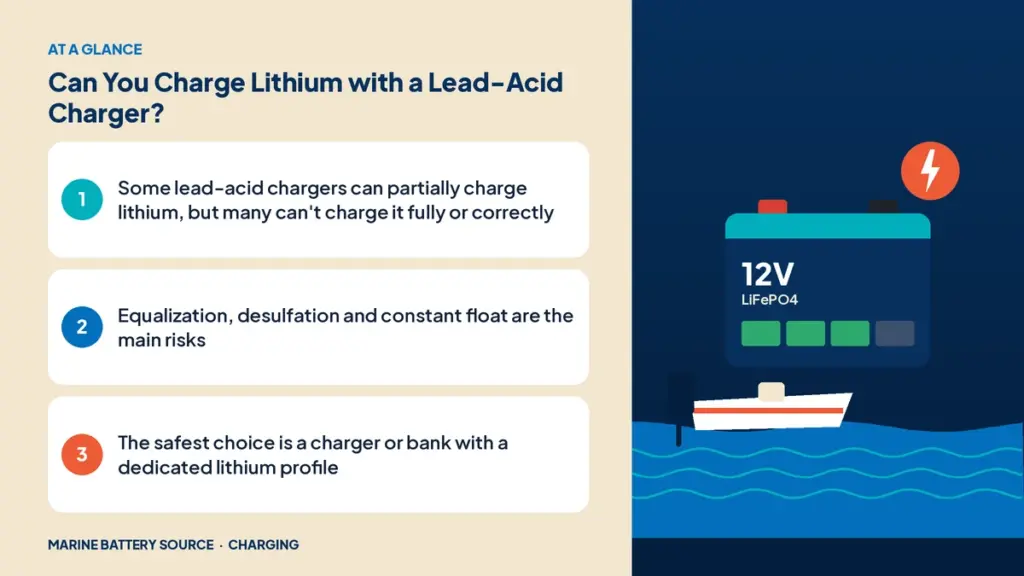
- Low absorption voltage: flooded or gel profiles may stop too early, leaving the lithium battery undercharged.
- Equalization: voltages around 15V or more can trigger the battery’s protection or cause damage.
- Desulfation modes: pulse modes designed for sulfated lead-acid batteries aren’t appropriate for lithium.
- “Dead battery” detection: some lead-acid chargers won’t start charging a lithium battery whose BMS has disconnected, because they see zero volts.
- Constant float: holding a lithium battery at a high float voltage indefinitely isn’t ideal for long-term health.
Risks of getting it wrong
The battery management system in a quality lithium battery protects against overvoltage, so a mismatched charger usually leads to undercharging or nuisance disconnects rather than immediate danger. But relying on the BMS as your charge controller isn’t good practice. Repeated protection events and improper voltages can shorten battery life, and warranty terms often require a compatible charger.
Safer options
- A dedicated lithium charger such as the EPOCH 12V 15A for 12V batteries, or the EPOCH 36V 15A for 36V trolling batteries.
- A multi-bank onboard charger with a lithium profile on each lithium bank.
- A mixed-voltage charger like the EPOCH 12V & 36V onboard charger for a 12V cranking battery and a 36V lithium trolling battery.
- A charger with a programmable custom profile set to the lithium maker’s voltages.
Mixed systems: lithium trolling, lead-acid starting
A very common setup is a lead-acid cranking battery with a lithium trolling bank. You need a charger that can apply a lead-acid profile to the cranking battery and a lithium profile to the trolling bank at the same time. Our guide to charging lithium trolling and lead-acid starting batteries covers this in depth.
Charging lithium underway
Alternators are a related question. Many outboard and inboard alternators are designed for lead-acid. Lithium’s low internal resistance can draw high current from an alternator, and the alternator’s voltage regulation may not match lithium needs. A DC-DC charger is the usual solution. See charging on the water and charging lithium batteries on a boat.
How to test your existing charger
- Check the charger’s manual for its profile voltages and whether equalization or desulfation can be disabled.
- Compare with your lithium battery’s recommended charge voltage and maximum current.
- If the values match and no equalize mode runs automatically, the charger may be usable.
- Monitor the first few charges with a voltmeter or the battery’s Bluetooth app. Look for full charge without protection events.
- If anything looks wrong, switch to a lithium charger.
Charger amps and lithium
Lithium batteries accept higher charge rates, so an older lead-acid charger may be slower than necessary. A 10A lead-acid charger works but may take longer than you’d like for a large lithium battery. See the charger amp rating guide and how long it takes to charge a marine battery.
Example
An angler upgrades a 12V 100Ah AGM trolling battery to a 12V 100Ah lithium battery. The existing onboard charger has flooded, AGM and gel profiles with automatic equalization on the flooded profile only. The lithium maker says an AGM profile of 14.4V is acceptable. The angler sets that bank to AGM, confirms no equalization, and monitors the first few charges. The battery reaches full without issues. Later, the angler upgrades to a charger with a dedicated lithium profile for faster, cleaner charging.
Questions to ask before buying lithium
Before you switch, ask:
- What charger profiles does my current charger offer?
- Does my lithium battery maker allow an AGM profile?
- Does my charger equalize automatically?
- Is my alternator compatible, or do I need a DC-DC charger?
Budgeting for the switch
When you price a lithium upgrade, include a compatible charger in the budget from the start. A dedicated lithium charger often costs a fraction of the battery, and it protects that investment. If your existing onboard charger has several banks and only one needs a lithium profile, consider whether the charger can be configured per bank before buying a new one. Some owners keep their old charger for the cranking battery and add a separate lithium charger for the trolling bank, which is a simple and effective solution.
A note on warranties
Many lithium battery warranties require charging within the maker’s specified voltage and current limits. Keep a note of the charger and settings you use, and follow the maker’s guidance, so a warranty claim isn’t complicated by questions about charging.
Bigger systems
For house banks on cruising boats, see house bank sizing, where charger and inverter-charger settings matter even more. Browse marine chargers in the store.
Frequently asked questions
Can I charge a lithium battery with a regular lead-acid charger?
Sometimes. If the charger’s voltage matches the lithium maker’s range and it doesn’t equalize or desulfate, it may work. A lithium charger is the safer choice.
Will a lead-acid charger damage my lithium battery?
Equalization or desulfation modes and improper voltages can stress it. The BMS usually protects it, but don’t rely on that.
Can I use the AGM setting to charge lithium?
Some lithium makers accept an AGM profile. Check your battery’s manual.
Why won’t my lead-acid charger start charging my lithium battery?
Some chargers won’t start if they detect zero volts, which can happen when a lithium battery’s BMS has disconnected.