


Charging a Lithium Trolling Bank and a Lead-Acid Starting Battery
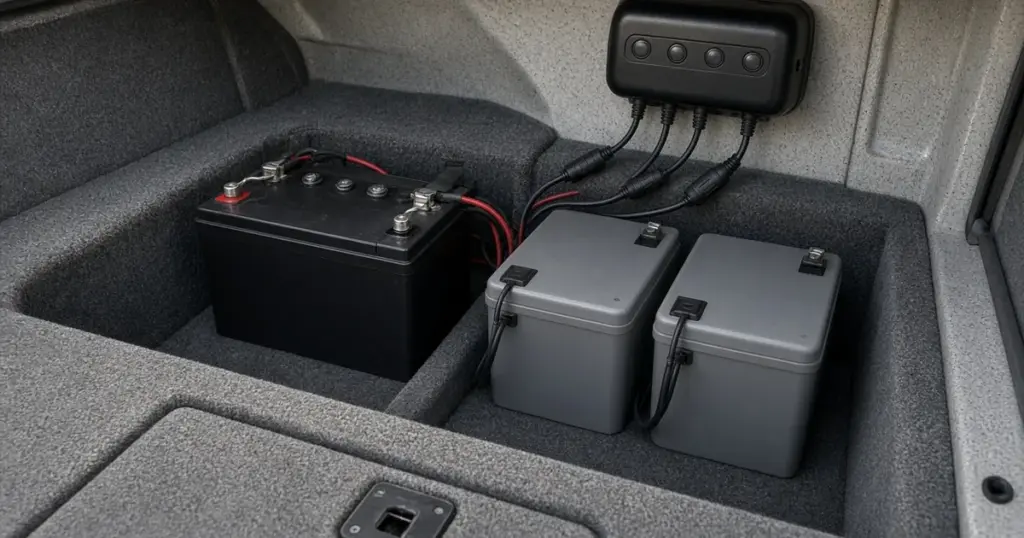
One of the most common upgrades in fishing boats is swapping heavy lead-acid trolling batteries for lithium while keeping a lead-acid or AGM cranking battery for the outboard. It’s a smart combination: lithium saves weight and runs the trolling motor longer, while a proven starting battery handles the engine. But it creates a charging question. How do you charge both chemistries correctly, at the dock and on the water? This guide explains the options.
Why you can’t treat them the same
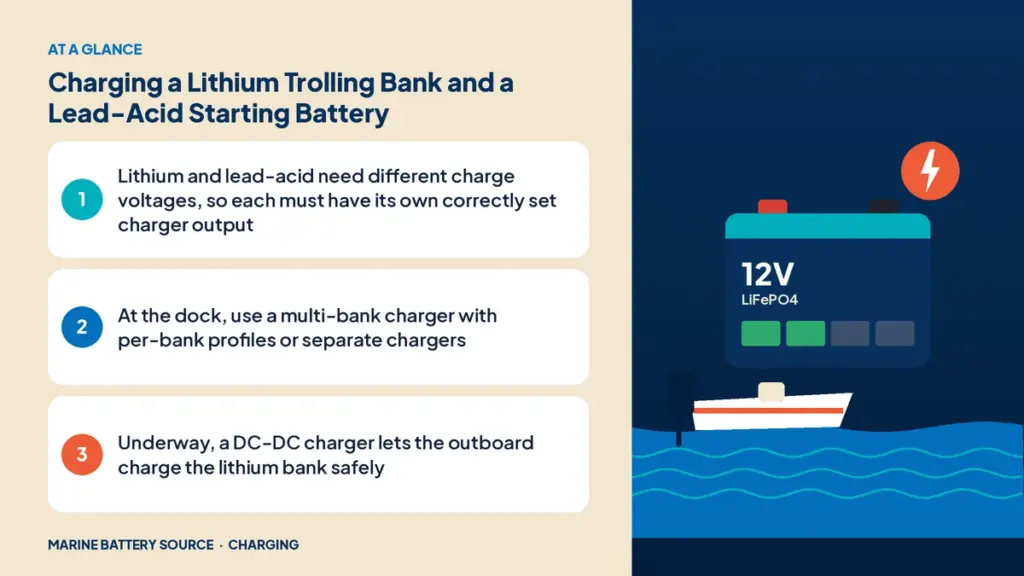
Lead-acid batteries need a bulk, absorption and float profile, with voltages tuned to flooded or AGM. Lithium batteries need a constant-current, constant-voltage profile that stops or holds a low float, with no equalization. Charging lithium on a lead-acid profile may undercharge it or apply equalization; charging lead-acid on a lithium profile may leave it chronically undercharged. Each battery needs its own correctly set output. Our guide to charging lithium with a lead-acid charger explains the risks.
Never parallel them directly
Connecting a lithium battery directly in parallel with a lead-acid battery, or charging them as one bank, is a bad idea. Their resting voltages and charging behavior differ, so current flows between them unpredictably and neither charges correctly. Keep the trolling bank and starting battery electrically separate except through a device designed to manage the connection.
Dock charging options
Option 1: multi-bank charger with per-bank profiles
A multi-bank onboard charger whose banks can each be set to a different chemistry is the cleanest solution. Set the starting battery’s bank to AGM or flooded and the trolling banks to lithium. Check carefully: some multi-bank chargers apply one profile to all banks.
Option 2: mixed-voltage charger
When the trolling bank is a single 24V or 36V lithium battery, a mixed-voltage charger can provide a 12V output for the starting battery and a higher-voltage lithium output for the trolling battery. The EPOCH 12V & 36V onboard lithium charger is a two-bank mixed-voltage unit designed for that layout. Confirm that its 12V bank’s profile suits your starting battery’s chemistry.
Option 3: two separate chargers
A dedicated lithium charger for the trolling battery and a lead-acid charger or maintainer for the starting battery. Simple, flexible and easy to troubleshoot. For example, an EPOCH 36V 15A lithium charger for a 36V lithium trolling battery plus a small AGM charger for the cranking battery.
See portable vs onboard chargers for help choosing between permanently mounted and portable units.
Charging underway
The outboard’s alternator charges the starting battery. To share that charge with the lithium trolling bank, use a DC-DC charger:
- It draws from the starting battery while the engine runs, usually triggered by voltage or an ignition signal.
- It boosts or regulates the output to the lithium profile and voltage the trolling bank needs.
- It limits current so the outboard’s charging system isn’t overloaded.
The EPOCH 12V to 36V DC-DC charger charges a 36V lithium trolling battery from a 12V starting system. The EPOCH dual-output 12V/36V DC-DC charger offers two independent output banks for boats with both a 12V lithium house battery and a 36V trolling battery.
Don’t expect a DC-DC charger to fully recharge a large trolling bank on a short run. Outboard charging outputs are modest. It’s best seen as a top-up. For more, see charging on the water.
How long will it take?
At the dock, charge time depends on each bank’s charger. The starting battery usually needs little, while the trolling bank may need most of its capacity replaced. A 36V 100Ah lithium battery down 70Ah on a 15A charger needs about 5 hours. See how long it takes to charge a marine battery.
Storage and maintenance
- During storage, lead-acid batteries benefit from a maintainer or float charge.
- Lithium batteries don’t need constant float; many owners charge them, then disconnect.
- A charger that holds lithium at full voltage for months isn’t ideal; check its storage behavior.
The battery maintainer guide covers off-season strategies for both chemistries.
Cold weather
Lead-acid batteries can be charged below freezing. Most lithium batteries can’t unless they’re heated. If your boat stays in an unheated garage or you fish in cold weather, consider heated lithium trolling batteries, or charge the lithium bank only when it’s warm enough.
Wiring tips
- Fuse every charger output positive close to its battery.
- Label each bank’s leads and battery.
- Keep trolling bank and starting battery negatives connected only as the charger, DC-DC charger and motor makers specify.
- Use tinned marine cable sized for current and length.
- Follow the DC-DC charger maker’s guidance on ignition triggers and cable sizes.
Example setup
A bass boat has a 12V AGM cranking battery and a single 36V 100Ah lithium trolling battery. At home, a two-bank mixed-voltage onboard charger charges the AGM on a lead-acid profile and the lithium battery on a lithium profile. On the water, a 12V-to-36V DC-DC charger adds a few amp-hours to the trolling battery during long runs between spots. After a full day, the owner plugs in, and both batteries are full by morning.
Common mistakes
- Using one profile for both chemistries.
- Paralleling lithium and lead-acid batteries.
- Connecting a 36V lithium battery directly to the outboard’s charging lead.
- Ignoring cold-temperature charging limits on non-heated lithium.
- Skipping fuses on DC-DC charger inputs and outputs.
Bigger boats with house banks
The same principles apply to cruising boats with a lead-acid starting battery and a lithium house bank, usually charged through a DC-DC charger or an alternator with an external regulator. See charging lithium batteries on a boat and house bank sizing for those systems.
Planning the upgrade
When you replace lead-acid trolling batteries with lithium, review the whole charging system at the same time. List each battery, its voltage and chemistry, and how you’ll charge it at the dock and on the water. If your existing onboard charger can’t set per-bank profiles, budget for a new charger or a dedicated lithium charger alongside the old one. Planning this up front avoids the most common problem after a lithium upgrade: a trolling bank that never seems to reach full.
Browse marine chargers in the store.
Frequently asked questions
Can one charger charge lithium and lead-acid batteries?
Yes, if it has independent banks that can each be set to the correct profile, or a mixed-voltage design built for this layout.
Can my outboard charge my lithium trolling batteries?
Use a DC-DC charger between the starting battery and the lithium bank. It applies the right profile and limits current.
Should I connect my lithium and lead-acid batteries together?
No. Keep them separate and manage charging with a multi-bank charger and a DC-DC charger.
What happens if I charge lithium on an AGM setting?
It may work if the battery maker allows it, but a dedicated lithium profile is safer and usually charges more completely.