


Electric Outboard Battery Guide
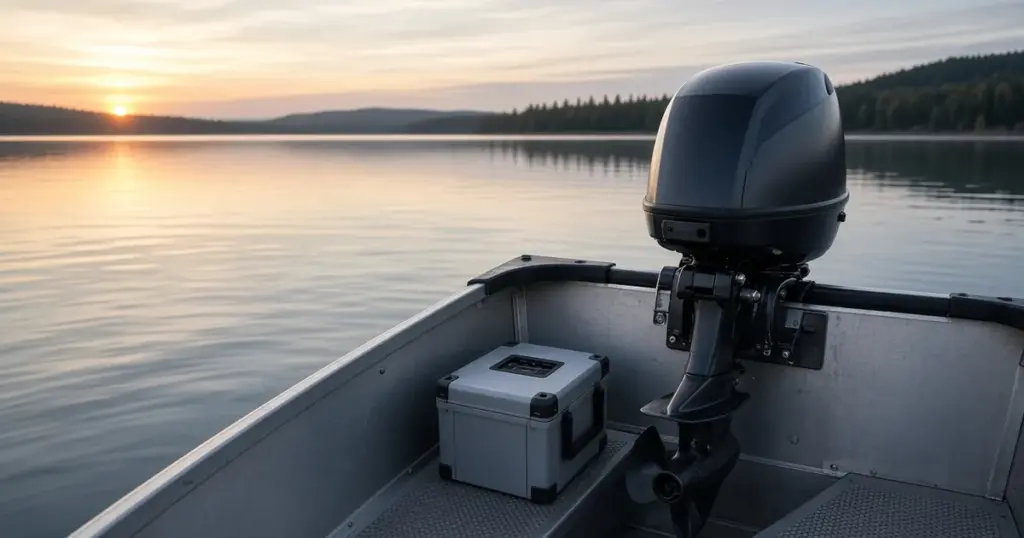
Electric outboards have moved from novelty to practical choice on tenders, small fishing boats, pontoons and lakes with gas-motor restrictions. They’re quiet, clean and nearly maintenance-free. But an electric outboard is only as capable as its battery. This electric outboard battery guide explains how to size a battery, which voltages and chemistries are common, and how to charge and install the system safely.
How electric outboards are rated
Electric outboards are usually rated in kilowatts (kW) or watts of input power, and sometimes compared with gas horsepower equivalents. The power you actually use depends on boat speed: power rises steeply as you go faster. Running at half throttle may use far less than half the maximum power.
Manufacturers often publish runtime and range at different speeds for specific battery sizes. Those figures are the best starting point.
Voltage
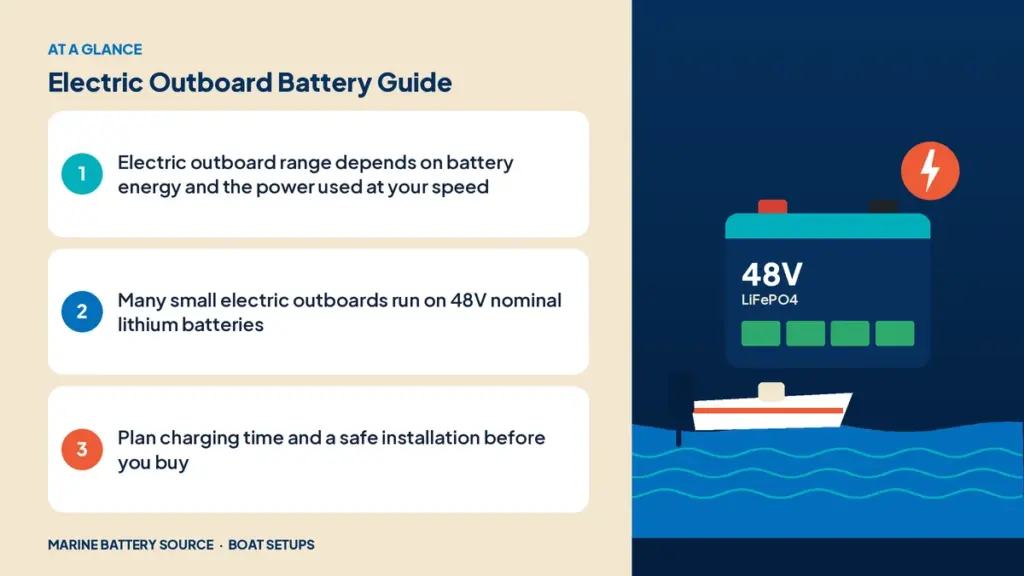
Small electric outboards and trolling-style motors may run at 12V, 24V or 36V. Many larger electric outboards for tenders, pontoons and small boats run at 48V nominal, which keeps current reasonable at several kilowatts. Always confirm the motor’s voltage range and approved battery types.
Sizing the battery
Start with how far or how long you need to go:
Runtime (hours) ≈ usable battery energy (kWh) ÷ average power (kW)
Example: a motor averaging 1.5 kW at a comfortable cruising speed, with a 5 kWh lithium battery used to about 80%, gives roughly 4 kWh ÷ 1.5 kW ≈ 2.7 hours. At a faster speed using 3 kW, runtime drops to about 1.3 hours.
Range ≈ runtime × speed. Plan with margin for wind, current, load and battery aging.
48V lithium options
At 48V, LiFePO4 is the practical choice because lead-acid would be very heavy for the same usable energy. Store examples:
- EPOCH 48V 100Ah V2 Elite: 5.12 kWh, 97 lb, 8D footprint, Bluetooth and heating.
- Dakota Lithium 48V 105Ah: 5,376 Wh listed, 81.6 lb, Bluetooth, 200A continuous.
- The Dakota Lithium 48V 100Ah set, made of four matched 12V Group 24 batteries, for boats where spreading the weight helps.
Check the battery’s continuous discharge rating against the motor’s maximum current. At 48V, a 6 kW motor at full power draws roughly 125A.
Lower-voltage electric motors
Smaller electric outboards and high-thrust trolling motors used as primary propulsion on small boats may run on 24V or 36V. Single-case batteries like the EPOCH 36V 100Ah (3.84 kWh) can work if the motor is designed for that voltage. Our pillar on choosing a trolling motor battery covers lower-voltage sizing.
Charging
Charging time ≈ energy to replace ÷ charger power.
- A 48V charger delivering about 15A puts in roughly 0.75 kW, so replacing 4 kWh takes over 5 hours.
- A 22A 48V charger, such as the Dakota Lithium 48V 22A onboard charger, delivers about 1.1 kW, shortening that to under 4 hours.
Use a charger with a LiFePO4 profile that matches the battery maker’s voltages and doesn’t exceed its maximum charge current. Solar can help over several days but rarely replaces a full charge in one day.
12V accessories
Navigation lights, electronics and pumps still need 12V. Options include a separate small 12V lithium battery or a 48V-to-12V DC-DC converter rated for the loads.
Weight and placement
A 5 kWh battery at 80 to 100 lb is heavy for a small boat. Place it low and near the center, secure it with proper hold-downs, and keep the high-current cables short. On tenders and small boats, consider how the weight affects trim and freeboard.
Wiring and safety
- Fuse the battery positive close to the battery with a fuse rated for the system voltage and current.
- Use a disconnect switch rated for 48V and the motor’s current.
- Use marine-grade tinned copper cable sized for current and length.
- Many 12V components aren’t rated for 48V; check every part’s voltage rating.
- Follow the motor maker’s installation instructions.
Electric outboards on pontoons
Pontoons are a popular platform for electric outboards because they’re often used at low speeds and have room for batteries. See the pontoon battery guide. On fishing boats, electric outboards sometimes replace small gas kickers; compare with multi-species setups and bass boat setups.
Questions to answer before buying
- What speed will you usually run, and for how long?
- What’s your longest trip, including a margin for wind and current?
- Where will the battery sit, and can the boat carry its weight?
- How and where will you charge, and how long can it take?
- What’s the motor maker’s approved battery list?
Battery care
Lithium batteries need little routine maintenance, but a few habits help. Keep terminals clean and tight, check cable connections each season, and store the battery at the maker’s recommended charge level over winter. Avoid charging below the battery’s minimum charge temperature unless it has built-in heating. Watch the Bluetooth app or monitor for cell imbalance or unusual temperatures, and contact the maker if warnings appear.
Comparing gas and electric costs
Electric outboards and batteries cost more up front than small gas outboards, but they have low running and maintenance costs. Whether that pays off depends on how often you boat and local electricity costs. The quiet and convenience are benefits that don’t show up on a spreadsheet.
For the big picture, read battery setups by boat type and small boat electrical basics. Wake and ski boat owners curious about electric power should also see wake boat setups. Browse lithium batteries in the store.
Frequently asked questions
What battery do I need for an electric outboard?
A battery matching the motor’s voltage, with enough energy for your runtime at your typical speed. Many electric outboards use 48V lithium batteries of around 5 kWh or more.
How long will an electric outboard run on one battery?
Divide usable battery energy by the motor’s average power at your speed. Faster speeds use far more power and shorten runtime.
Can I use lead-acid batteries with an electric outboard?
Some motors allow it, but lithium is far lighter for the same usable energy and is the common choice, especially at 48V.
How long does it take to charge an electric outboard battery?
Divide the energy you need to replace by the charger’s output power. A 15A 48V charger replaces about 0.75 kWh per hour.