


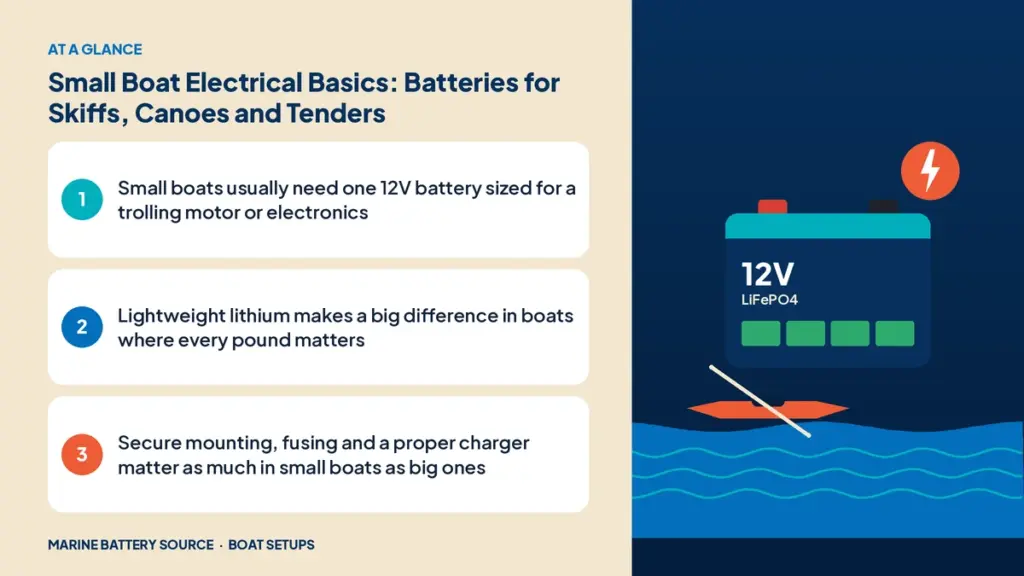
Small Boat Electrical Basics: Batteries for Skiffs, Canoes and Tenders

Small boats have simple electrical systems, but that doesn’t mean the battery choice is unimportant. In a canoe, kayak, jon boat, skiff or tender, the battery may be the heaviest single item aboard, and it’s often your only power for propulsion or electronics. This small boat battery guide covers how to choose, size, mount and charge a battery for boats under about 18 feet, and links to detailed guides for specific boats and uses.
What counts as a small boat
For this guide, small boats include:
- Kayaks and canoes, paddled or with small motors.
- Jon boats and small aluminum utility boats.
- Flats skiffs and small center consoles.
- Dinghies and tenders.
- Duck boats and hunting skiffs.
- Small fishing boats with tiller outboards.
What they have in common: limited space, weight sensitivity and simple systems, often with a single battery.
Common small boat power needs
- Trolling motor: the biggest draw on most small boats, usually 12V.
- Electronics: a fish finder and GPS, sometimes with forward-facing sonar.
- Pumps: livewell and bilge pumps.
- Lighting: navigation lights and deck or hunting lights.
- Engine starting: on small boats with electric-start outboards.
Choosing a chemistry
| Chemistry | Pros | Cons |
|---|---|---|
| Flooded lead-acid | Low upfront cost | Heavy, needs maintenance, can spill |
| AGM | Sealed, durable, no maintenance | Heavy for usable capacity |
| Lithium (LiFePO4) | Light, long life, steady voltage | Higher upfront cost, cold charging limits |
On small boats, lithium’s weight savings are especially valuable. A 12V 100Ah lithium battery such as the EPOCH 12V 100Ah Eco weighs 21 lb, while a lead-acid battery with similar usable energy can weigh two to three times as much. That difference affects trim, draft, portability and how easily you can carry the battery to the car.
Sizing the battery
Add up your loads in amps and multiply by the hours you use them. Then size for chemistry: use about 80% to 100% of lithium capacity, and about 50% of lead-acid.
Example: a jon boat with a 55 lb thrust 12V trolling motor averaging 15A for 4 hours (60Ah), plus a fish finder at 1A for 6 hours (6Ah), needs about 66Ah. A 100Ah lithium battery covers that with margin; lead-acid would need about 130Ah or more.
For electronics only, a small lithium battery is enough: a fish finder drawing 1A for 8 hours uses 8Ah, which a Battle Born 20Ah (5.7 lb) handles easily.
Guides for specific small boats
- Canoe trolling motor batteries: light batteries and balanced placement.
- Dinghy and tender batteries: compact power for electric tender motors.
- Flats skiff battery setups: saltwater, shallow water and poling platforms.
- Duck boat and hunting skiff batteries: cold weather and rough use.
- Kayaks, jon boats and other boats are covered in battery setups by boat type.
Guides for specific loads
- Fish finder batteries: sizing small batteries for electronics.
- Livewell and bilge pump draw: how much they really use.
- Ice fishing batteries: flasher and electronics power on the hard water.
- Adding a second battery for accessories: when one battery isn’t enough.
Mounting the battery
A loose battery in a small boat is dangerous. It can slide, short its terminals, damage the hull or shift the boat’s balance. Always:
- Use a battery box or a tray with a hold-down strap.
- Cover the terminals.
- Keep the battery low and near the centerline.
- Keep it away from fuel tanks and sources of standing water.
See the battery box and mounting guide for details.
Wiring basics
- Fuse the positive cable near the battery.
- Use marine-grade tinned copper wire sized for the current and length.
- Use sealed connectors and heat-shrink to resist corrosion.
- Consider a battery switch or a quick-disconnect trolling motor plug.
- Keep wiring neat and protected from feet, gear and bilge water.
Charging
Use a charger matched to your battery chemistry. A portable charger is fine for a single battery you take home; an onboard charger is convenient if the boat stays on a trailer near power. Lithium batteries need a lithium profile. A EPOCH 12V 15A lithium charger recharges a 100Ah battery from half in a few hours.
Weight and balance
In small boats, a battery’s position changes how the boat sits. A heavy battery in the stern of a canoe or kayak can lift the bow and make paddling harder; a battery off-center lists the boat. Move the battery and gear until the boat sits level, then secure everything. Lighter batteries make this easier.
Cold weather
Lead-acid batteries lose capacity in the cold but can be charged below freezing. Most lithium batteries shouldn’t be charged below about 32°F unless they’re heated. Hunters and ice anglers should plan for that.
Upgrading an older small boat
Many small boats come with an old lead-acid battery, cheap wiring and no fuse. When you upgrade, start by replacing the battery with one sized for your actual use, add a fuse at the positive terminal, replace corroded connectors and secure everything properly. That handful of changes makes a bigger difference to reliability than any single expensive accessory.
Maintenance
- Charge after every trip and before storage.
- Inspect terminals and wiring regularly.
- Store lead-acid batteries charged; maintain them over winter.
- Keep batteries clean and dry.
Choosing your first small boat battery
If you’re starting from scratch, here’s a simple guide:
- Electronics only: a 10Ah to 20Ah lithium battery.
- Trolling motor for a few hours: a 50Ah to 100Ah lithium battery, or a Group 24 to 27 deep-cycle lead-acid battery if budget matters most.
- Trolling motor all day: a 100Ah lithium battery or more.
- Electric-start outboard: a cranking or dual-purpose battery meeting the engine’s spec.
Browse trolling motor batteries and lithium batteries in the store.
Frequently asked questions
What battery is best for a small boat?
It depends on use. For a trolling motor, a 12V deep-cycle battery, ideally lithium to save weight. For electronics only, a small 10Ah to 20Ah lithium battery.
How big a battery do I need for a small trolling motor?
Multiply average draw by hours used, then size for chemistry. Many small boats are well served by a 50Ah to 100Ah lithium battery.
Do I need a battery box in a small boat?
You need a secure mount and covered terminals. A battery box is the easiest way to get both.
Can I charge my small boat battery with a car charger?
Only if the charger matches the battery chemistry. Lithium batteries need a lithium-compatible charger.