


Pontoon Stereos, Lights and Accessories: Do You Need a Second Battery?
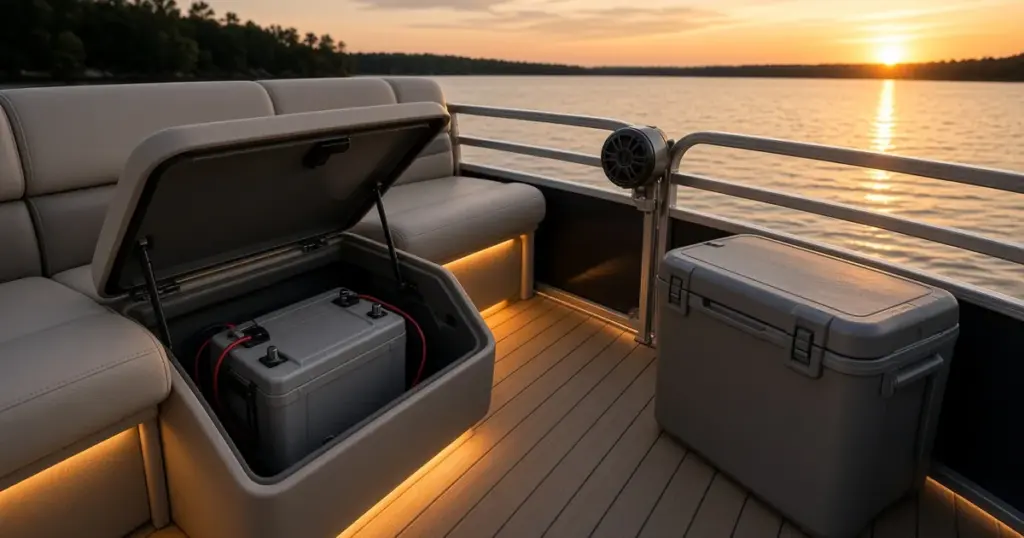
On a pontoon, the stereo, lights, electronics and fridge often share one battery with the engine. Spend an afternoon at the sandbar with the music playing and you may find the engine won’t start. A second battery for accessories solves that. This guide explains when you need a second pontoon battery, how to size it, how to connect it, and how to keep both batteries charged.
Signs you need a second battery
- The engine cranks slowly after time at anchor with the stereo on.
- You’ve needed a jump start at the sandbar.
- You’re adding a bigger stereo, amplifier or more lights.
- Electronics reboot when you start the engine.
- You want to run accessories for hours without the engine.
What goes on the accessory battery
- Stereo and amplifiers.
- Interior, underwater and courtesy lights.
- Fish finders and chart plotters, if not on a separate electronics battery.
- Livewell pumps, USB chargers and a small fridge or cooler.
Keep the engine’s starting, tilt/trim and essential engine electronics on the starting battery.
Sizing the accessory battery
Add up accessory current and hours:
| Load | Draw | Hours | Energy |
|---|---|---|---|
| Stereo at moderate volume | 8A | 4 | 32Ah |
| LED interior and underwater lights | 3A | 3 | 9Ah |
| Fish finder | 1.5A | 6 | 9Ah |
| Livewell pump on timer | 3A × 50% | 6 | 9Ah |
| Total | 59Ah |
For a 59Ah day, a 100Ah lithium battery (about 80Ah to 100Ah usable) gives comfortable margin. With AGM, plan for about 120Ah or more. Amplified systems can draw far more at high volume; size accordingly.
Lithium examples include the EPOCH 12V 105Ah Essential (22.1 lb, Bluetooth, heated) and the Battle Born 100Ah (31 lb).
Ways to connect the two batteries
Dual-battery switch
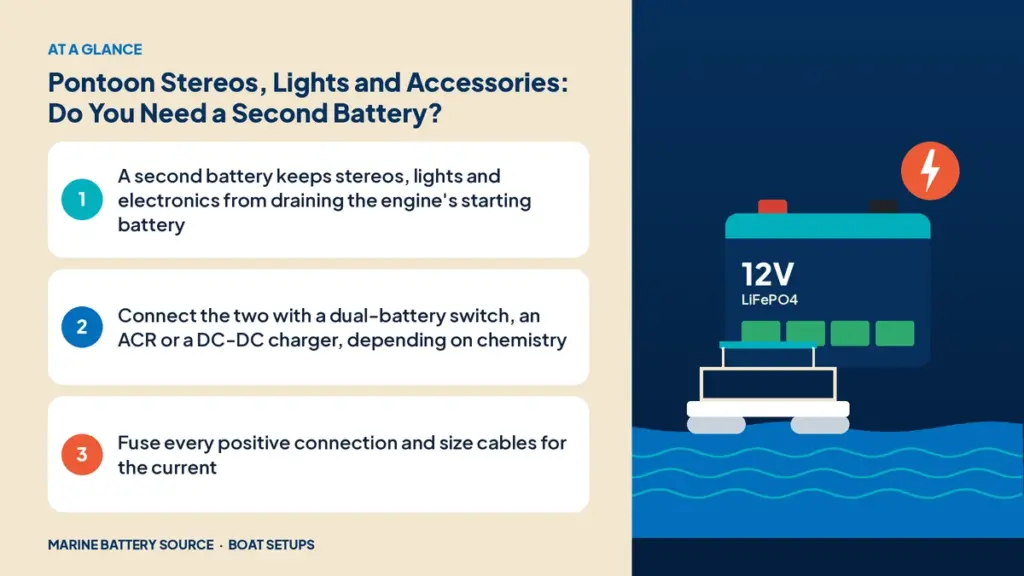
A manual switch with positions like 1, 2, Both and Off. You choose which battery feeds which loads, and select Both to charge both from the engine. Simple and inexpensive, but relies on the user. Leaving it on Both at the sandbar drains both batteries.
Automatic charging relay (ACR)
An ACR connects the batteries when the engine is charging and separates them when it isn’t, so accessories can’t drain the starting battery. Kits like the Dakota Lithium dual battery isolator kit combine an ACR, cables and fuses. ACRs work best when both batteries share similar chemistry; check the maker’s guidance for lithium.
DC-DC charger
A DC-DC charger takes power from the starting battery while the engine runs and charges the accessory battery with a proper profile. It’s the recommended choice when the accessory battery is lithium and the starting battery is lead-acid, and it protects the outboard’s charging system from excessive current.
Wiring the second battery
- Mount the new battery securely in a box or tray with a hold-down.
- Install a fuse close to the positive terminal of each battery.
- Connect negatives to a common ground point.
- Install the switch, ACR or DC-DC charger per its instructions.
- Move accessory circuits to the accessory battery through a fuse block or distribution panel.
- Use marine-grade tinned copper cable sized for current and length.
Charging both batteries
- Underway: through the switch, ACR or DC-DC charger.
- At the dock or in storage: a two-bank onboard charger keeps both batteries topped up with appropriate profiles.
- Solar: a small panel on the bimini can maintain the accessory battery between weekends.
Lithium accessory batteries
Lithium is a good fit for accessory batteries: light, steady voltage for audio, and more usable capacity. Keep these points in mind:
- Use a DC-DC charger or a lithium-compatible ACR setup.
- Use a charger with a lithium profile for that bank.
- Most lithium batteries shouldn’t be charged below about 32°F unless heated.
Common mistakes
- Leaving a manual switch on Both while at anchor.
- Skipping fuses on the new battery’s positive cable.
- Connecting a lithium battery directly in parallel with a lead-acid starting battery.
- Undersized cables that cause voltage drop and amplifier cutouts.
Example: a family pontoon
A 22-foot pontoon with a 115 hp outboard, a four-speaker stereo with a small amplifier, LED lighting and a fish finder. The owner adds a 100Ah lithium accessory battery, a DC-DC charger fed from the starting battery, and a two-bank onboard charger. Now the family can play music for an afternoon at the sandbar and still start the engine without thinking about it.
Hunting and fishing boats too
The same approach works on fishing and hunting boats with heavy accessory loads. See duck boat and hunting skiff batteries and ice fishing batteries for cold-weather considerations, and use the livewell and bilge pump guide and fish finder guide to tally loads.
Testing the system
After installing a second battery, test it before your next big outing. Turn on your accessories with the engine off and confirm they run from the accessory battery while the starting battery voltage stays steady. Start the engine and confirm the accessory battery begins charging through the switch, ACR or DC-DC charger. At the dock, check that the onboard charger reaches full charge on both banks. These simple checks catch wiring mistakes before they leave you stranded.
Maintenance
Inspect cable connections and fuses every season. Keep terminals clean and covered. For lead-acid batteries, check charge levels and maintain them over winter. For lithium batteries, follow the maker’s storage guidance and keep loads disconnected during long storage.
For whole-boat planning, read battery setups by boat type and the small boat battery guide. Browse house bank batteries in the store.
Frequently asked questions
Do I need a second battery on my pontoon?
If you run a stereo, lights or electronics for long periods without the engine, a second battery protects engine starting.
What’s the best way to connect a second battery?
An ACR is simple and automatic for matched chemistries. A DC-DC charger is best when adding a lithium battery to a lead-acid starting system.
How big should my accessory battery be?
Add up accessory amps times hours, then add margin. Many pontoons are well served by a 100Ah lithium battery.
Can I put a lithium accessory battery with a lead-acid starting battery?
Yes, with a DC-DC charger or a lithium-compatible isolator, and a charger with a lithium profile for that bank.