


Lithium Rhino Marine Conversion Kits Explained
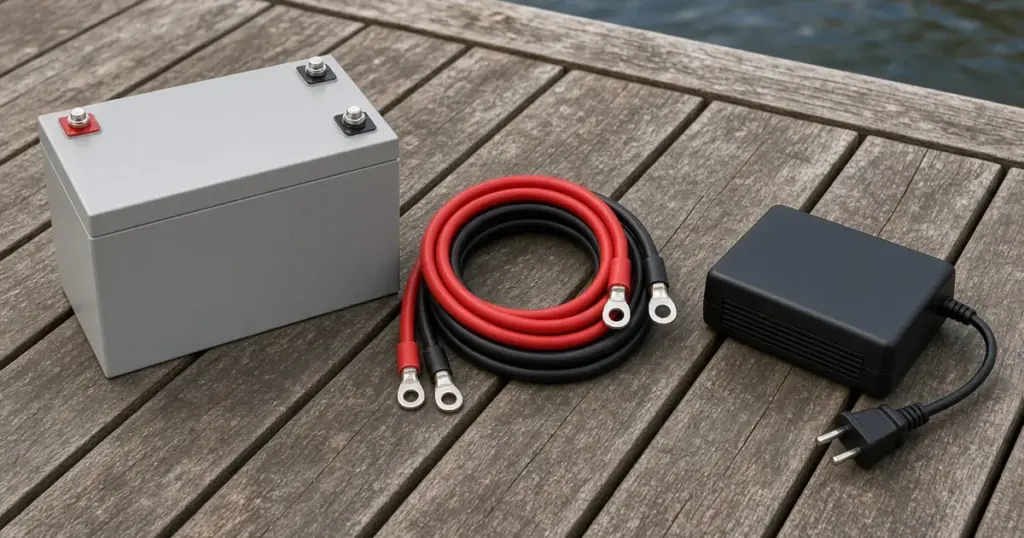
Lithium Rhino focuses on one job: converting trolling motor banks to lithium. Instead of wiring two or three 12V batteries in series, a Lithium Rhino conversion kit puts 24V or 36V of LiFePO4 power in a single case. This guide covers the kits in our store, what the specs mean and how to decide whether a conversion kit fits your boat. Specs come from our product listings, based on manufacturer information.
What a conversion kit is
A “conversion kit” here means a single high-voltage lithium battery designed to replace a multi-battery lead-acid trolling bank. Converting usually means:
- Removing two or three 12V lead-acid batteries and their series jumpers
- Installing one 24V or 36V lithium battery
- Connecting it to the trolling motor leads
- Switching to a lithium-compatible charger for that voltage
The kits in our store
| Kit | Voltage | Capacity | Energy (approx.) |
|---|---|---|---|
| 24V 100Ah | 24V | 100Ah | about 2.4 kWh |
| 36V 65Ah | 36V | 65Ah | about 2.3 kWh |
| 36V 120Ah | 36V | 120Ah | about 4.3 kWh |
Energy is nominal voltage times capacity, rounded. Some 12V Lithium Rhino kits are listed but currently out of stock.
Shared specs from the listings
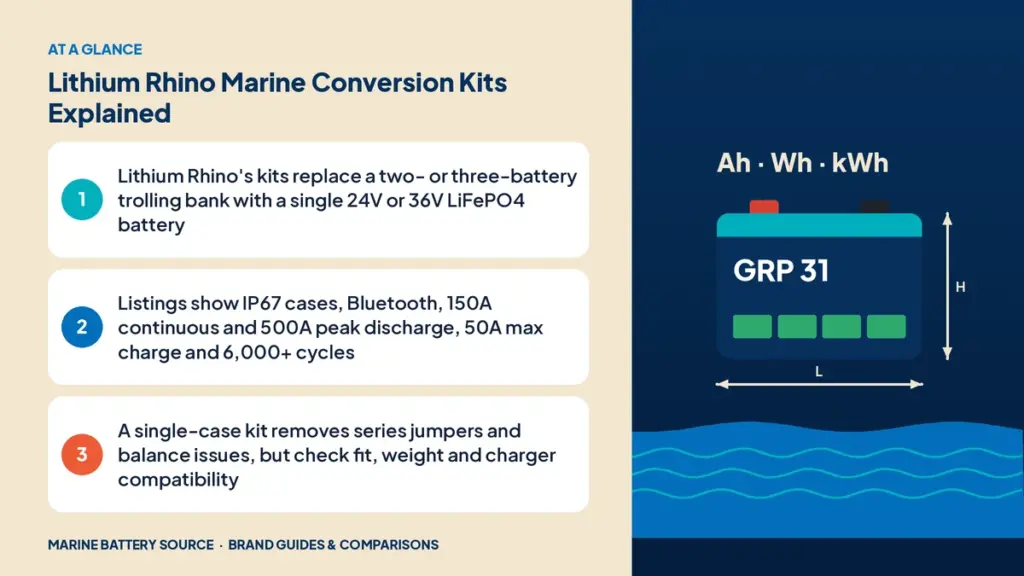
- Chemistry: LiFePO4
- Ingress protection: IP67
- Bluetooth monitoring: yes
- Continuous discharge: 150A
- Peak discharge: 500A
- Maximum charge current: 50A
- Cycle life: 6,000+
- Warranty: 8 years
What the specs mean for anglers
150A continuous discharge
Trolling motors draw far less than this in normal use, even big 36V motors on high. The headroom means the BMS is unlikely to trip on overcurrent.
IP67
IP67 means the case is rated to resist dust and temporary immersion under test conditions. That’s reassuring in a wet hatch, but it doesn’t mean the battery should live in bilge water, and the terminals and cable connections still need protection.
Bluetooth
Lets you check state of charge and status from your phone. With lithium’s flat voltage curve, this is the easiest way to know how much run time remains.
50A maximum charge
You can charge faster than with most lead-acid banks, if your charger supports it. Most onboard trolling chargers deliver much less, which is fine.
6,000+ cycles
That’s a listing figure under defined conditions. Even at a fraction of that, the kit can outlast several sets of lead-acid batteries.
Choosing a kit
- 24V motor, long days: 24V 100Ah.
- 36V motor, moderate use or lighter boat: 36V 65Ah.
- 36V motor, heavy GPS-anchor use, big lakes or tournament days: 36V 120Ah.
Estimate your average draw. A 36V motor averaging 20A for 6 hours uses 120Ah; the 36V 65Ah kit would cover roughly half of that day, and the 120Ah kit would cover all of it.
Charging
Use a lithium charger of the right voltage. The Allied Lithium 36V 15A waterproof charger is a 36V option. EPOCH’s 36V chargers and two-bank 12V/36V onboard chargers are also compatible with 36V LiFePO4. A DC-DC charger can top up the bank from the outboard.
Installation tips
- Confirm the kit fits your battery compartment and tray.
- Secure it with a strap or bracket; a single heavy battery must not shift.
- Fuse or breaker the positive lead as the motor maker specifies.
- Use cable sized for the motor and run length.
- Protect connections with boots and a thin film of protectant.
Lithium Rhino vs a set of 12V batteries
Single case advantages: no series jumpers, no balance issues between batteries, one Bluetooth readout for the whole bank, fewer connections to corrode.
Set of 12V advantages: individual batteries are lighter to lift, can fit split compartments and can be reused separately.
Lithium Rhino vs other 36V options
EPOCH and Interstate also offer single-case 36V lithium batteries. Compare capacity, case size, weight, heating and warranty. See the EPOCH marine battery guide and the ECO Battery guide for other lithium options. If you’re mixing lead-acid start batteries with lithium, Trojan and Interstate cover the lead-acid side; see the Trojan marine batteries guide. For more lithium brand detail, see Battle Born batteries.
The marine battery brands compared pillar and marine battery comparisons cover all brands side by side.
Weight and balance
A single high-capacity battery concentrates weight in one place. On most bass and bay boats, the trolling bank lives in a rear or center compartment, and replacing three lead-acid batteries with one lithium case removes a lot of weight from that spot. That can change how the boat sits at rest and how quickly it planes. Usually the change is welcome, but if your boat was set up to balance a heavy bank, check trim and jack plate settings after the swap.
Questions to ask before converting
- Does the kit fit the compartment? Measure the space, including height under the hatch lid and room for cables.
- Is the motor’s breaker and wiring adequate? The battery’s high current capability doesn’t change the motor’s requirements; follow the motor maker’s breaker and cable size.
- What charger will you use? Budget for a lithium charger at the right voltage if your current charger doesn’t support LiFePO4.
- How will you charge on the water? A DC-DC charger from the start battery can add range on long days.
- What happens to your old batteries? Lead-acid batteries are recyclable; most retailers accept them.
Example conversion
A 20-foot bass boat runs a 36V 112-lb-thrust motor on three group 31 AGM batteries. The owner replaces them with a Lithium Rhino 36V 120Ah kit and a 36V lithium charger. The trolling bank loses a large amount of weight, the motor holds speed all day, and the Bluetooth app shows remaining capacity. The start battery stays separate.
Shop all Lithium Rhino products.
Frequently asked questions
What is a Lithium Rhino conversion kit?
A single 24V or 36V LiFePO4 battery that replaces a multi-battery lead-acid trolling motor bank.
Are Lithium Rhino batteries waterproof?
The kits are listed as IP67. Still mount them above bilge water and protect the terminals.
What warranty do Lithium Rhino kits have?
The listings show 8 years. Check the product page and manufacturer terms.
Which Lithium Rhino kit do I need for a 36V trolling motor?
The 36V 65Ah for moderate use or the 36V 120Ah for heavy use and long days.
Can I charge a Lithium Rhino kit with my old charger?
Only if it has a LiFePO4 profile at the right voltage. Otherwise, use a lithium charger.