


Livewells, Bilge Pumps and Small Loads: Planning Battery Draw
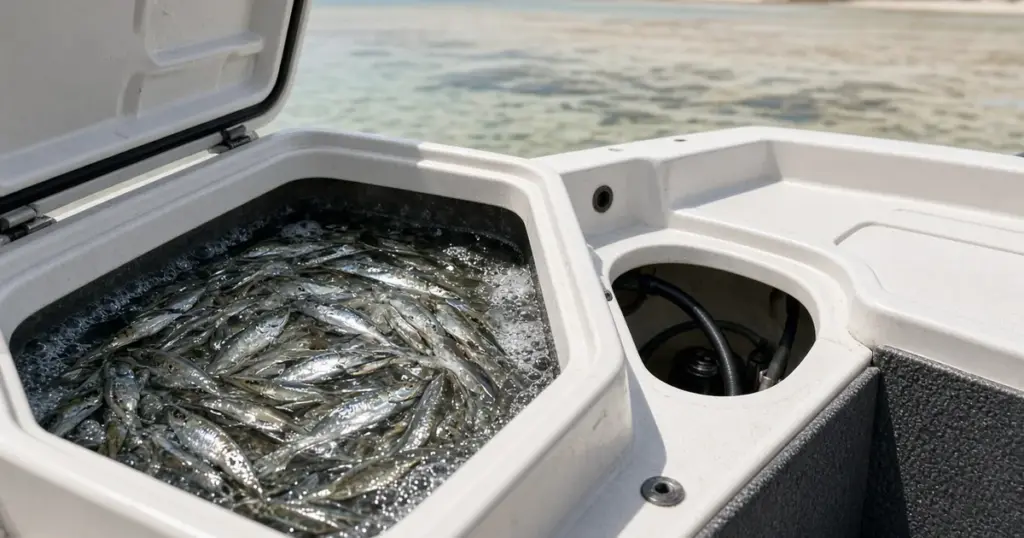
Livewell and bilge pumps are easy to overlook when you’re planning batteries, but they add up. A livewell pump running all day can use as much energy as a fish finder and lights combined, and a bilge pump must always have power available when it matters. This guide explains livewell battery drain, bilge pump draw, and how to size and wire your batteries so pumps never leave you stranded.
Typical pump draws
| Pump | Typical draw | Notes |
|---|---|---|
| Small aerator pump | 1–2A | Common on small boats and buckets |
| Livewell pump (500–800 gph) | 2–4A | Often runs continuously or on a timer |
| Larger livewell pump (1,000+ gph) | 4–6A | Large tournament livewells |
| Bilge pump (500–1,100 gph) | 2–5A when running | Runs intermittently |
| Larger bilge pump (1,500–2,000 gph) | 6–10A when running | Offshore and larger boats |
These are rough figures. Check the pump’s label or manual for its rated current.
How much energy livewells use
Energy (Ah) = pump draw (A) × hours running
Example: a 3A livewell pump running continuously for 8 hours uses 24Ah. Two livewells doubles that to 48Ah. On a single battery that also starts the engine, that’s significant.
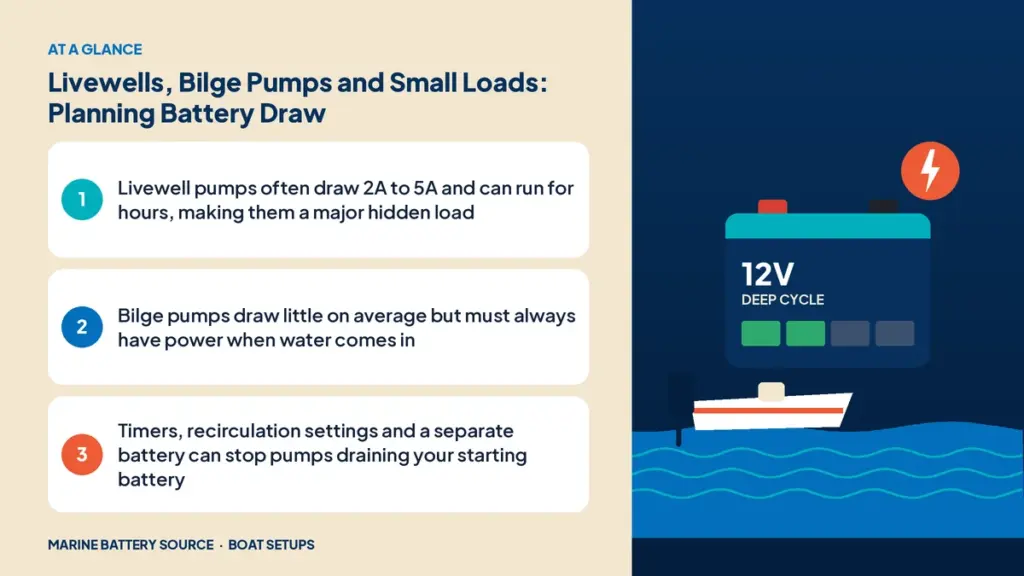
Many livewell systems run on timers, cycling the pump on and off. A timer running the pump 50% of the time halves energy use. Recirculating modes may also use less power than filling modes, depending on the system.
How much energy bilge pumps use
Bilge pumps run only when water triggers the float switch or when you switch them on manually. On a dry boat, average daily use may be tiny. But during heavy rain, rough water or a leak, a bilge pump can run for long periods.
Example: a 4A bilge pump running 15 minutes per hour during a storm uses about 1Ah per hour, or 24Ah per day. That’s enough to drain a small battery left on a mooring.
Why bilge pumps need protected power
Bilge pumps are safety equipment. If the battery powering them goes flat, a leak can sink the boat. Good practice includes:
- Wiring the automatic bilge pump circuit so it stays powered even when the main battery switch is off, as many boat builders do, with its own fuse.
- Choosing a battery that won’t be drained by other loads, or using a dedicated or isolated battery.
- Checking the bilge pump’s float switch and wiring regularly.
- Using a bilge pump counter or monitor to detect frequent cycling, which signals a leak.
Follow your boat builder’s wiring and applicable standards; don’t remove the bilge pump’s always-on circuit.
Planning batteries for pumps
- List every pump and its rated draw.
- Estimate hours of use per day, including timer duty cycles.
- Add pump energy to your total daily energy budget.
- Decide whether pumps share the cranking battery or a house or accessory battery.
On boats with livewells running all day, a separate house or accessory battery protects the cranking battery. See adding a second battery for accessories for wiring options.
Battery choices for pump loads
- Lithium deep-cycle batteries deliver more usable energy for the weight. A 50Ah lithium battery like the EPOCH 12V 50Ah Essential provides roughly 40Ah to 50Ah usable, enough for a livewell running most of the day.
- Dual-purpose batteries suit small boats where one battery starts the engine and powers pumps. The EPOCH 12V 172Ah dual-purpose is a high-capacity example.
- AGM deep-cycle batteries work well when sized at about twice the usable capacity you need.
Reducing pump energy use
- Use a livewell timer instead of running continuously.
- Choose efficient pumps sized for the livewell.
- Fix leaks so bilge pumps run less.
- Keep pump intakes clean so pumps don’t run longer than needed.
Moored and stored boats
A boat left on a mooring or in the water depends on its batteries for bilge protection. Keep batteries fully charged and consider solar charging to maintain them. A small solar panel can offset routine bilge pump use. Check the boat after storms.
Measuring your actual pump draw
Rated figures are a starting point, but real pumps vary with voltage, plumbing and wear. To measure, use a clamp meter on the pump’s positive wire while it runs, or watch a battery monitor while switching the pump on and off. Note the difference in current. Then time how long the pump runs over a typical hour on its timer. Multiply the current by the running time and you have a real-world figure for your energy budget.
Measuring is also a good maintenance check. A pump that draws noticeably more current than when it was new may be wearing out or partly blocked, and replacing it before it fails can save a day’s catch.
Example energy budgets
| Boat | Pumps | Daily pump energy |
|---|---|---|
| Kayak with aerator | 1.5A aerator, 6 hours | About 9Ah |
| Jon boat with livewell | 3A livewell, 50% timer, 8 hours | About 12Ah |
| Bass boat | Two 3A livewells, 8 hours | About 48Ah |
| Offshore center console | 5A livewell all day plus bilge | 50Ah or more |
Troubleshooting pump-related battery drain
- Cranking battery low after fishing: livewells on the cranking battery; add a house battery or a timer.
- Battery dead on the mooring: bilge pump running frequently; check for leaks and charging.
- Pump runs but moves little water: clogged intake or failing pump drawing current inefficiently.
Related guides
Pumps are part of the bigger electronics and accessories picture. See the fish finder battery guide, the flats skiff setup and the small boat battery guide. For whole-boat planning, read battery setups by boat type. Browse lithium batteries in the store.
Frequently asked questions
How much battery does a livewell pump use?
Many livewell pumps draw 2A to 4A. Running continuously for 8 hours, a 3A pump uses about 24Ah.
Will my bilge pump drain my battery?
It can if the boat takes on water often or the pump runs frequently. Keep batteries charged and fix leaks.
Should livewells run off the starting battery?
On small boats it’s common, but on boats running livewells all day, a separate house or accessory battery protects engine starting.
Can a bilge pump stay on when the battery switch is off?
Many boats wire the automatic bilge pump to stay powered regardless of the main switch. Follow your builder’s wiring.