


Flats Skiff Battery Setups: Saving Weight Without Losing Range
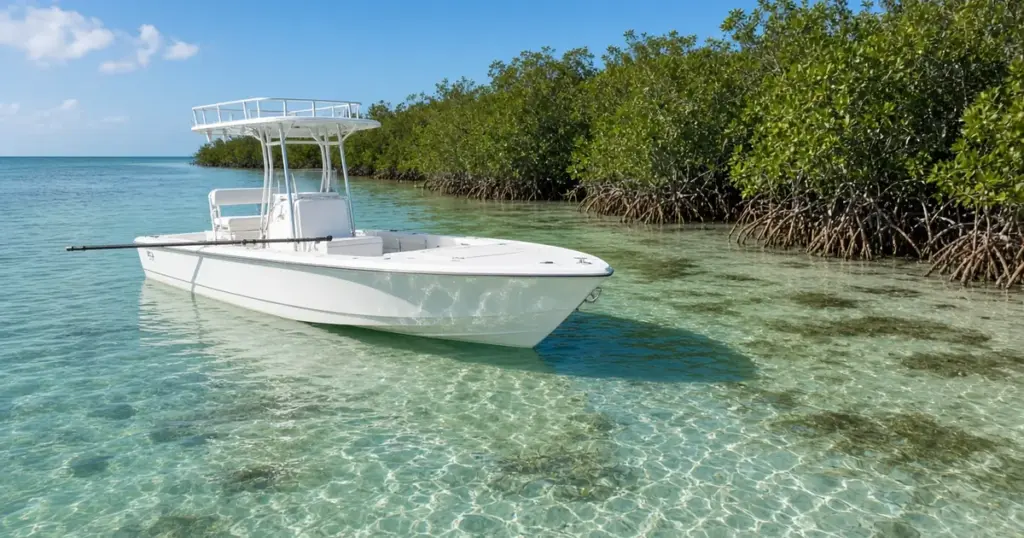
Flats skiffs are built to float in inches of water and to be poled silently across shallow flats. Every pound affects draft, and every component lives in salt spray. That makes battery selection unusually important: the wrong battery adds weight where you can least afford it and corrodes quickly. This flats skiff battery guide covers loads, battery choices, saltwater protection and weight placement.
Typical flats skiff loads
- Outboard starting, often a 60 to 150 hp engine with electric start and tilt/trim.
- Trolling motor, commonly a 12V or 24V bow-mount for quiet positioning.
- Shallow-water anchors, electric or hydraulic, which draw briefly but heavily.
- Electronics: a GPS chart plotter, sometimes sonar.
- Livewell and baitwell pumps.
- Lights and a bilge pump.
Why weight matters on a flats skiff
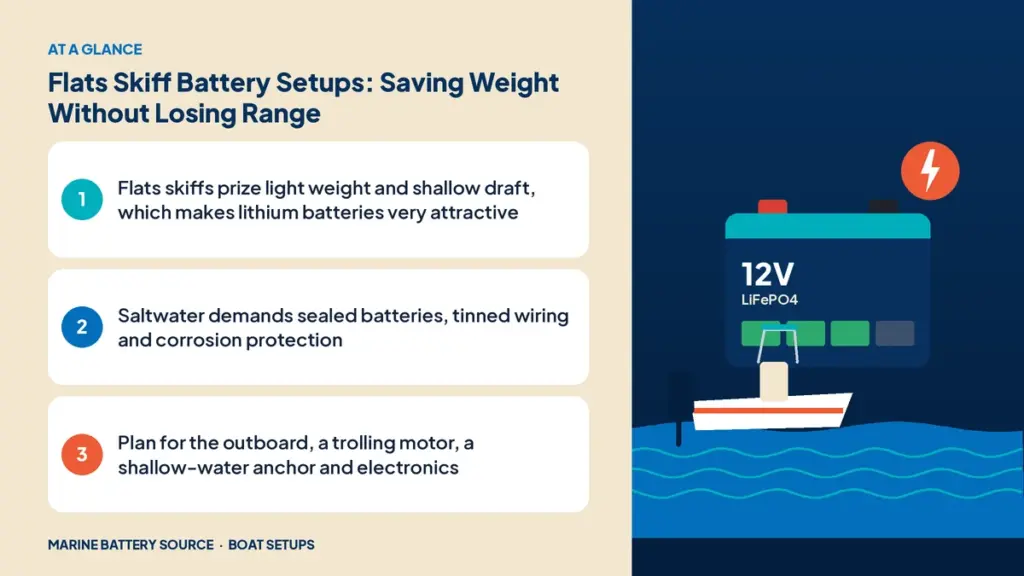
Draft is everything when you’re fishing water a foot deep or less. A typical lead-acid setup of a cranking battery and two trolling batteries can weigh over 150 lb. Switching to lithium can save 70 lb or more. That reduces draft, makes poling easier and improves hole shot.
Battery layout options
- Single battery: a dual-purpose battery for starting and light loads on minimalist skiffs without trolling motors.
- Cranking plus trolling: a cranking battery and a 12V or 24V trolling bank.
- Cranking plus lithium trolling and house: the most capable, often seen on technical poling skiffs with electronics and anchors.
Starting battery choices
The outboard needs a battery meeting its cranking spec. On weight-sensitive skiffs, some owners choose lithium dual-purpose batteries such as the EPOCH 12V 172Ah dual-purpose, rated 1,000 CCA at 40 lb, which can start the engine and power accessories. Confirm compatibility with the outboard’s charging system before switching. AGM starting batteries remain a durable, sealed option.
Trolling motor bank
Flats skiffs usually use smaller trolling motors than bass boats because they’re lighter and mainly need stealthy positioning. A 12V system with a 100Ah lithium battery, or a 24V system with a single 24V lithium battery such as the Battle Born 50Ah 24V at 31 lb, is common. For sizing, see the trolling motor power system guide.
Shallow-water anchors
Electric shallow-water anchors draw high current briefly when deploying and retracting. Wire them as the maker instructs, usually to the cranking battery or a house battery, with appropriate fuses or breakers. Their total energy use is small but their peak current is not.
Electronics and pumps
Chart plotters and sonar draw a few amps each; livewells draw more. Tally up usage with the livewell and bilge pump draw guide and the fish finder battery guide.
Saltwater protection
- Sealed batteries only: AGM or lithium. Avoid flooded batteries in saltwater skiffs.
- Tinned copper wire and sealed connectors throughout.
- Terminal covers on every battery.
- Dielectric grease on connections.
- Rinse the boat with fresh water after every trip, but avoid spraying directly into battery compartments.
- Inspect terminals monthly during the season.
Weight placement
Batteries in flats skiffs usually live in the console or a rear compartment. Position matters for trim: heavy batteries in the stern help planing but can push the stern down at rest. Lighter lithium batteries give designers and owners more flexibility. Secure every battery with proper hold-downs.
Charging
- A multi-bank onboard charger with appropriate profiles is ideal for trailered skiffs stored near power.
- A DC-DC charger can top up a lithium trolling battery from the outboard during runs between flats.
- Solar panels on a T-top or console can maintain batteries between trips.
Example setups
| Skiff type | Batteries | Notes |
|---|---|---|
| Minimalist poling skiff | One dual-purpose battery | No trolling motor; lightest setup |
| Technical skiff with trolling motor | Cranking + 12V lithium trolling | Common, lightweight |
| Bay-style flats boat | Cranking + 24V lithium trolling + house | Most capable |
A day on the flats
Consider a skiff with a 24V trolling motor, an electric shallow-water anchor and a GPS. A long morning run to the flats charges the cranking battery. The trolling motor gets intermittent use for positioning, perhaps 20Ah to 30Ah over the day. The anchor deploys dozens of times, each using little energy. The GPS draws a couple of amps all day. A 24V 50Ah lithium trolling battery and a solid cranking battery comfortably handle this day.
Upgrading a used skiff
Used flats skiffs often come with tired batteries and saltwater-damaged wiring. Before fishing a new-to-you skiff hard, inspect every battery cable end for green corrosion under the insulation, check that fuses or breakers protect each circuit, and load-test the batteries. Replacing corroded terminals and cables is inexpensive compared with being stranded on a falling tide miles from the ramp. If you’re replacing batteries anyway, it’s the ideal time to consider lithium, because the weight savings show up immediately in draft and poling effort.
When you plan the upgrade, write down every load, its current and how long it runs on a typical day. That list tells you whether one battery can do the job or whether you need separate starting and trolling batteries. It also helps you choose wire sizes and fuse ratings for any new circuits.
Storage between trips
Skiffs often sit on trailers for days or weeks between trips. Turn off the battery switches so small loads can’t drain the batteries, and keep lead-acid batteries on a maintainer. Lithium batteries hold their charge well, but they still benefit from being switched off. If the skiff lives outdoors in hot climates, ventilate battery compartments and check them periodically.
Common problems
- Corroded terminals: salt exposure without protection.
- Heavy setup: lead-acid batteries increasing draft.
- Anchor slow to deploy: undersized wiring or a weak battery.
- Electronics restart during starting: shared battery voltage drop.
Related small boat guides
Compare with canoe setups for minimalist trolling, tenders for compact power, and the broader small boat battery guide and boat type overview. Browse lithium batteries in the store.
Frequently asked questions
What battery is best for a flats skiff?
Lithium batteries are popular because they save weight and reduce draft. Sealed AGM batteries are a durable lower-cost option.
Can a lithium battery start my skiff’s outboard?
Dual-purpose lithium batteries with high CCA ratings can, if the outboard maker approves lithium. Check the engine’s requirements.
How do I prevent battery corrosion on a saltwater skiff?
Use sealed batteries, tinned wire, sealed connectors, terminal covers and dielectric grease, and inspect regularly.
Where should batteries go in a flats skiff?
Usually in the console or a rear compartment, secured and positioned for good trim.