


Dinghy and Tender Batteries: Starting, Lights and Electric Drives

A tender or dinghy carries you between an anchored boat and shore, and more owners now power them with electric motors. The battery needs to be light enough to lift, compact enough to fit, and big enough for the trips you make. This dinghy battery guide covers sizing, choosing between lithium and lead-acid, mounting in a small inflatable or hard dinghy, and charging from the mothership.
What a tender battery powers
- An electric tender motor: a trolling-style motor or a small electric outboard.
- Navigation lights for night trips.
- Starting an electric-start gas outboard on larger tenders.
- Occasionally a small bilge pump or fish finder.
Why weight matters so much
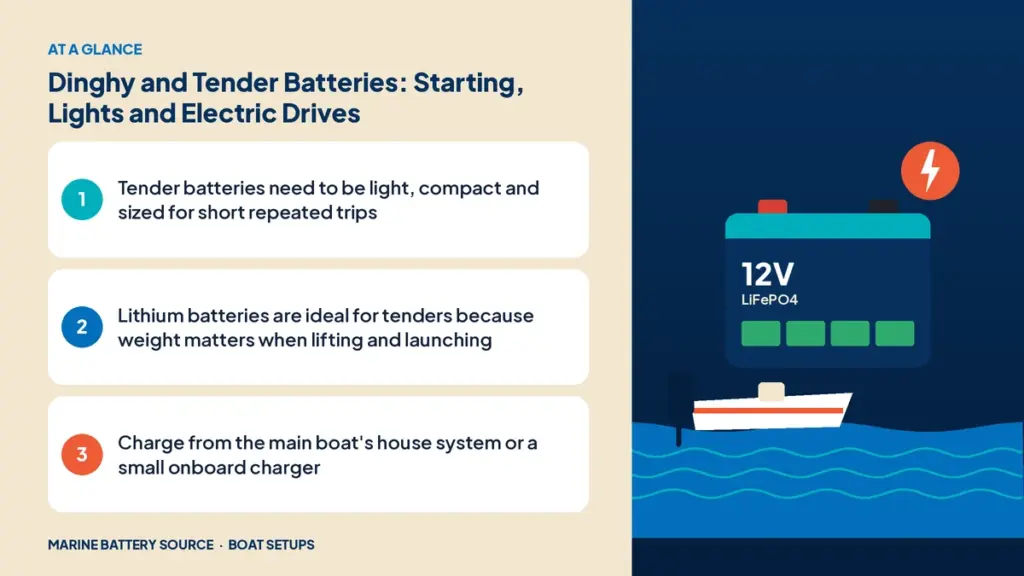
Tenders get lifted onto davits, hauled up swim platforms, carried up beaches and stowed on deck. Every pound counts. A lead-acid Group 27 battery can weigh over 60 lb; a 12V 50Ah lithium battery like the EPOCH 12V 50Ah Essential weighs 14.3 lb. That’s the difference between lifting the battery out with one hand and needing help.
Sizing for typical tender use
Tender trips are usually short but frequent. Estimate:
Daily energy (Ah) = motor draw (A) × minutes of running per day ÷ 60
Example: a 55 lb thrust 12V motor averaging 25A at a useful cruising speed, running 20 minutes per round trip, three round trips per day: 25 × 60 ÷ 60 = 25Ah per day. A 50Ah lithium battery covers that with margin; a 100Ah battery covers two or three days between charges.
Wind and current matter. Pushing a loaded tender into a chop can double the draw. Size up if you anchor far from shore or in exposed harbors.
Lithium or lead-acid?
| Factor | Lithium | Lead-acid |
|---|---|---|
| Weight per usable Ah | Low | High |
| Usable capacity | 80%–100% | About 50% |
| Maintenance | None | Some, for flooded |
| Upfront cost | Higher | Lower |
For tenders, lithium is usually worth it. A larger but still compact option such as the Battle Born 75Ah Group 24 (27 lb) offers more range for longer trips while staying portable.
Electric outboards for tenders
Some tenders use dedicated electric outboards with integrated or separate battery packs. Follow the motor maker’s battery requirements. Our boat type overview covers larger electric outboard setups, and the trolling motor power system guide explains how motor thrust relates to current draw.
Mounting in an inflatable or hard dinghy
- Use a battery box with a strap; inflatable floors flex and can’t hold a loose battery in place.
- Protect the inflatable fabric from sharp corners and acid. A box with a smooth bottom or a mounting pad helps.
- Keep the battery near the center for balance, not crowded against the transom.
- Cover terminals completely; salt spray and wet feet are constant in a tender.
See the battery box and mounting guide for more.
Charging from the mothership
Options include:
- Carry the battery aboard and charge it from the main boat’s house system with a small portable charger or a DC-DC charger.
- Use a dedicated charging lead from the house system to the tender.
- Solar: a small panel and controller on the tender can maintain or slowly recharge a battery while it’s tied up.
- Shore power at marinas.
Match the charger to the battery chemistry. A 12V lithium charger like the EPOCH 12V 15A replaces about 25Ah in under two hours.
Range planning example
Suppose you anchor half a mile from a town dock. At about 3 mph, a one-way trip takes 10 minutes, so a round trip is 20 minutes of running. Two trips ashore and one trip to explore a nearby cove add up to roughly an hour of motor use. With a motor averaging 25A, that’s about 25Ah. Add a stiff afternoon headwind on the way back and the draw could rise to 35A or more for part of the trip. A 50Ah lithium battery handles this day, but a second day without charging would be tight. That’s why many cruisers either size up to 75Ah to 100Ah or make charging the tender battery part of the evening routine.
Gas-start tenders
Larger hard-bottom tenders and RIBs often run small gas outboards with electric start. The battery in these boats is mainly a starting battery, with lights and a bilge pump as secondary loads. Choose a battery that meets the engine’s cranking requirement, keep it in a sealed box, and make sure the outboard’s charging output keeps it topped up. A compact lithium dual-purpose battery can save significant weight, but confirm that the outboard’s charging system is compatible with lithium.
Common tender battery mistakes
- Using a car battery that’s too heavy and not built for deep cycling.
- Leaving the battery loose on the floor of an inflatable.
- Forgetting to charge after a long day of trips.
- Running exposed terminals that short when wet gear lands on them.
Safety in the tender
- Always carry paddles or oars in case the battery runs flat.
- Fuse the battery positive near the battery.
- Wear a life jacket; tender trips at night or in chop are where many incidents happen.
- Use navigation lights after dark.
Storing the tender battery
Between trips, keep the battery charged and disconnected from the motor. If the boat goes into seasonal storage, bring the tender battery home or store it per the maker’s guidance.
Related small boat guides
Tender setups share a lot with canoe trolling motor setups and flats skiffs. If your tender also runs to the ice shack or a hunting blind in the off-season, see the ice fishing battery guide. Start with the small boat battery guide for basics, and browse lithium batteries in the store.
Frequently asked questions
What size battery does a dinghy trolling motor need?
For a few short trips a day, a 12V 50Ah lithium battery is often enough. Size up for longer distances or windy anchorages.
Is lithium worth it for a tender?
Usually yes. The weight savings make lifting, launching and stowing much easier, and lithium delivers more usable capacity.
How do I charge a tender battery on a cruising boat?
Carry it aboard and charge from the house system with a suitable charger, or use solar or a dedicated charging lead.
Can an inflatable dinghy hold a battery safely?
Yes, if the battery is in a box with a strap, protected from sharp edges and placed near the center.