


Ice Fishing Electronics Batteries: Cold-Weather Choices
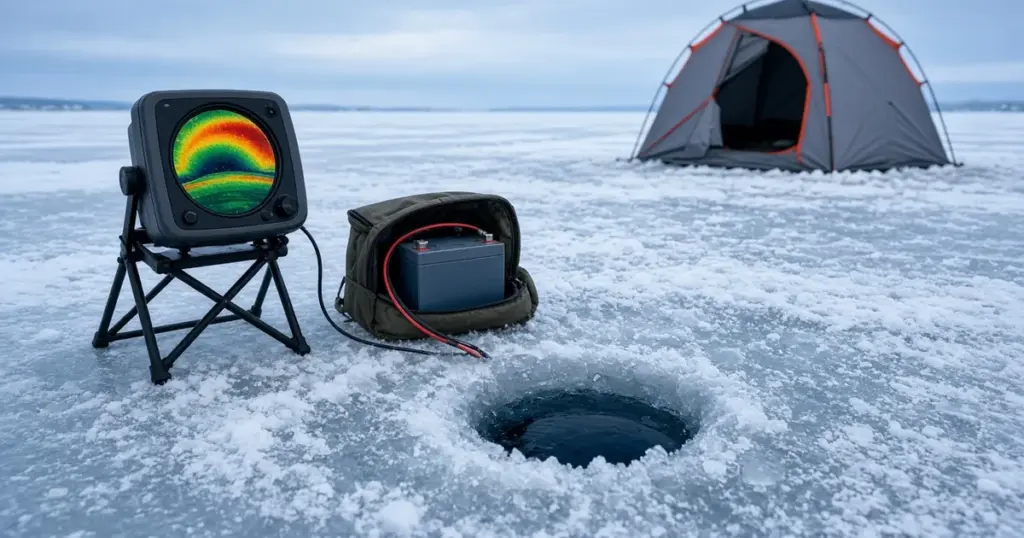
Ice fishing electronics have transformed hard-water fishing. Flashers, fish finders, underwater cameras and forward-facing sonar let anglers see fish and lures under the ice. All of them depend on a battery that works in bitter cold. This ice fishing battery guide covers how much power ice electronics use, how to size a battery, how cold affects lithium and lead-acid, and how to charge and store your batteries.
What ice fishing electronics draw
| Device | Typical draw |
|---|---|
| Flasher | 0.5–1.5A |
| Small fish finder | 0.5–1A |
| 7–9 inch display | 1–2.5A |
| Underwater camera | 0.5–1.5A |
| Forward-facing sonar setup | 2–5A total |
| Shack lights and fans | 0.5–3A |
Check your device’s manual for exact figures.
Sizing the battery
Battery capacity needed (Ah) = draw (A) × hours ÷ usable fraction
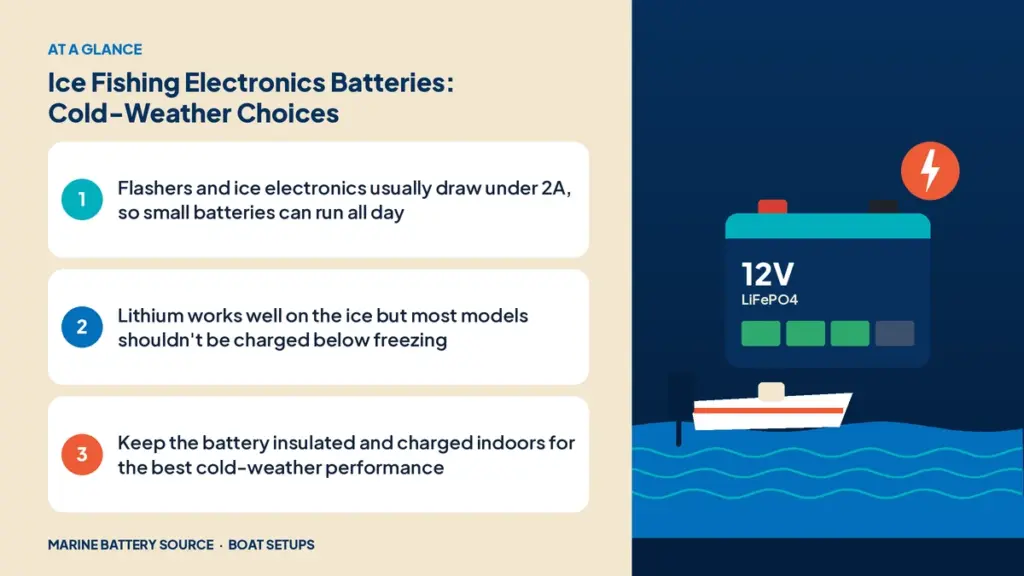
Example: a flasher drawing 1A for 8 hours uses 8Ah. A 10Ah lithium battery such as the Dakota Lithium 10Ah mini (under 2 lb) covers a day in mild cold, but extreme cold reduces available capacity, so many anglers size up. A Battle Born 20Ah gives two full days of flasher use in most conditions.
Forward-facing sonar setups drawing 4A for 8 hours use 32Ah; a 50Ah lithium battery like the EPOCH 12V 50Ah Essential provides comfortable margin.
How cold affects batteries
Lead-acid
Sealed lead-acid batteries, the traditional choice for flashers, lose significant capacity in the cold. A 9Ah sealed lead-acid battery might deliver noticeably less at 0°F. They can be charged below freezing, but a discharged lead-acid battery can freeze and crack.
Lithium
Lithium batteries hold their voltage and capacity better in the cold than lead-acid, and they’re much lighter to carry across the ice. But:
- Most lithium batteries shouldn’t be charged below about 32°F unless heated.
- Discharge is usually allowed to well below freezing, often around -4°F, with reduced capacity. Check your battery’s spec.
- Built-in battery management systems may cut power if temperatures fall below the discharge limit.
Keeping batteries warm on the ice
- Keep the battery in an insulated bag or the flasher’s soft case.
- Place it off the ice, on a seat or in the shelter.
- Inside a heated shelter, batteries perform close to normal.
- Avoid leaving batteries in a truck bed overnight.
Charging
- Charge indoors at room temperature after every trip.
- Use a charger matched to the battery chemistry. Many flashers ship with lead-acid chargers; if you switch to lithium, use a lithium-compatible charger.
- Don’t charge a cold lithium battery until it warms up, unless it’s a heated model.
Upgrading from sealed lead-acid to lithium
Many ice anglers upgrade their flasher’s original sealed lead-acid battery to lithium. Benefits include lighter weight, longer runtime, steadier voltage and more charge cycles. Check that the lithium battery fits the flasher’s case and connectors, and that its maximum discharge current exceeds the device’s needs. Small batteries often have 10A to 20A limits, more than enough for electronics.
Ice fishing from a boat or tender
Some anglers fish early or late ice from a boat or use a tender to reach open water. The same small electronics batteries work there too. See the tender guide for small boat power.
Power for shelter accessories
Lights, fans and USB charging ports in a shelter add up. A 50Ah to 100Ah lithium battery can power electronics and accessories for a weekend. Keep the battery inside the shelter for warmth and secure it so it can’t tip.
Safety
- Never use fuel-burning heaters without proper ventilation; carbon monoxide is a serious risk in shelters.
- Protect battery terminals from shorting against tools, augers or ice spikes.
- Carry ice picks and a throw rope, and check ice thickness.
Off-season storage
At the end of ice season, charge batteries and store them in a cool, dry place. Lead-acid batteries benefit from a maintainer. Lithium batteries can usually be stored at partial charge per the maker’s guidance.
Common problems
- Flasher dies early in extreme cold: undersized lead-acid battery; switch to lithium or carry a spare.
- Lithium won’t charge in the truck: the battery is below its charge temperature limit.
- Display dims: low voltage from an aging battery.
- Connector problems: cold-stiffened wires or loose terminals; inspect before the season.
Choosing your ice battery
- Add up the draw of every device you plan to run.
- Multiply by the hours of your longest outing.
- Add 30% to 50% margin for cold.
- Choose lithium for weight and runtime, keeping charging temperature limits in mind.
A typical weekend on the ice
Imagine a two-day trip with a flasher, a small display with GPS and an underwater camera used for an hour each day. The flasher draws about 1A for 10 hours, the display about 1.5A for 10 hours, and the camera about 1A for an hour. That’s roughly 26Ah per day, or 52Ah for the weekend. With no way to charge in between, a 50Ah lithium battery would be tight once cold reduces available capacity, so a 75Ah to 100Ah battery or two smaller batteries make sense. If you return to a warm cabin each night, a 30Ah to 50Ah battery charged overnight is plenty.
Related guides
Ice anglers share cold-weather concerns with duck boat and hunting skiff setups. For accessory power, see adding a second battery. For small battery mounting tips, see the battery box guide. For basics, read the small boat battery guide and setups by boat type. Browse lithium batteries in the store.
Frequently asked questions
What size battery do I need for ice fishing?
A flasher usually needs 8Ah to 15Ah per day. Many anglers choose a 10Ah to 20Ah lithium battery for flashers and 50Ah for forward-facing sonar.
Is lithium good for ice fishing?
Yes. Lithium is lighter and holds capacity better in the cold than lead-acid, but most models shouldn’t be charged below freezing.
How do I keep my ice fishing battery warm?
Keep it insulated, off the ice and inside your shelter when possible. Charge indoors.
Can I charge my lithium ice battery in my truck?
Only when the battery is above its minimum charging temperature, usually about 32°F, or if it’s a heated model.