


Duck Boat and Hunting Skiff Battery Setups

Duck boats and hunting skiffs work in some of the harshest conditions any boat sees: pre-dawn launches in freezing temperatures, ice in the bilge, mud everywhere and long, cold waits in the blind. A battery failure out there isn’t just inconvenient; it can leave you stranded in the dark on cold water. This duck boat battery guide covers loads, cold-weather chemistry choices, mounting and charging.
Typical hunting boat loads
- Electric-start outboards or mud motors. Many mud motors are pull-start, but larger models and outboards often have electric start.
- Spotlights and navigation lights for running in the dark.
- GPS and fish finders for navigating marsh channels and finding depth.
- Bilge pumps.
- Heated accessories: some hunters run heated seats or small heaters, which draw significant current.
- Small trolling motors for quiet positioning in some setups.
Cold weather: the key consideration
Lead-acid in the cold
Lead-acid batteries lose cranking power and capacity as temperatures fall. A battery that easily starts the motor in September may struggle in December. However, lead-acid batteries can be charged below freezing, and a fully charged lead-acid battery resists freezing far better than a discharged one.
Lithium in the cold
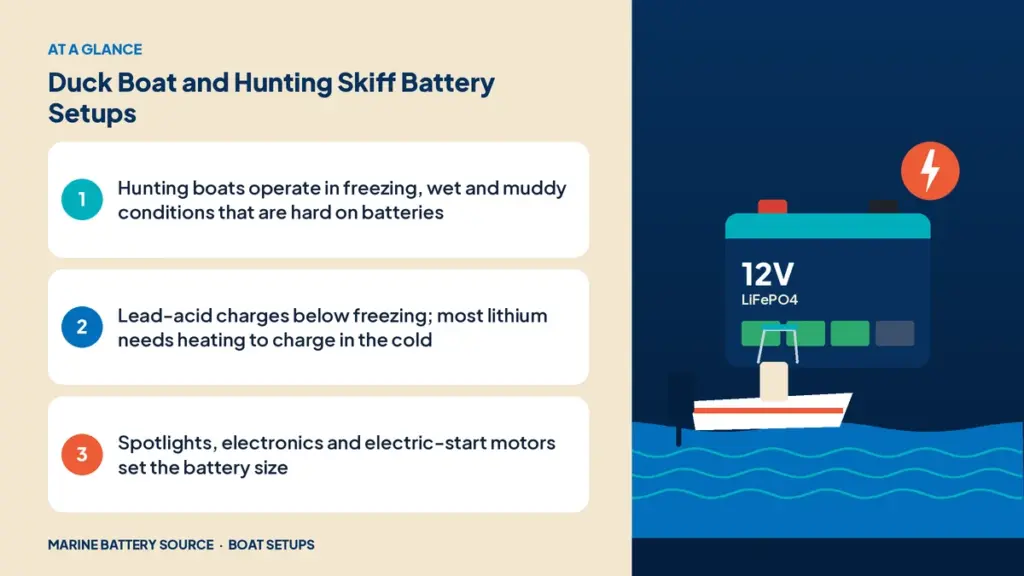
Lithium (LiFePO4) batteries discharge well in the cold, with some reduction in available capacity. But most shouldn’t be charged below about 32°F unless they have built-in heating. If your outboard charges the battery on a frigid morning run, a non-heated lithium battery may refuse the charge or, if it lacks proper protection, be damaged.
Heated lithium batteries solve this by warming the cells before accepting charge. Store examples include the EPOCH 12V 105Ah Essential (heated, Bluetooth, 22.1 lb) and the Dakota Lithium DL 12V 135Ah heated dual-purpose.
Starting batteries
For electric-start motors, choose a battery that meets the engine’s cranking requirement with margin for the cold. AGM batteries handle cold, vibration and wet conditions well. A strong option is the Interstate 27M-XHD at 800 CCA. Dual-purpose batteries can start the engine and power lights and electronics on small boats with one battery.
Sizing for a hunt
Add up loads in amps and hours:
- Spotlight: 5A to 10A for 1 hour of running in the dark.
- GPS: 1.5A for 6 hours.
- Navigation lights: 1A for 2 hours.
- Bilge pump: intermittent.
That’s roughly 20Ah per hunt plus starting. A 50Ah to 100Ah battery covers this with margin; size up for heated accessories, which can draw 5A or more each.
Mounting in a hunting boat
Hunting boats take a beating: running over stumps and through mud, loading decoys and dogs, and trailering on rough roads.
- Use a sturdy, sealed battery box with a strong strap.
- Mount the box to the hull so it can’t slide.
- Cover terminals completely; wet decoy bags and dog paws are a short-circuit risk.
- Route cables away from feet, dogs and gear, and protect them with loom.
- Fuse the positive near the battery.
See the battery box and mounting guide for details.
Corrosion and moisture
Hunting boats often stay wet for weeks. Use sealed AGM or lithium batteries, tinned wire, sealed connectors and dielectric grease. Inspect terminals after every few hunts.
Charging during the season
- Charge after every hunt. A discharged lead-acid battery can freeze in an unheated garage.
- If you charge in a cold garage, use lead-acid or heated lithium, or bring the battery inside.
- Use a charger with the correct profile for your chemistry.
- A maintainer keeps lead-acid batteries topped up between hunts.
Safety
Hunting from boats in cold water is dangerous. Batteries are part of your safety system: they run navigation lights, spotlights and bilge pumps. Carry a backup light, wear a life jacket, and tell someone your plans. Test your battery before the season and replace it if it’s weak.
Off-season storage
After the season, fully charge the battery, then store it disconnected in a cool, dry place. Keep lead-acid batteries on a maintainer. Follow the maker’s storage guidance for lithium.
Example setups
| Boat | Battery | Notes |
|---|---|---|
| Small duck skiff with pull-start mud motor | 12V 50Ah lithium or Group 24 AGM | Lights, GPS, pump |
| Larger hunting boat with electric-start outboard | Group 27 AGM starting + optional accessory battery | Cold-cranking margin |
| Combo hunting/fishing boat | Heated lithium dual-purpose | Starts and powers accessories |
Common problems
- Motor won’t crank on a frosty morning: undersized or aging lead-acid battery.
- Lithium won’t charge on the run: non-heated battery below its charge temperature limit.
- Spotlight dims: undersized battery or voltage drop in long, thin wires.
- Corroded terminals: wet storage without protection.
A typical cold morning
Picture a 4:30 AM launch at 25°F. The motor must start cold, the spotlight runs for half an hour while you find the blind, and the GPS stays on all morning. After the hunt, the run back charges the battery. If the battery is lead-acid, it accepts that charge even in the cold. If it’s non-heated lithium, the battery’s protection may block charging until it warms. That’s why the choice of chemistry depends on how and where you charge. Many hunters who choose lithium go with heated models for exactly this reason.
Related guides
Hunting boats share cold-weather concerns with ice fishing setups. If you add accessories, see adding a second battery and the bilge pump draw guide. For basics, start with the small boat battery guide, setups by boat type and the trolling motor power system guide if you run a trolling motor. Browse AGM batteries and lithium batteries in the store.
Frequently asked questions
What battery is best for a duck boat?
A sealed AGM or a heated lithium battery. AGM is durable and charges in the cold; heated lithium saves weight and charges safely below freezing.
Can I use lithium in freezing weather?
Lithium discharges in the cold, but most models shouldn’t be charged below about 32°F unless heated.
How do I keep my duck boat battery from freezing?
Keep it fully charged. A charged lead-acid battery resists freezing much better than a discharged one.
What size battery do I need for a hunting boat?
Many hunting boats are well served by a 50Ah to 100Ah battery, plus a starting battery that meets the motor’s cranking spec.