


Wake and Ski Boat Battery Setups for Big Audio
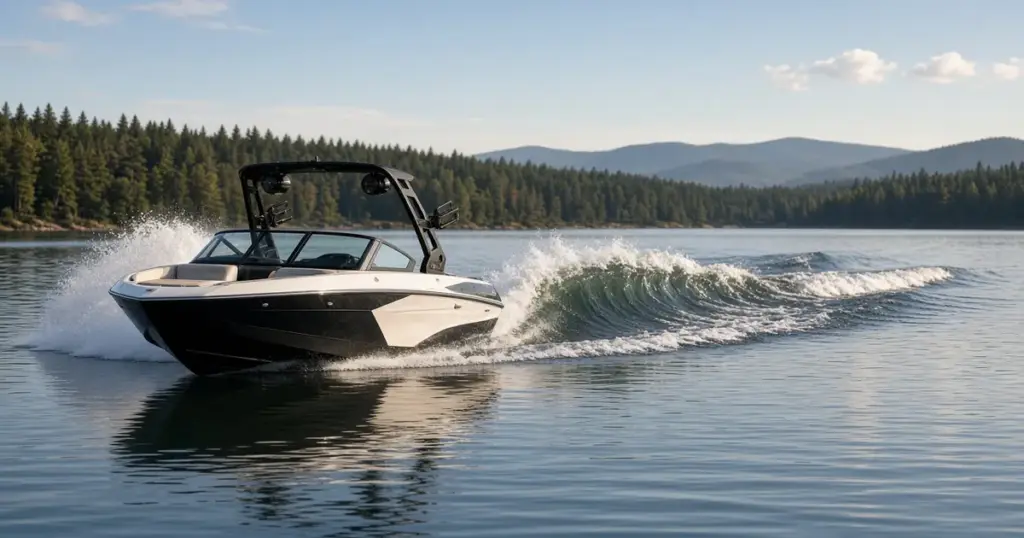
Wake and ski boats are built for fun: towing riders, cruising the lake and playing music loud. Modern wake boats often carry powerful audio systems with several amplifiers and tower speakers, plus ballast pumps, lighting and big displays. That puts serious demand on the batteries. A good wake boat battery setup protects your ability to start the engine while giving the stereo the power it needs. This guide explains how.
The loads on a wake boat
- Engine starting: inboard engines, typically gasoline V8s on many wake boats.
- Audio: head units, multiple amplifiers, tower speakers and subwoofers.
- Ballast pumps: filling and draining ballast tanks draws current, often for several minutes at a time.
- Lighting: interior, underwater and tower lights.
- Electronics: touchscreen displays and engine management.
Starting battery
Inboard engines have cranking and reserve requirements listed in their manuals. AGM batteries are popular on wake boats because they’re sealed, handle vibration and offer strong cranking. Examples include the Interstate 31M-AGM (925 CCA, 1190 MCA) and the Interstate 34M-AGM (800 CCA, 1000 MCA in a compact case). See our guide to inboard and sterndrive starting batteries for more.
The dedicated stereo bank
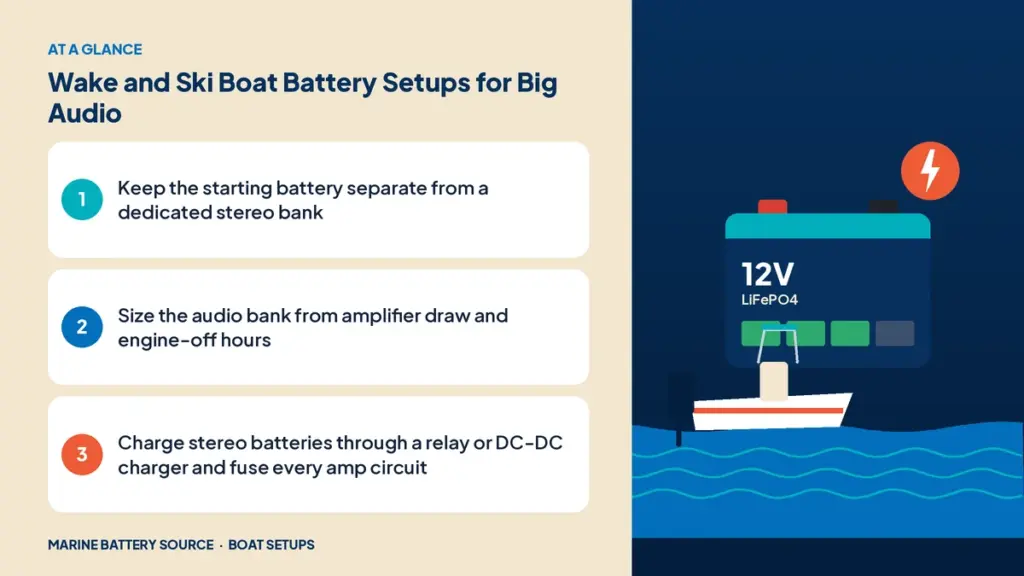
The key to a reliable wake boat system is separating audio from starting. A dedicated stereo battery or bank powers amplifiers, and the starting battery stays reserved for the engine.
Sizing the stereo bank
Amplifier current varies with volume, music and impedance, and peak draw is far higher than average. A practical approach:
- Check each amplifier’s fuse rating and the maker’s typical current draw at moderate volume.
- Estimate engine-off listening hours, such as at a sandbar or cove.
- Multiply average current by hours.
Example: an audio system averaging 30A at party volume for 3 hours with the engine off uses about 90Ah. A lead-acid bank would need roughly 180Ah of rated capacity to stay above half charge, likely two large AGM batteries. A lithium bank of about 120Ah to 150Ah covers it, with steadier voltage that keeps amplifiers performing.
Lithium for audio
Lithium suits audio well: high current capability, steady voltage and much less weight. The EPOCH 12V 172Ah dual purpose (Group 31, 40 lb, Bluetooth) is a strong audio battery with cranking capability for emergencies. Check the battery’s continuous discharge rating against your amplifiers’ combined fuse ratings.
Charging the stereo bank
- Automatic charging relay: connects the stereo bank to the starting battery when the engine charges, then separates them. Good for lead-acid audio banks.
- DC-DC charger: preferred for a lithium audio bank, protecting the alternator and applying a lithium profile.
- Onboard charger: a multi-bank charger keeps everything topped up at the dock or on the lift.
Inboard alternators on wake boats can produce substantial current, but a large lithium bank can still demand full output for a long time. A DC-DC charger limits current to a safe level.
Wiring amplifiers
- Run amplifier power directly from the stereo bank through a properly sized fuse close to the battery.
- Use cable sized for the amplifiers’ combined fuse ratings and the run length.
- Use a distribution block with individual fuses for multiple amplifiers.
- Keep audio grounds tied to the boat’s main negative, not to random points.
- Follow the amplifier maker’s instructions and ABYC standards.
Ballast pumps
Ballast pumps can run for several minutes to fill or drain tanks. They’re typically on the boat’s main electrical system. Running them with the engine on lets the alternator support the load.
On the lift
Wake boats often sit on lifts. Audio memory, bilge float switches and other small loads drain batteries over time. Turn off battery switches, or keep a charger or solar maintainer connected.
Typical configurations
| Setup | Starting | Audio | Charging |
|---|---|---|---|
| Factory | One or two AGM | Shared | Alternator + optional charger |
| Popular upgrade | AGM starting | Two AGM audio batteries | ACR + multi-bank charger |
| Lithium audio | AGM starting | Lithium audio bank | DC-DC + lithium charger profile |
Comparing with other boats
Wake boats are inboards with heavy accessory loads; contrast them with the trolling-focused multi-species, bay boat and jon boat setups. Electric propulsion is covered in the electric outboard guide.
Signs your audio system is outgrowing its batteries
- Amplifiers cut out or distort at volume, especially with the engine off.
- Headlights-style dimming of interior lights when the bass hits.
- The starting battery is low after a day at the sandbar.
- Batteries wear out within a season or two.
Each of these points to too little capacity, too much voltage drop in the wiring, or audio sharing the starting battery. A dedicated, properly sized audio bank with short, heavy cables usually solves all four.
Planning before you upgrade the stereo
If you’re adding amplifiers or tower speakers, plan the electrical side at the same time. Add up the new amplifiers’ fuse ratings, check the existing cable and distribution capacity, and decide where an additional battery can go. Upgrading the audio without upgrading the power supply is the most common reason big systems disappoint.
Off-season care
Before winter layup, fully charge every battery, then disconnect them or switch them off. Lead-acid batteries benefit from a maintainer through the off-season, and a discharged battery can freeze in an unheated storage building. For lithium audio batteries, follow the maker’s storage guidance, which often favors a partial state of charge with loads disconnected.
Safety notes
- Never connect amplifiers directly without fusing.
- Ventilate engine compartments before starting gasoline engines.
- Secure batteries firmly; wake boats carry a lot of weight and move in rough water.
For trolling motors on multi-use wake boats, see how to choose a trolling motor battery. For the overview, read battery setups by boat type and small boat electrical basics. Browse dual-purpose batteries in the store.
Frequently asked questions
Do I need a separate battery for my boat stereo?
If you play music for long periods with the engine off, a dedicated stereo battery protects your ability to start the engine.
Is lithium good for boat audio?
Yes. Lithium delivers high current with steady voltage and saves weight. Check its discharge rating against your amplifiers.
How do I charge a stereo battery on a wake boat?
With an automatic charging relay for lead-acid or a DC-DC charger for lithium, plus an onboard charger at the dock.
How big should my wake boat stereo bank be?
Multiply the system’s average current by engine-off listening hours, then size for the chemistry’s usable capacity with reserve.