


Bay Boat Battery Setups for Shallow-Water Anglers
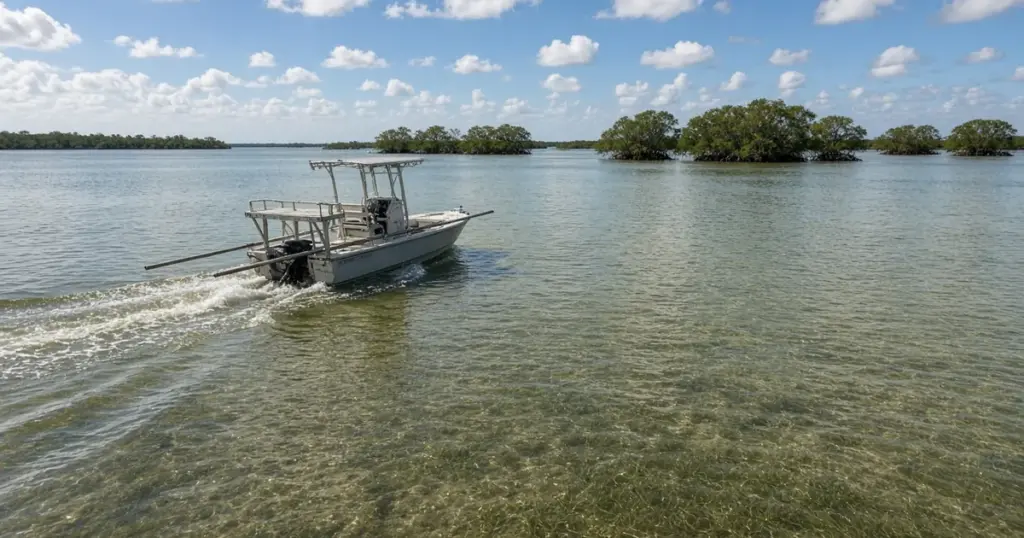
Bay boats live in a demanding middle ground: they run across open bays like a center console, then fish shallow flats and shorelines like a bass boat. That means an outboard, a bow-mount trolling motor, often shallow-water anchors, livewells and plenty of electronics, all in saltwater. A good bay boat battery setup supports all of it while keeping weight down for shallow draft. This guide covers the typical layout and the best upgrades.
The typical bay boat electrical load
- Outboard starting and engine electronics.
- Trolling motor, commonly 24V or 36V on bay boats because of wind and current.
- Shallow-water anchors, which draw significant current briefly when deploying and retracting.
- Livewell and baitwell pumps, often running for hours.
- Electronics: one or two displays, sonar, VHF.
- Lighting, including underwater lights for night fishing on some boats.
The standard layout
- Starting battery for the outboard, often also powering accessories such as livewells, electronics and shallow-water anchors.
- Trolling bank: two or three 12V batteries, or a single 24V or 36V lithium battery.
- Multi-bank onboard charger.
Some owners add a separate house battery for electronics and pumps.
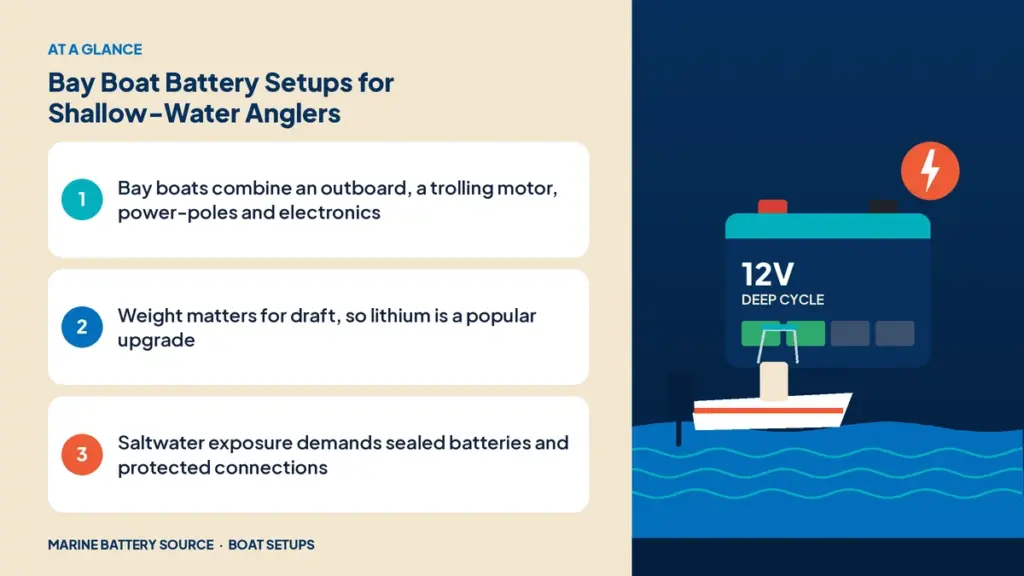
Why weight matters on a bay boat
Bay boats are designed to float and run in shallow water. Every pound adds draft. A three-battery lead-acid 36V bank can weigh close to 200 lb. Switching to lithium removes much of that weight, which can help the boat float shallower, get on plane in skinny water, and pole more easily if it has a platform.
Lithium options include:
- EPOCH 36V 50Ah Essential: 1.92 kWh, 35 lb, Group 31 size.
- Lithium Rhino 36V 65Ah conversion kit: IP67-rated, Bluetooth.
- EPOCH 24V 60Ah Pro Series: 1.54 kWh in a Group 27 size, 30 lb, for 24V motors.
Sizing the trolling bank
Bay boat anglers often run the trolling motor against wind and tidal current, which raises average draw. GPS anchoring on a windy flat can use a lot of energy. Track your use for a few trips, then size the bank with reserve. A 36V 50Ah to 60Ah lithium battery covers many anglers’ days; heavy GPS-anchor users or long days may want more. Our trolling motor battery guide explains the math.
Shallow-water anchors
Hydraulic or electric shallow-water anchors draw high current for a few seconds when deploying or retracting. Follow the maker’s wiring instructions: cable size, fuse or breaker, and which battery to connect. They’re usually connected to the starting battery or a house battery, not the trolling bank.
Livewells and pumps
Livewell pumps running all day add up. A pump drawing a few amps on a recirculating timer can use tens of amp-hours over a long day. If the starting battery runs them, size it generously or add a house battery.
Saltwater protection
- Use sealed AGM or lithium batteries; flooded batteries are a poor match for wet compartments.
- Choose batteries with good ingress protection if they’re exposed to spray; IP67-rated options like the Lithium Rhino kits are designed for wet environments.
- Coat terminals, use heat-shrink on every lug and keep battery compartments drained and ventilated.
- Rinse the boat after saltwater trips and inspect connections regularly.
Charging
- Multi-bank onboard charger with lithium profiles for lithium batteries.
- DC-DC charger from the outboard to top up the trolling bank during runs.
- Recharge after every trip, especially lead-acid.
Typical bay boat configurations
| Setup | Starting | Trolling | Extras |
|---|---|---|---|
| Budget | AGM dual purpose | Two or three AGM | Shared accessories |
| Popular upgrade | AGM starting | Single 36V lithium | Livewells on starting battery |
| Full upgrade | AGM or lithium starting | 36V lithium | Separate lithium house battery |
Placement
Bay boats often place batteries in the console or a rear compartment. Console placement keeps weight central but lengthens cables to the bow and stern. Size trolling motor cables for the full run.
Night fishing and lights
Underwater LED lights and deck lights for night fishing can draw significant current for hours. Budget them, and run them from a house battery if possible.
Comparing with other boats
Bay boats sit between kayak simplicity and multi-species complexity. Small-boat anglers will find more in the jon boat guide, and inboard owners in our wake boat guide.
A day on the flats: energy example
Consider a bay boat with a 36V trolling motor, two displays, a livewell and a shallow-water anchor. A typical day might look like this:
- Morning run across the bay: the outboard charges the starting battery and, through a DC-DC charger, adds some energy to the trolling bank.
- Three hours drifting and trolling along a shoreline against a light wind: the trolling motor uses a meaningful share of a 36V 50Ah battery.
- Two hours on GPS anchor on a windy point: draw rises sharply as the motor fights gusts.
- All day: the livewell pump and electronics draw steadily from the starting or house battery.
By the afternoon, the trolling bank may be well below half, and a lead-acid starting battery that has been running pumps and electronics may be much lower than you’d expect. Tracking these numbers for a few trips, with Bluetooth battery data or a monitor, tells you whether you need a bigger trolling bank, a separate house battery, or both.
Upgrades worth considering
- A single 36V lithium battery in place of three lead-acid batteries.
- A dedicated lithium house battery for electronics and livewells.
- A DC-DC charger to top up the trolling bank on long runs.
- Upgraded, sealed trolling motor plugs and terminal covers for saltwater.
Maintenance checklist
- Inspect terminals and lugs for corrosion every few trips.
- Check that compartments drain and stay dry.
- Test batteries before the season.
- Confirm the onboard charger reaches full on every bank.
- Clean and lubricate trolling motor plugs.
For the overview, read battery setups by boat type and small boat electrical basics. Browse trolling motor batteries in the store.
Frequently asked questions
What batteries does a bay boat need?
Usually a starting battery for the outboard and a 24V or 36V trolling bank, often with a separate house battery for electronics and pumps.
Is lithium worth it on a bay boat?
For many anglers, yes. Lithium saves significant weight, which helps shallow draft, and gives steady trolling power.
Which battery should power shallow-water anchors?
Follow the anchor maker’s instructions. They’re commonly wired to the starting or house battery with their own fuse or breaker.
How do I protect bay boat batteries in saltwater?
Use sealed batteries, protect terminals with coatings and heat-shrink, keep compartments drained and inspect connections often.