


Boat Won’t Start and Just Clicks: What to Check
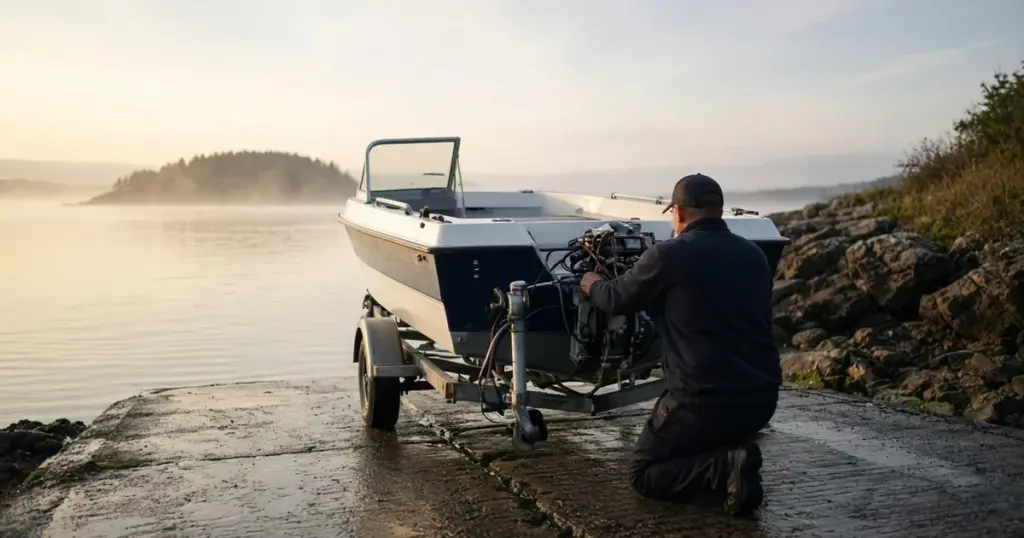
You turn the key and hear a click, or a rapid clicking, and the engine doesn’t turn over. It’s one of the most common boat problems, and in most cases the cause is electrical, not mechanical. The starter needs a lot of current, and anything that limits that current, from a weak battery to a corroded cable, can leave you clicking at the ramp. Here’s how to find the problem.
What the clicks mean
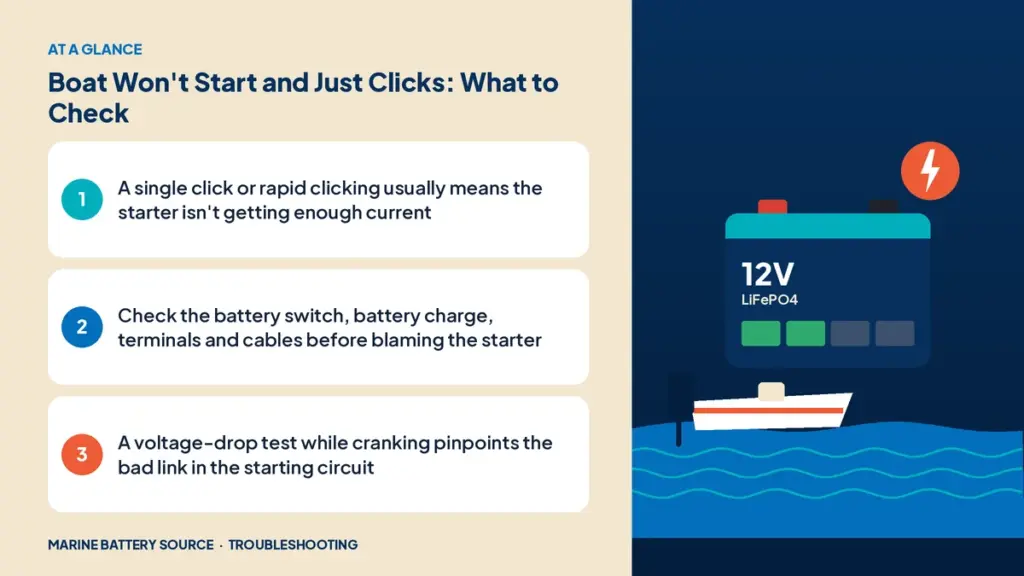
- Rapid clicking: the starter solenoid engages, voltage collapses, the solenoid drops out, voltage recovers, and it repeats. Usually a weak battery or a poor connection.
- A single click: the solenoid engages but the starter doesn’t turn. Could be a poor connection, a weak battery, a failing solenoid or a starter problem.
- No click at all: no signal reaching the solenoid. Check the switch, the neutral safety switch, the kill switch lanyard, fuses and the ignition circuit.
Step 1: The quick checks
- Battery switch: is it on, and set to the start battery?
- Kill switch lanyard: is the clip attached?
- Throttle in neutral: most engines won’t crank in gear.
- Fuses: check the main engine fuse and any ignition fuses.
- Terminals: are the battery terminals tight and clean?
Step 2: Check the battery
Measure resting voltage. A 12V lead-acid start battery should be about 12.6V or higher when fully charged. If it’s around 12.2V or lower, it’s at half charge or less and may not crank a big engine. Charge it and try again. If it still won’t crank after a full charge, load test it. A battery that drops far below about 9.6V during a load test is weak. See marine battery troubleshooting guide.
If the battery is low and you aren’t sure why, check the charging system. A battery charger fault light or an engine that isn’t charging can leave the start battery low after every trip.
Step 3: Check cables and connections
Corroded or loose connections are a top cause of clicking. Check:
- Battery terminals and lugs
- The battery switch terminals
- The connection at the starter solenoid
- The engine ground (often overlooked)
- Any busbars in the circuit
Look for corrosion, heat discoloration and loose lugs. Wiggle each connection; if anything moves, tighten it.
Step 4: Voltage-drop test while cranking
This finds the bad link quickly. Have a helper crank the engine while you measure:
- Positive side: battery positive post to the starter’s positive terminal. More than about 0.5V suggests resistance in the positive cable, switch or connections.
- Negative side: battery negative post to the engine block. More than about 0.3V suggests a bad ground.
- Across the battery: voltage during cranking. If it drops below about 9.6V, the battery is weak or undersized.
Move the probe along the circuit to find exactly where the drop occurs.
Step 5: Check the battery switch
Battery switches carry starting current, and their internal contacts can corrode. Measure voltage across the switch while cranking. A noticeable drop means the switch should be replaced.
Step 6: Solenoid and starter
If the battery is good and voltage at the starter is good during cranking, but the engine still won’t turn, the solenoid or starter may be failing. Signs:
- Click with full voltage at the starter terminal
- Grinding or whirring without engaging
- The starter works intermittently after tapping it
These usually need a mechanic or a replacement part.
Using the house battery to start
Most dual-battery boats have a parallel or “both” switch position. If your start battery is weak, combining it with the house battery may get the engine going. Afterward, find out why the start battery was weak. Don’t rely on it permanently.
Why start batteries go weak
- Not recharged after trips
- Electronics or accessories drawing from the start battery
- A parasitic drain while the boat sits
- Age and heat
- The engine not charging the battery
Picking the right start battery
Match or exceed the engine manufacturer’s CCA or MCA requirement. Sealed batteries handle vibration and heat well. Options include the Interstate 27M-XHD starting battery, the Interstate 31M AGM for dual-purpose use, or lithium starting like the Dakota Lithium 60Ah 1000 CCA if your engine maker approves it. Shop cranking batteries.
Lithium start batteries that click
If a lithium start battery clicks:
- The BMS may have disconnected after a deep discharge.
- Cold temperatures may limit output.
- The battery may be too small for the engine’s cranking current.
Check the battery’s app or status, warm it if cold, and confirm it’s rated for your engine. If the problem is charging, see lithium battery won’t charge.
Example: the ramp click
A center console owner hears rapid clicking at the ramp after two weeks on the trailer. Resting voltage reads 12.1V, so the battery is low. After a full charge, it reads 12.7V and cranks the engine, but slowly. A voltage-drop test while cranking shows 0.9V lost on the negative side. The engine ground lug is corroded under its heat-shrink. Replacing the lug and cleaning the mounting point brings the drop down to under 0.2V, and the engine cranks briskly. The owner also adds a battery switch habit: off at the end of every trip, so the stereo memory no longer drains the battery on the trailer.
Prevention
- Charge the start battery after every trip.
- Keep electronics on a separate house battery.
- Clean and protect connections twice a year.
- Test the start battery each spring.
- Replace cables showing corrosion.
Related problems
If other things on the boat are acting up, see boat electrical problems troubleshooting. Trolling motor issues are covered in trolling motor won’t turn on and trolling motor losing power.
Frequently asked questions
Why does my boat just click when I turn the key?
Usually the starter isn’t getting enough current because of a weak battery or a corroded or loose connection.
Can a bad ground cause a boat not to start?
Yes. A poor engine ground causes clicking and slow cranking. Check with a voltage-drop test.
How do I know if it’s the starter or the battery?
If the battery is fully charged and voltage at the starter is good while cranking but the engine doesn’t turn, the starter or solenoid is likely at fault.
Can I jump-start a boat?
Yes, with jumper cables or a jump pack, connecting carefully. Find out why the battery was weak afterward.
Why does my boat battery die after starting a few times?
The battery may be weak, or the engine may not be charging it. Test both.