


What Is a DC-DC Charger and Does Your Boat Need One?
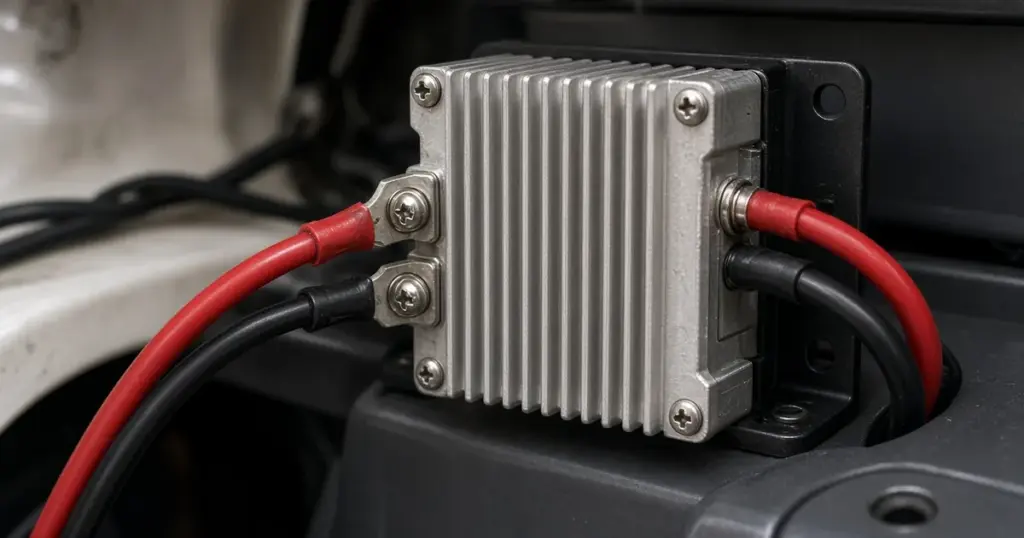
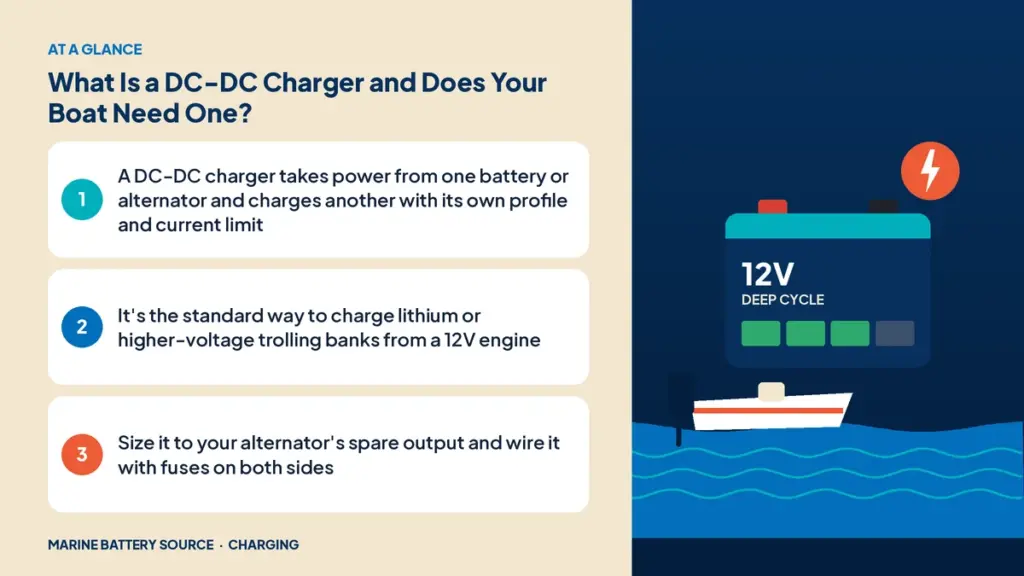
A DC-DC charger is a small box that solves a big problem: charging one battery from another when their chemistries, voltages or charging needs don’t match. It’s become standard equipment on boats with lithium batteries and on fishing boats that want the outboard to top up their trolling bank. This guide explains what a DC-DC charger does, when you need one and how to choose and install it.
What it does
A DC-DC charger takes DC power from a source, usually the starting battery or alternator circuit, and converts it to a regulated output that charges a second battery. It acts like a smart charger powered by your engine instead of shore power:
- Applies the correct profile for the target battery, such as lithium or AGM.
- Limits current so the alternator isn’t overloaded.
- Steps voltage up or down, so a 12V system can charge a 24V or 36V battery.
- Isolates the batteries in function so house or trolling loads don’t drain the starting battery.
When you need one
- Lithium house or trolling battery charged from an engine. Lithium’s low internal resistance can pull very high current from an alternator, risking overheating. A DC-DC charger caps that current.
- Different voltages. Charging a 36V trolling battery from a 12V outboard requires stepping up the voltage.
- Mixed chemistries. A lead-acid starting battery and a lithium house battery need different charging voltages.
- Long cable runs. A DC-DC charger compensates for voltage drop that would undercharge a distant battery.
- Smart alternators. Some modern engines vary alternator voltage; a DC-DC charger provides a steady charge regardless.
If both batteries are the same chemistry and voltage, close together, and charged by a conventional alternator, an ACR may be enough. See ACR vs isolator vs DC-DC charger.
Store examples
- EPOCH 12V to 36V DC-DC charger: single-bank, IP67, charges a 36V trolling battery from a 12V system while running.
- EPOCH dual-output 12V/36V DC-DC charger: two independent outputs for boats with both a 12V auxiliary battery and a 36V trolling battery.
- For 12V accessories on 24V, 36V or 48V systems, a step-down converter is a different device: it powers loads rather than charging a battery.
Sizing a DC-DC charger
DC-DC chargers are rated by output current. Choose one that:
- Your alternator can support on top of normal engine and starting battery needs. Small outboards may have only a modest spare output.
- Your target battery can accept within its maximum charge current.
- Matches your typical engine hours. A 20A charger running for 2 hours adds roughly 40Ah at 12V.
For step-up chargers, remember that input current is higher than output current. A charger delivering 10A at 36V draws roughly 30A or more from the 12V side, plus losses.
Ignition and voltage triggers
DC-DC chargers need to know when the engine is running so they don’t drain the starting battery:
- Voltage sensing: the charger turns on when the starting battery voltage rises above a threshold, indicating charging.
- Ignition wire: a trigger wire from the ignition switch turns the charger on.
Smart alternators that drop voltage at times may need an ignition trigger. Follow the maker’s instructions.
Wiring basics
- Mount the charger in a dry, ventilated spot with clearance for cooling, close to the batteries.
- Fuse the input cable near the starting battery and the output cable near the target battery, with ratings the maker specifies.
- Use cable sized for the input current and length, which is often larger than the output cable.
- Connect negatives as the maker specifies; some units are non-isolated and share a common negative.
- Fit a temperature sensor if supplied.
What to expect on the water
DC-DC charging is a top-up, not a replacement for shore charging, on most trailered boats. A 30-minute run with a 10A step-up charger adds about 5Ah to a 36V trolling battery. On cruising boats with longer engine hours and larger chargers, DC-DC charging can replace a large share of daily use. See charging on the water.
DC-DC vs external regulator
Larger cruising boats with powerful inboard alternators may use an external regulator to charge lithium directly. That can deliver more current than a DC-DC charger but requires alternator temperature sensing and careful setup. See external alternator regulators for lithium and alternator charging lithium.
Cruising sailboats
On sailboats, a DC-DC charger often charges a lithium house bank from a small diesel’s alternator, protecting it from overload. Combine it with solar and wind for a complete system. See wind and hydro generators and the liveaboard sailboat battery guide.
Example installation
A bass boat owner has a 150 hp outboard, a 12V AGM cranking battery and a 36V lithium trolling battery. A 12V-to-36V DC-DC charger is mounted in the rear compartment near both batteries. Its input runs from the cranking battery through a fuse within a few inches of the positive post, and its output runs to the trolling battery through a second fuse. When the engine runs and the cranking battery voltage rises, the charger switches on and sends a steady lithium charge to the trolling battery. When the engine stops, the charger switches off and the cranking battery is protected. At home, an onboard charger finishes the job.
Common mistakes
- Undersized input cables causing low voltage and reduced output.
- No input fuse at the starting battery.
- Expecting a full recharge of a large trolling bank from a short run.
- Setting the wrong output profile.
Is it worth it?
For boats with lithium batteries charged by an engine, yes, nearly always. For boats with matched lead-acid batteries and a basic outboard, an ACR may be the simpler, cheaper choice. Read charging lithium batteries on a boat for the full lithium picture.
Browse chargers and DC-DC chargers in the store.
Frequently asked questions
What does a DC-DC charger do on a boat?
It charges a second battery from the engine’s charging system using the correct profile, voltage and current limit.
Do I need a DC-DC charger for lithium?
In most cases, yes, when lithium is charged from an alternator, especially a small or conventional one.
Can a DC-DC charger charge a 36V battery from a 12V outboard?
Yes. Step-up DC-DC chargers are designed for this.
How big a DC-DC charger should I get?
One your alternator can support and your battery can accept. Check spare alternator output and the battery’s maximum charge current.