


Wind Generators and Hydrogenerators for Cruising Boats
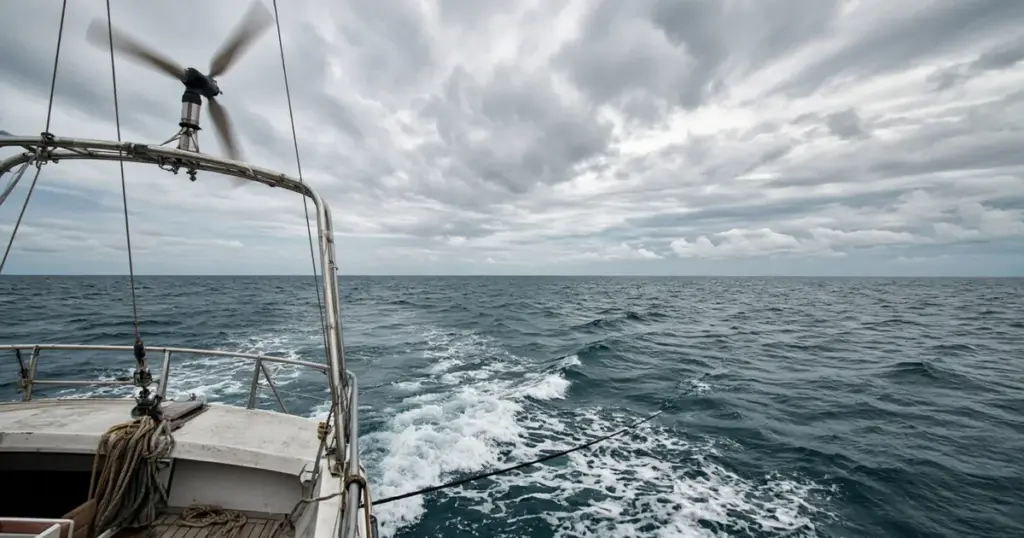
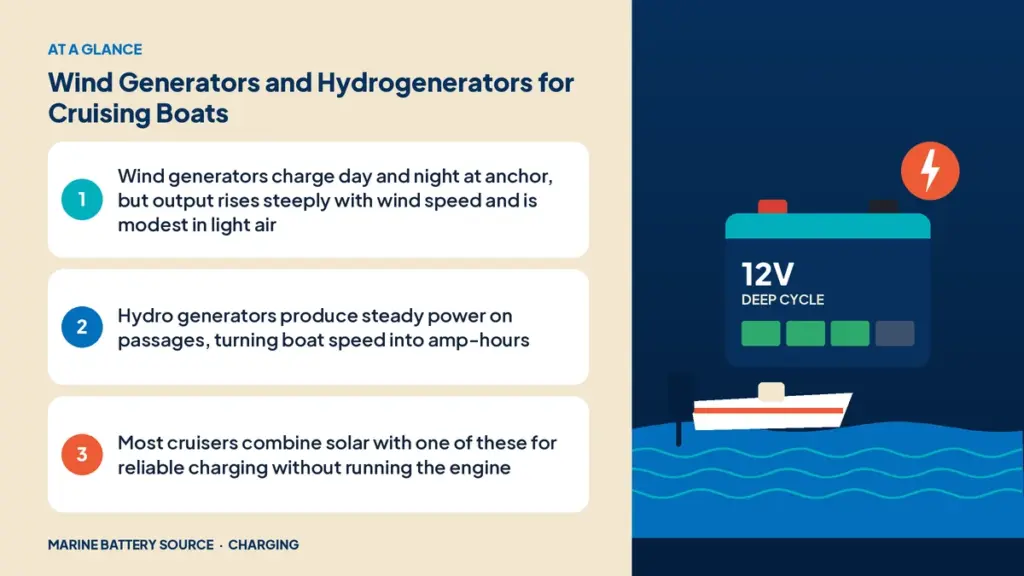
Solar is the starting point for most cruising boats, but it stops at sunset and struggles in cloudy weather. Wind generators and hydro generators fill the gaps, charging at night, in overcast conditions and on long passages. This guide explains how wind and hydro generators work for cruisers, what they really produce, and how to combine them with solar and a lithium or lead-acid house bank.
Wind generators
A marine wind generator is a small turbine, usually mounted on a stern pole or mizzen, that turns wind into electrical power. Output depends heavily on wind speed: doubling wind speed can increase available power several times over.
Typical behavior:
- Below about 6 to 8 knots of apparent wind, output is small.
- In 12 to 15 knots, a typical marine unit may produce a useful steady charge.
- In 20 knots or more, output can be substantial, and the unit must regulate or brake to protect itself.
Strengths:
- Charges day and night.
- Excellent in trade-wind anchorages and higher latitudes.
- Complements solar in cloudy weather.
Weaknesses:
- Little output in sheltered, calm anchorages.
- Noise and vibration, varying by design.
- Exposed blades require care around people and rigging.
- Less effective downwind underway, when apparent wind drops.
Hydro generators
A hydro generator mounts on the transom and lowers a propeller into the water while sailing. As the boat moves, the propeller spins a generator.
Typical behavior:
- Output rises with boat speed; at 5 to 7 knots, many units produce a strong, steady charge.
- At anchor, they produce nothing.
Strengths:
- Steady, predictable power on passages.
- Works day and night while sailing.
- Quiet.
Weaknesses:
- Adds a small amount of drag.
- Only useful underway.
- Must be raised when motoring slowly, in shallow water or at anchor.
Comparing sources
| Source | Works when | Best for |
|---|---|---|
| Solar | Daylight, unshaded | Most cruising, all latitudes in summer |
| Wind generator | Steady wind | Windy anchorages, trade winds |
| Hydro generator | Sailing at speed | Ocean passages |
| Alternator | Engine running | Backup, calm days |
See charging on the water for the full overview.
Charge controllers and regulation
Wind and hydro generators need regulators that protect batteries from overcharging and the generator from overspeeding. Many wind controllers divert excess power to a dump load or brake the turbine when batteries are full. Set regulation voltages to suit your battery chemistry. For lithium, confirm the controller supports lithium voltages and safely handles a BMS disconnect.
Solar uses its own controller; see MPPT vs PWM controllers. Set every source’s voltage so they cooperate rather than fight.
Pairing with lithium house banks
Lithium banks accept charge efficiently at any state of charge, so they make the most of intermittent wind and hydro output. Large lithium batteries like the EPOCH 12V 460Ah Essential (5.89 kWh, heated, Bluetooth) store multi-day energy. Protect the system with a Class T fuse near the bank and follow the battery maker’s charging limits.
On boats charging lithium from an engine too, see DC-DC chargers and external alternator regulators.
Sizing your charging mix
- Estimate daily use. Many cruising boats use 100Ah to 250Ah per day at 12V, driven by refrigeration, autopilot and electronics.
- Estimate solar output for your panel area and cruising grounds.
- Fill the gap with wind for anchorages or hydro for passages.
- Keep the engine as backup.
For a structured budget, see the liveaboard sailboat battery guide.
Mounting and safety
- Mount wind generators high enough that blades clear heads and rigging, with secure poles and stays.
- Add a manual brake or stop switch for storms.
- Fuse output cables near the battery or controller.
- For hydro generators, use a robust transom mount and a safe way to raise the unit.
Noise and neighbors
Some wind generators hum or whine at higher speeds, which can bother you and neighboring boats in quiet anchorages. Newer designs are quieter. Consider noise ratings and blade designs before buying.
Small boats
Wind and hydro generators make little sense on trailered fishing boats. For those, solar on a console or bimini is more practical; see solar for trolling batteries.
Example systems
- Coastal cruiser, sheltered anchorages: 400W solar; wind generator not worthwhile.
- Trade-wind cruiser: 400W to 600W solar plus a wind generator for nights and cloudy days.
- Ocean passagemaker: solar plus a hydro generator for long passages; engine as backup.
Maintenance
Wind generators need periodic checks of bearings, blades and mounting hardware. Hydro generators need their propellers inspected for fouling and damage. Check wiring and connections for corrosion on both, especially where cables enter the hull.
Lead-acid banks and renewable charging
Lead-acid house banks can work with wind and hydro generators, but they accept charge slowly above about 80% state of charge. That means a strong wind on a full-ish bank often gets diverted to the dump load rather than stored. Lead-acid banks also need regular full charges to avoid sulfation, which intermittent renewable charging may not provide. Many cruisers who add wind or hydro generators eventually upgrade to lithium for this reason. If you stay with lead-acid, sealed AGM batteries are the usual choice for house banks, and a monthly full charge from shore power or the engine helps keep them healthy.
Planning wiring runs
Wind generators are often mounted at the stern, far from the battery bank. Long cable runs at 12V lose significant power unless the cable is generously sized. Some generators offer 24V or higher output to reduce losses. Plan the cable route, size it for low voltage drop, and fuse it close to the battery or controller.
Measuring the payoff
A battery monitor shows how much each source contributes over a week. Many cruisers find that a wind generator supplies most of their power on windy nights and almost nothing in calm, protected anchorages, while a hydro generator on a long passage can cover autopilot and fridge loads entirely. Watching real numbers helps decide whether to add, move or remove a source. If you rarely anchor in wind, solar and occasional engine charging may be the better investment.
Read charging lithium batteries on a boat for lithium charging details, and browse house bank batteries in the store.
Frequently asked questions
How much power does a boat wind generator make?
It depends on wind speed. Output is small in light air and can be substantial in 15 to 20 knots.
Is a hydro generator worth it?
For long ocean passages, often yes. It provides steady charging while sailing.
Can wind generators charge lithium batteries?
Yes, with a controller that supports lithium voltages and handles BMS disconnects safely.
Should I get solar or a wind generator?
Most cruisers start with solar. Add wind if you spend time in windy anchorages or cloudy regions.