


Keeping Bait Alive: Livewell Pump Power Over a Long Day

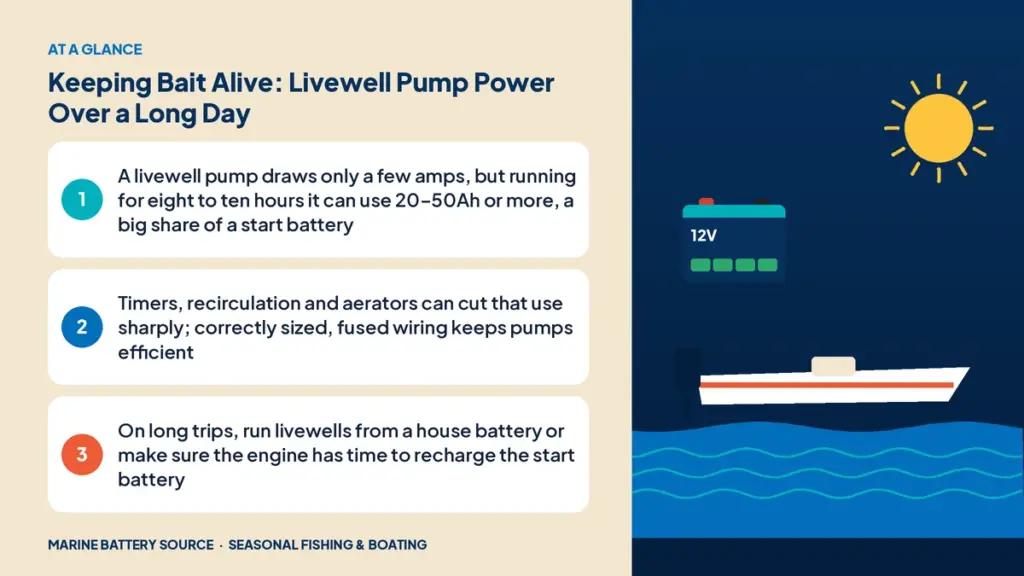
Livewells are easy to overlook in a battery plan. The pump is small, quiet and tucked away under a hatch. But for anglers who fish with live bait or keep fish for a weigh-in, the livewell may run longer than anything else on the boat. A pump that draws only 3A doesn’t sound like much until you realize it might run for ten hours straight.
This guide explains how much power livewells actually use, how to reduce it, and how to make sure your livewell doesn’t leave you with a boat that won’t start. For a detailed look at pump draw alongside bilge pumps, see livewell and bilge pump battery draw.
How much power does a livewell use?
Livewell systems usually have one or more of these:
- Fill/flow pump: pulls in fresh water from outside the boat. Common sizes draw roughly 2–5A.
- Recirculating pump: circulates and aerates water already in the well without pulling in new water. Usually similar draw.
- Aerator or spray head: adds oxygen; may be part of the pump or a separate small air pump drawing about 1–2A.
Daily energy depends on hours of use:
| Setup | Draw | Hours | Daily use |
|---|---|---|---|
| One pump, continuous | 3A | 8 | 24Ah |
| One pump, continuous, long day | 4A | 10 | 40Ah |
| Two pumps offshore, continuous | 5A each | 10 | 100Ah |
| One pump on 50% timer | 3A | 8 (4 running) | 12Ah |
| Small aerator only | 1.5A | 8 | 12Ah |
These are typical ranges; check your pump’s label or manual for its actual draw.
Why it matters for the start battery
On many boats, livewells are wired to the start battery or a single combined battery. A group 24 or 27 lead-acid battery might hold 70–90Ah. Using 30–40Ah for the livewell, plus electronics, can take it well past half charge. Add hot weather and an aging battery, and the next crank may be weak.
If the engine runs often between spots, the alternator puts some of that back. On days of drifting, anchoring or trolling with the main engine off, it doesn’t. That’s when livewells cause dead batteries.
Ways to reduce livewell power use
- Use a timer. Many livewell controls cycle the pump on and off. Running half the time cuts energy use roughly in half. How much your bait can tolerate depends on bait type, water temperature and how many baits are in the well.
- Use recirculation when appropriate. In some conditions, recirculating water already in the well works well and lets you avoid pumping in hot surface water.
- Don’t overcrowd the well. Fewer baits need less oxygen and less flow.
- Keep the water cooler. Warm water holds less oxygen. Some anglers add frozen water bottles to the well; check that this suits your bait.
- Keep intakes clean. A clogged screen or strainer makes pumps work harder and may starve them.
Tournament livewells
In bass tournaments, healthy fish at weigh-in matter, and many anglers run livewells with timers and recirculation through the day, switching to fresh water when they move to a new area. Most tournament boats power livewells from the start battery, so a long day of drifting and trolling can leave it low by weigh-in. A dedicated electronics or accessory battery takes some load off, and a healthy start battery with a good charging system handles the rest. Check your tournament’s rules on livewell operation and fish care.
Wiring livewell pumps
- Use wire sized for the pump’s current and the run length. Long runs to the stern can cause voltage drop, which slows pumps and reduces flow.
- Fuse each pump circuit close to the power source, using the size the pump maker specifies.
- Use marine-grade tinned wire and sealed connectors; livewell areas stay wet.
- Check switch panels for corrosion, which adds resistance.
Which battery should run the livewell?
- Short trips, engine running often: the start battery is usually fine if it’s healthy.
- Long days, lots of drifting or anchoring: run the livewell from a house battery, or add a dedicated accessory battery with a charging relay so starting power stays in reserve.
- Offshore with multiple pumps: livewells belong on the house bank. See offshore electronics.
Lithium house batteries suit livewell loads well. They deliver most of their rated capacity and keep pumps running at full speed as they discharge, while lead-acid voltage sags.
Multi-day trips
Keeping bait alive for several days means livewells or aerators run long hours every day. Include them in your daily energy balance; see multi-day fishing trip batteries. Overnight at a campground or anchored, a small aerator may keep bait alive while using much less than a full pump; see boat camping power.
Kicker motors and livewells
Boats that troll with a kicker motor for walleye, salmon or other species often run livewells too. A kicker’s charging output is small, so check whether it can keep up; see kicker motor batteries.
Seasonal notes
Livewells work hardest in summer, when warm water holds less oxygen and pumps run more. Check pumps, hoses and screens before the season starts. See the seasonal battery calendar and include livewells in your overall plan using fishing trip power planning.
Troubleshooting
| Symptom | Possible cause |
|---|---|
| Pump runs slowly | Low battery, voltage drop or corroded connections |
| Pump hums but no flow | Clogged intake, air lock or failed impeller |
| Fuse blows | Jammed pump, short or undersized fuse |
| Battery low after livewell use | Pump on start battery; long run time with engine off |
Products that help
- EPOCH 12V 100Ah Eco lithium battery
- Interstate group 27M AGM dual-purpose battery
- Battle Born fuse block
- Browse house batteries.
Frequently asked questions
How many amps does a livewell pump draw?
Most draw roughly 2–5A. Check the label or manual for your pump.
Can a livewell drain my boat battery?
Yes. Running for eight to ten hours, a single pump can use 20–40Ah, enough to weaken a start battery.
Should I use a livewell timer?
A timer can cut energy use substantially. How much off-time is safe depends on bait type, water temperature and how full the well is.
Which battery should power my livewell?
On short trips the start battery is fine. On long days of drifting or anchoring, use a house battery.
Why is my livewell pump running slowly?
Low battery voltage, undersized wiring, corroded connections or a clogged intake are common causes.