


Offshore Tournament Electronics: Powering Radar, Sonar and Livewells

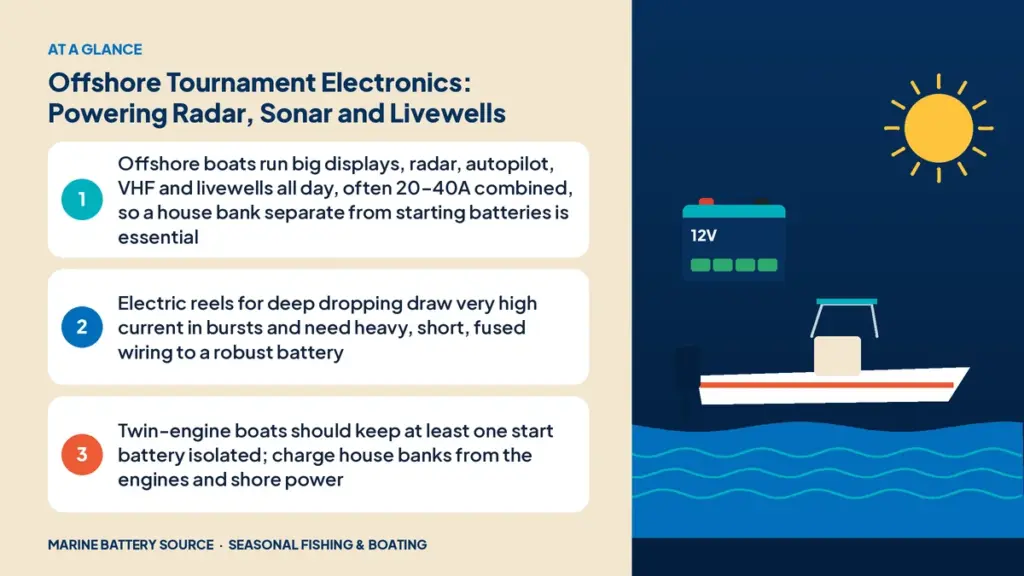
Offshore fishing puts a boat’s electrical system through a long, demanding day. Center consoles and sportfishers run large multifunction displays, radar, autopilot, VHF radios, livewells, pumps and sometimes electric reels from early morning until well after dark. Many of these run while the boat drifts or trolls slowly, when the outboards aren’t charging much. And offshore, a dead battery isn’t an inconvenience; it’s a safety problem.
This guide covers how to plan battery power for offshore electronics so you keep everything running and always have starting power for the ride home.
Typical offshore loads
| Load | Typical draw (12V) | Notes |
|---|---|---|
| Multifunction display, 12–16 in | 2–5A each | Many boats run two or three |
| Radar (open array or dome) | 3–8A | More when transmitting at long range |
| Autopilot | 2–10A+ | Varies widely with sea state |
| VHF radio | Under 1A receive, 5–6A transmit | Keep it on all day |
| Livewell pumps | 3–8A each | Often run continuously offshore |
| Raw-water washdown | 5–10A | Intermittent |
| Electric reels | Very high bursts | Deep dropping and swordfishing |
| Underwater and spreader lights | 2–10A | Night trips |
| Fridge or freezer | 3–6A while running | Cycles |
A center console running two displays, radar, autopilot and a livewell might draw 20–30A while drifting. Over ten hours, that’s 200–300Ah, far more than one start battery can supply. That’s why offshore boats need a dedicated house bank.
Separate starting from house loads
On single-engine boats, a common layout is one start battery plus a house battery or bank, with a battery switch or automatic charging relay. On twin-engine boats, each engine usually has its own start battery, and a house bank powers electronics.
Key principles:
- Never let house loads drain all start batteries. Use switches, relays or battery protectors so at least one start battery stays reserved.
- Use the engine charging system to recharge the house bank during runs, through a relay or a DC-to-DC charger (common with lithium house banks).
- Use an onboard multi-bank charger to fully recharge everything at the dock.
Sizing the house bank
Add up loads and hours as shown in fishing trip power planning. Then:
- Lead-acid: plan to use about half the rated capacity regularly.
- Lithium: plan on most of the rated capacity.
Account for engine charging during runs. A long run offshore can put back a meaningful amount, but drifting and slow trolling put back little. Many offshore anglers size the house bank to cover the whole day without counting on engine charging, so the boat stays safe if an engine is shut down.
Electric reels
Deep-drop reels for tilefish, grouper and swordfish draw very high current during a retrieve, often tens of amps or more, especially with heavy weights from deep water. Guidance:
- Follow the reel maker’s wire size, fuse and battery recommendations.
- Keep cables short and heavy to limit voltage drop; low voltage slows the reel and heats wiring.
- Use a battery that can deliver high current. Some anglers carry a dedicated reel battery.
- Fuse the circuit close to the battery.
Livewells offshore
Offshore livewells keep goggle-eyes, threadfin, pilchards or blue runners alive for hours, and the pumps often run continuously. Two pumps at 5A each for ten hours is 100Ah. See livewell pump batteries for how to plan this load.
Voltage drop and electronics
Modern displays and radars can reboot or show errors when voltage drops, especially during engine cranking. Prevent problems by:
- Using wire sized for the length and current; aim for 3% drop or less for electronics.
- Powering electronics from the house bank, not the start battery.
- Checking connections at the battery, switch and distribution panel for corrosion.
Night and overnight trips
Swordfishing, nighttime snapper and overnight canyon trips add lights and longer run times. If you’re out overnight, plan for two days of house loads or more. See night fishing lights and multi-day trips.
Safety electronics
- EPIRB and PLBs have their own internal batteries. Check expiration dates.
- VHF should stay powered all day; a handheld VHF is a good backup.
- Bilge pumps should be wired so they work even when the main switch is off, with proper fusing.
- Navigation lights must work for late returns.
Battery choices for offshore boats
- AGM batteries are sealed, handle vibration and are common as start and house batteries.
- Lithium house banks save weight and deliver more usable capacity. They need a compatible charging setup, including a lithium profile on the shore charger and often a DC-to-DC charger from the engines.
- Dual-purpose lithium batteries with high cranking ratings can serve as start batteries on some engines; check the engine maker’s battery requirements.
Secure every battery against the pounding offshore boats take. A battery that breaks loose in a head sea can damage wiring and cause a fire.
Adding electronics over time
Many offshore boats gain electronics year by year: a second display, then radar, then a bigger livewell pump, then an electric reel. Each addition may be small, but together they can outgrow a house bank and wiring that were sized for the original setup. When you add equipment, recheck the total load, the house bank’s capacity, the charging system and the size of the main feed to your distribution panel. A battery monitor makes it easy to see whether the bank still lasts the day.
Before every offshore trip
Check that every battery is fully charged, switches and relays work, connections are tight, and electronics start without errors. If a battery is weak, replace it before the trip. Season changes affect what you’ll run, so use the seasonal battery calendar. Inshore anglers who also spider rig or troll slowly face different demands; see crappie spider rigging.
Products that help
- EPOCH 12V 300Ah dual-purpose Pro lithium battery
- Interstate group 31M AGM dual-purpose battery
- EPOCH heavy-duty power distribution block
- Browse house batteries.
Frequently asked questions
How much battery do I need for offshore electronics?
Add up displays, radar, autopilot, livewells and other loads times hours. Many offshore boats need 200Ah or more per day from a dedicated house bank.
Should electronics run off the start battery offshore?
No. Use a separate house bank so starting power is always available.
How do I power an electric reel?
Follow the reel maker’s wire, fuse and battery recommendations, keep cables short and heavy, and fuse near the battery.
Do outboards charge house batteries?
They can, through a relay or DC-to-DC charger, but drifting and slow trolling put back little energy.
Is lithium good for an offshore house bank?
Yes, if the charging system supports it. Lithium gives more usable capacity and saves weight.