


Night Fishing Lights and Battery Planning
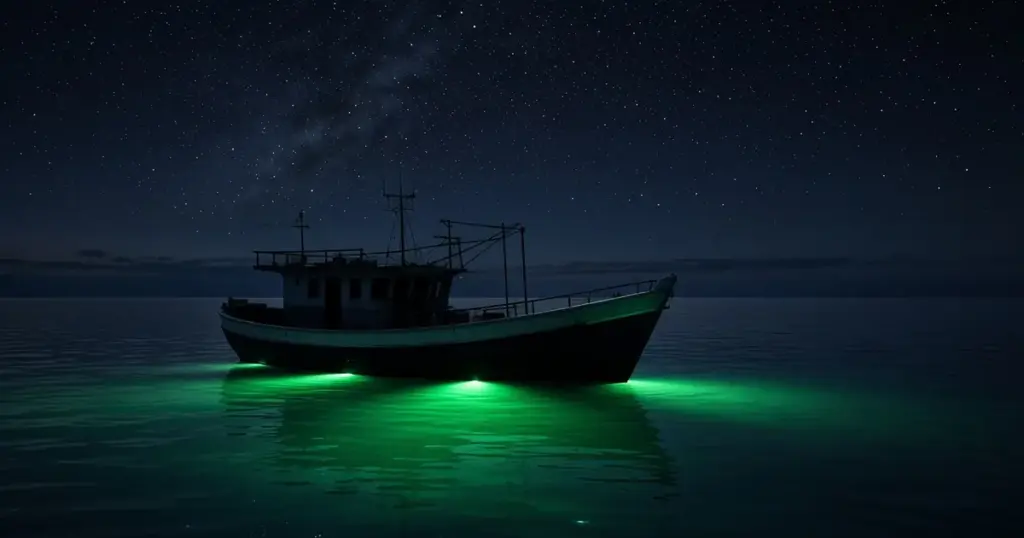
Night fishing has its own appeal: cooler temperatures, quiet water and fish that feed after dark. Crappie anglers hang lights over brush piles, snook anglers fish dock lights, and others drop green lights under the boat to draw in baitfish. All of these use power for hours, often while the engine is off. Without a plan, a night of fishing can end with a battery too weak to start the outboard.
This guide covers how to estimate the power your lights need, pick a battery for them and wire it safely.
Types of night fishing lights
| Light type | Typical draw (12V) | Notes |
|---|---|---|
| Submersible green LED | 1–5A | Popular for attracting baitfish and crappie |
| Floating LED light | 1–3A | Sits at the surface, lights the water below |
| Underwater hull-mounted LEDs | 2–10A per pair | Permanently installed on transom |
| Deck or spreader floodlights (LED) | 1–4A each | For working the deck |
| Black lights (UV) | 1–3A | Make fluorescent line easier to see |
| Navigation and anchor lights (LED) | Under 1–2A | Required between sunset and sunrise |
Older halogen and incandescent lights draw much more than LEDs. If you’re still running them, switching to LED is the easiest way to extend battery life.
Estimating your energy use
Multiply each light’s current by the hours you’ll run it. For example:
- Two submersible green lights at 3A each for six hours: 36Ah
- Anchor light at 0.5A for six hours: 3Ah
- Fishfinder at 1.5A for six hours: 9Ah
- Deck light at 2A for one hour: 2Ah
Total: about 50Ah for the night. Add a 20–30% margin, and you need about 60–65Ah usable. That’s more than a typical start battery should give while still cranking reliably.
For more on this method, see fishing trip power planning.
Choosing a battery for lights
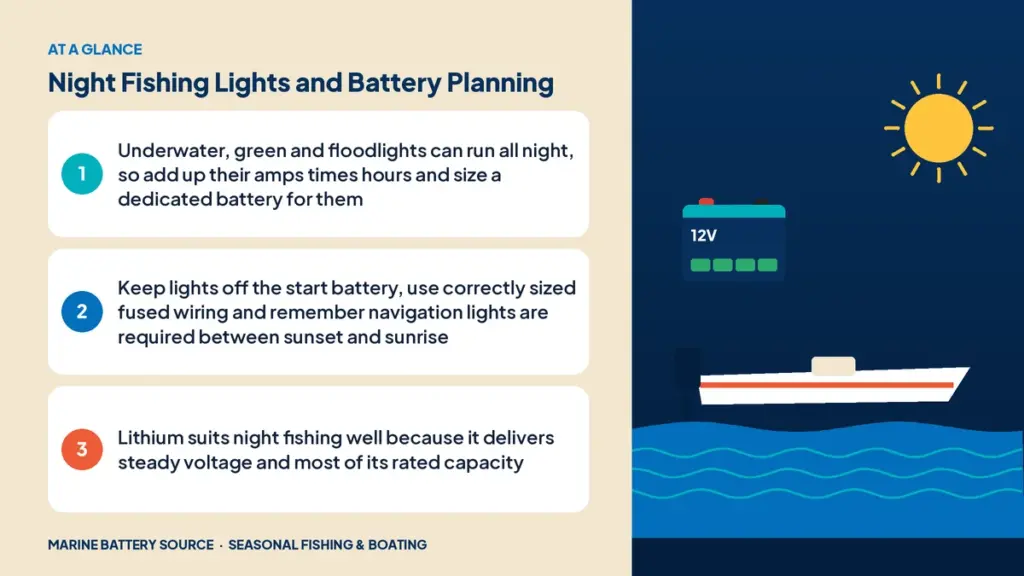
Use a separate battery. Lights should run from a house or accessory battery, not the start battery. A boat with only one battery can add a small dedicated battery for lights and electronics.
Lead-acid: Plan to use only about half the capacity regularly. A 100Ah deep-cycle AGM or flooded battery gives about 50Ah usable, just enough for the example above.
Lithium: A LiFePO4 battery delivers most of its rated capacity and holds a steady voltage, so lights stay bright until the battery is nearly empty. A 60–100Ah lithium battery would cover the example comfortably, at less weight. For small boats and kayaks, a 10–30Ah lithium battery can run a couple of LED lights for a night.
In winter, cold reduces lead-acid capacity, and unheated lithium shouldn’t be charged below freezing. In Florida this rarely matters, but it does for night anglers farther north.
Wiring lights safely
- Fuse every circuit close to the battery, sized for the wire.
- Use marine-grade tinned wire sized for the current and length to keep voltage drop low.
- Use waterproof connectors for lights that go in the water.
- Keep clamps off the battery terminals if you can; a proper accessory panel or fused terminal block is safer and more reliable than alligator clips.
- Secure the battery so it can’t slide or tip.
Portable setups for small boats and kayaks
Not every night angler has a boat with a house battery. Jon boats, kayaks and small skiffs often use a portable setup: a small lithium battery in a waterproof box with a fused output, a couple of LED lights and a fishfinder. A 20–30Ah lithium battery weighs only a few pounds and can run a pair of low-draw LED lights through a typical evening. Mark the box clearly, keep it secured so it can’t slide overboard, and charge it with a charger that has a lithium profile. A portable box also makes it easy to take the battery home to charge between trips.
Bugs, heat and running time
On warm summer nights, bright lights attract insects as well as fish. Some anglers run lights only part of the time, switching them on once they’re anchored and settled, to save power and reduce bugs. Planning your night so the lights aren’t running while you travel, set up or eat can cut energy use noticeably.
Navigation lights are not optional
Boats underway or at anchor between sunset and sunrise must show the navigation lights required for their size and type. An anchored boat generally needs an all-round white anchor light. Bright fishing lights don’t replace navigation lights and can make it harder for others to see them. Check the rules for your boat and waters.
Keeping starting power
The worst outcome of a night trip is a boat that won’t start in the dark. To avoid it:
- Keep the start battery isolated with a battery switch or charging relay while fishing.
- Check state of charge before you leave the dock.
- Carry a portable jump pack.
- Run the engine long enough on the way back to recharge, or plan to charge at home.
Night fishing styles
- Crappie under lights: Lights hang over brush piles or bridge pilings for hours. Many anglers also spider rig. See crappie spider rigging.
- Offshore and nearshore night trips: Swordfish, snapper and squid trips combine lights with big electronics and livewells. See offshore electronics.
- Bass at night: Summer night tournaments mean trolling motors and lights together. See bass tournament planning.
After the trip
Charge the light battery as soon as you’re home. Lead-acid batteries left partly discharged lose capacity, especially in hot weather. Rinse submersible lights and their connectors with fresh water and let them dry before storing.
Before the next trip, use the pre-trip battery check to confirm everything works. Night fishing is seasonal in many areas; see the seasonal battery calendar for maintenance timing.
Products that help
- Battle Born 30Ah 12V lithium battery
- EPOCH 12V 100Ah Eco lithium battery
- Battle Born fuse block
- Browse lithium batteries.
Frequently asked questions
What battery do I need for night fishing lights?
Add up each light’s amps times hours, add a margin, and pick a house battery with that much usable capacity. Don’t run lights from the start battery.
How long will a 100Ah battery run fishing lights?
A 100Ah lithium battery can run about 6A of lights for well over 12 hours. A 100Ah lead-acid battery gives about half that for good battery life.
Are green fishing lights hard on batteries?
LED green lights draw only a few amps each, but running them all night adds up.
Can I clip lights directly to my battery?
It’s better to use a fused accessory panel or terminal block. Every circuit should be fused near the battery.
Do I still need navigation lights if I have fishing lights?
Yes. Fishing lights don’t replace the navigation and anchor lights required between sunset and sunrise.