


Kicker Motors and Trolling: Battery Considerations
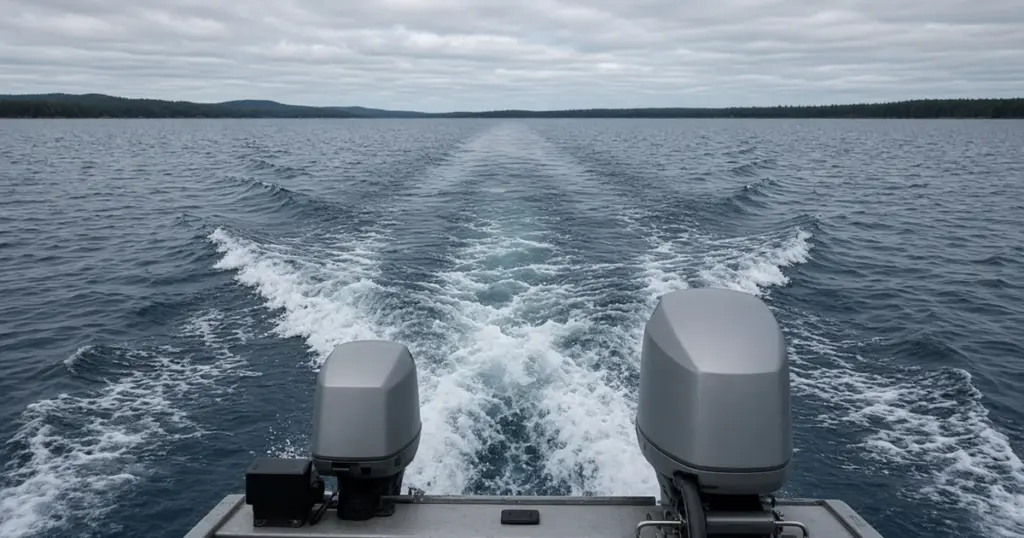
A kicker motor is a small outboard, usually around 8 to 25 horsepower, mounted beside the main engine. Anglers use kickers to troll at slow, steady speeds for walleye, salmon, trout and other species, and many boaters keep one as a backup to get home if the main engine fails. Whether it’s for trolling or emergencies, a kicker is only useful if it starts when you need it. This guide covers how to choose and wire a battery for a kicker motor.
Does a kicker need its own battery?
It depends on how the kicker starts and how the boat is wired:
- Pull-start kickers don’t need a battery to start. Some still have a small charging circuit that can help charge a battery.
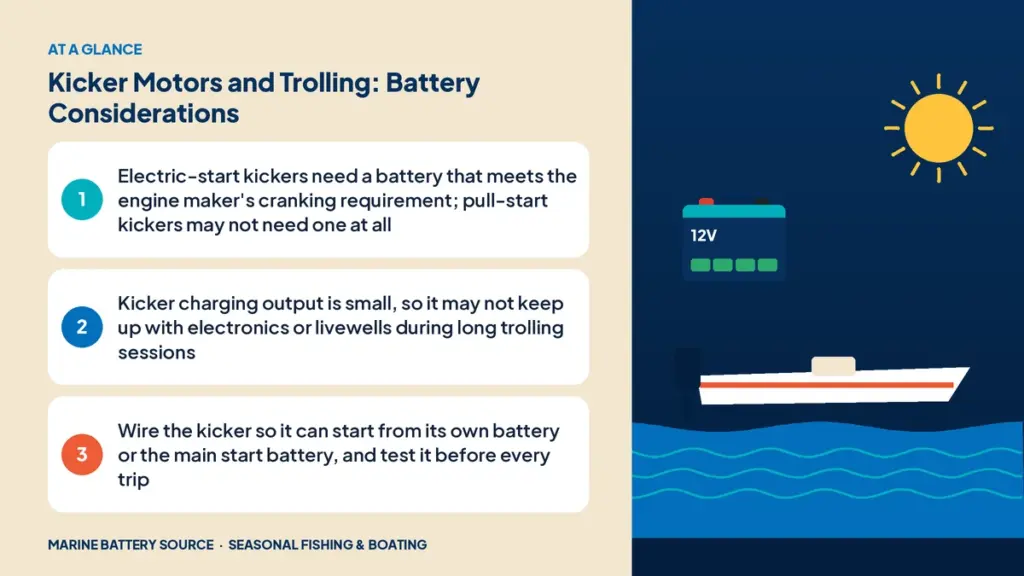
- Electric-start kickers need a battery that can crank them. They draw much less than a large outboard, but still need a battery that meets the engine maker’s minimum cranking rating.
- Shared battery: many boats wire the kicker to the main start battery or to a battery switch that can select either battery.
- Dedicated battery: some anglers give the kicker its own small start battery so it can always start, even if the main battery is drained.
As a backup motor, a kicker is most valuable when it doesn’t depend on the same battery as the main engine. If one battery fails, the other engine can still start.
Choosing a battery
Check the kicker’s owner’s manual for the minimum cranking amps (CCA or MCA) and recommended battery size. Then consider:
- Dual-purpose lead-acid or AGM: affordable and widely available; a group 24 is common.
- Lithium dual-purpose: much lighter, holds charge longer in storage and keeps voltage steady. Some small lithium batteries rated for cranking work well for kickers; confirm the CCA rating meets the engine’s requirement and that the kicker’s charging system is compatible.
- Space and weight: kickers are mounted at the transom, often on boats already heavy in the stern. A lighter battery helps.
Never use a deep-cycle-only battery that isn’t rated for cranking unless the engine maker allows it.
Kicker charging output
Most kickers have a small charging system, often only a few amps, and some have none. That’s enough to replace the energy used for starting but not much more. During hours of trolling, electronics, livewells and downriggers can use more than the kicker puts back. Plan for this:
- Don’t count on the kicker to keep the house battery full.
- Run electronics and livewells from a house battery sized for the day; see livewell pump batteries.
- Check the kicker’s charging output in the manual before you add loads.
For the full method of estimating loads, see fishing trip power planning.
Wiring options
| Setup | Pros | Cons |
|---|---|---|
| Kicker on main start battery | Simple, one battery | Both engines depend on one battery |
| Battery switch selects either battery | Flexibility; backup starting | Must remember switch position |
| Dedicated kicker battery | Kicker always starts | Extra weight and charging needs |
| Charging relay between batteries | Both charge automatically | More components to install |
Whatever the setup:
- Use cable sized for the kicker’s starter current and run length.
- Fuse according to the engine maker’s instructions and ABYC practice.
- Use marine-grade tinned cable and sealed terminals.
- Secure the battery in a box or tray so it can’t move.
If you’re unsure about wiring, have a qualified marine technician do it. From Venice to Gainesville, our team offers flat-price installation from $99 per battery. See battery setup by boat type for common layouts.
Trolling with a kicker
Kicker trolling is common on big lakes and rivers for walleye, and on coastal waters for salmon and trout. A typical day includes hours at a steady low speed with electronics, downriggers or planer boards, and sometimes a livewell. Electric downriggers in particular draw high current when they raise weights, and they often run from the main start battery or a house battery. Because the kicker’s charging output is small, a long trolling session can slowly drain the battery even while the kicker is running. A battery monitor or a quick voltage check after the engine has been off for a while tells you whether you’re keeping up.
Charging the kicker battery
If the kicker has its own battery, it needs charging too:
- Add a bank to your onboard charger, or use a multi-bank charger.
- A charging relay can charge it from the main engine when it runs.
- On multi-day trips, include it in your nightly charging routine; see multi-day fishing trip batteries.
Using the kicker as a backup
A kicker is a get-home motor only if it works. To keep it ready:
- Start and run it regularly, even if you don’t troll with it.
- Keep fresh fuel and check the fuel line.
- Test the battery and starting system before every trip; see the pre-trip battery check.
- Know how to switch batteries quickly if the main battery is dead.
- Carry a jump pack as a further backup; see jump starters and emergency starting.
Kickers on camping and long trips
Kickers are popular on boats used for camping and long trips because they provide backup propulsion and quiet trolling. Overnight loads and camping gear add to the battery plan; see boat camping power.
Seasonal maintenance
Before the season, charge and load test the kicker battery, clean terminals and check cables. In storage, keep it charged with a maintainer or disconnect it. Use the seasonal battery calendar for timing.
Products that help
- Dakota Lithium 12V 25Ah dual-purpose battery
- Interstate group 24M dual-purpose battery
- EPOCH 4-bank 12V charger
- Browse dual-purpose batteries.
Frequently asked questions
What size battery does a kicker motor need?
Check the owner’s manual for the minimum cranking rating. Many electric-start kickers use a group 24 dual-purpose battery or a small lithium battery rated for cranking.
Can a kicker motor charge my batteries?
Most have a small charging output, enough to replace starting energy but not to keep up with electronics and livewells.
Should my kicker have its own battery?
A separate battery makes the kicker a more reliable backup, because it can start even if the main battery is drained.
Can I use lithium for a kicker motor?
Often yes, if the battery meets the engine’s cranking requirement and its charging system is compatible. Check the engine maker’s guidance.
Does a pull-start kicker need a battery?
Not to start, but it may have a charging circuit, and you may still want power for electronics.