


Upgrading a 36V Trolling Motor Bank from Lead-Acid to Lithium
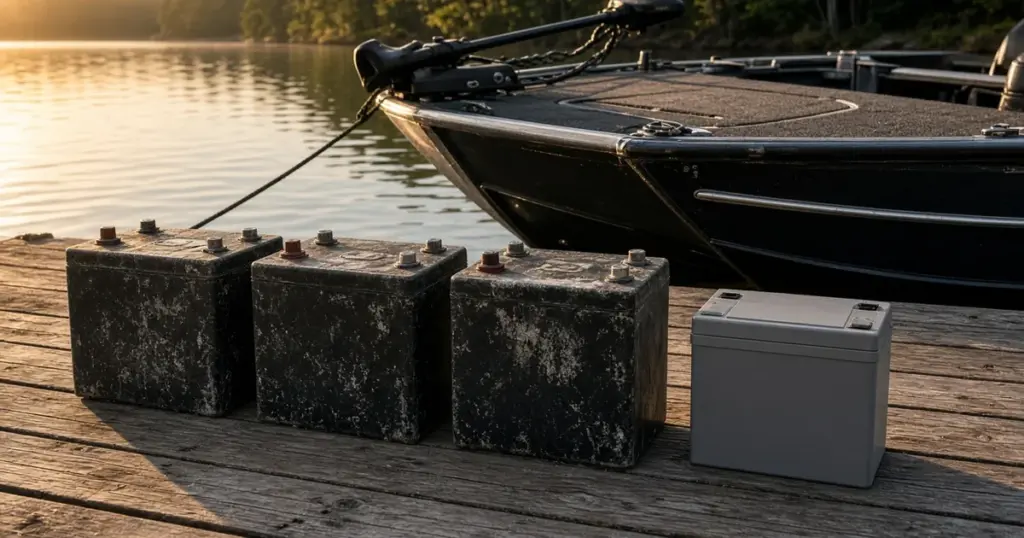
A 36V trolling motor running on three lead-acid batteries is one of the most common setups on bass, walleye and bay boats, and one of the most rewarding to upgrade. Converting a 36V trolling bank from lead-acid to lithium can remove well over 100 lb from the stern, deliver steady voltage all day and free up space. This guide covers the decisions, the parts, and the installation steps.
Before you start: what changes
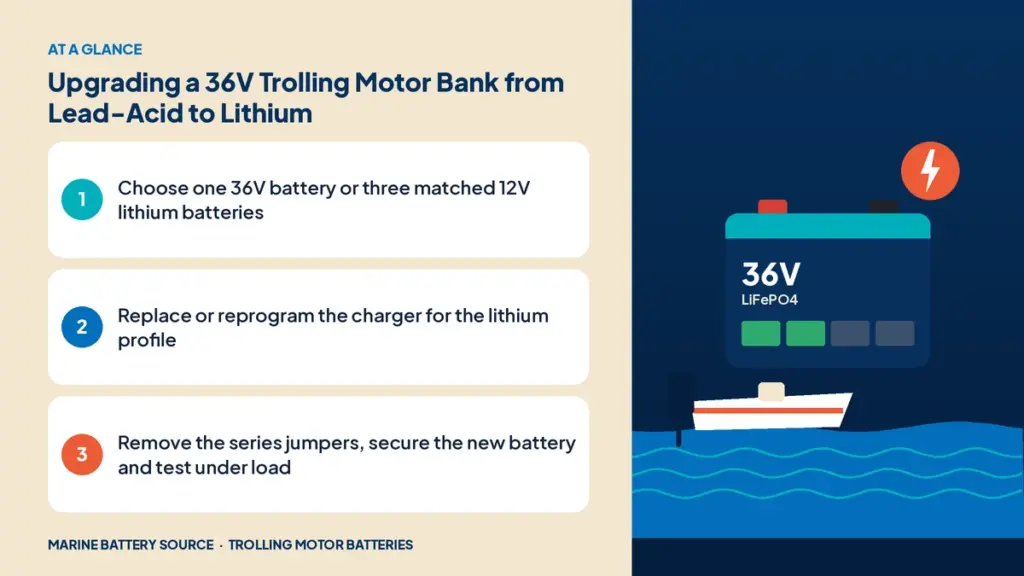
- Batteries. Three 12V lead-acid batteries become either one 36V lithium battery or three matched 12V lithium batteries.
- Charger. Most existing three-bank chargers were set for lead-acid. You’ll need a lithium profile, and possibly a new charger.
- Wiring. A single 36V battery eliminates the two series jumpers.
- Mounting. New battery sizes may need new trays or hold-downs.
- Monitoring. Many lithium batteries offer Bluetooth state of charge.
Step 1: Measure your current setup
Record how long you fish, how hard you run the motor and whether you spend long periods on GPS anchor. If you have a battery monitor, note how deep you typically discharge. This tells you how much lithium capacity you need. Lithium can be used much more deeply than lead-acid, so a smaller rated capacity often matches or beats your old bank.
As a rough comparison: three lead-acid batteries rated around 100Ah at the 20-hour rate give about 50Ah of usable capacity at 36V when you plan for 50% depth of discharge. A 36V 50Ah to 60Ah lithium battery used to around 80% gives a similar or larger usable figure, and it holds voltage more steadily.
Step 2: One battery or three?
One 36V battery
Simplest wiring and least weight. Examples in the store:
- EPOCH 36V 50Ah Essential: 1.92 kWh in a Group 31 size, 35 lb, with Bluetooth and heating.
- Interstate Li31M 36V 50Ah: a Group 31M case with a 60-month free-replacement period listed.
- The EPOCH 36V 100Ah, listed at 3.84 kWh and 75 lb, for long days or heavy anchoring.
- Lithium Rhino 36V 65Ah conversion kit: an IP67-rated kit sold for exactly this kind of upgrade, with Bluetooth and an 8-year warranty listed.
Three 12V lithium batteries
Keeps the existing three-bank layout. You can often reuse the multi-bank charger if it has a lithium profile. Use three identical batteries of the same model and age.
Our comparison of one 24V battery vs two 12V batteries explains the trade-offs, which scale directly to 36V.
Step 3: Plan the charger
| Battery choice | Charger options |
|---|---|
| One 36V lithium battery | A 36V lithium charger, such as the EPOCH 36V 15A or Allied Lithium 36V 15A, or a multi-voltage charger like the EPOCH 12V-36V onboard charger |
| Three 12V lithium batteries | A three- or four-bank charger with a lithium profile matching the battery maker’s voltages |
If you charge on the water, the EPOCH 12V-to-36V DC-DC charger can top up a 36V lithium bank from the outboard’s charging system. The details are in our guide on charging trolling motor batteries.
Step 4: Check discharge ratings
The lithium battery’s maximum continuous discharge rating must exceed the motor’s maximum current draw. Check the motor’s manual and the battery’s spec sheet. If the motor draws more than the battery’s BMS allows, the BMS may shut the battery off under heavy load.
Step 5: Remove the old bank
- Turn off the trolling motor breaker and disconnect the charger from shore power.
- Photograph the existing wiring for reference.
- Disconnect the motor leads, then the series jumpers, then the charger leads.
- Remove the hold-downs and lift out the batteries. Lead-acid batteries are heavy; lift carefully.
- Take the old batteries to a recycler or retailer that accepts them. Lead-acid batteries are widely recycled.
Step 6: Install the new battery
- Fit a tray or bracket sized for the new battery and fasten it securely.
- Secure the battery with a strap or hold-down.
- Connect the motor positive through the breaker to the battery positive, and the motor negative to the battery negative.
- Connect the new charger leads per the charger maker’s instructions, fused as required.
- Cover the terminals.
Our 24V and 36V wiring guide covers the three-battery layout if you’re keeping 12V batteries.
Step 7: Electronics and 12V accessories
If any 12V accessories were tapped from one of the old batteries, they need a new home. Options include a dedicated 12V battery or a 36V-to-12V converter. See running electronics off the trolling battery.
Step 8: Rebalance the boat
Removing well over 100 lb from the stern changes trim. Test the boat with a typical load and see whether you want to shift other gear. Our guide to battery placement and weight distribution helps.
Step 9: Test under load
- Charge the new battery fully before the first trip.
- Run the motor at high speed for several minutes and check the plug, breaker and connections for warmth.
- Check voltage at the motor and battery under load. A large difference means wiring losses.
- Confirm the Bluetooth app or monitor shows state of charge correctly.
What results to expect
Most owners notice steady thrust through the day, less weight in the stern and shorter charge times. Runtime improvements depend on the capacity you choose and how you fish. For more ways to stretch the day, read 12 ways to extend trolling motor run time.
Common mistakes
- Keeping a lead-acid charger profile.
- Buying a battery with too low a continuous discharge rating.
- Forgetting to relocate tapped 12V accessories.
- Mixing lithium batteries of different makes or ages in a series string.
- Leaving the battery loose in an oversized compartment.
For the bigger picture, see our trolling motor power system guide and our pillar on choosing a trolling motor battery. Browse trolling motor batteries for more 36V options.
Frequently asked questions
Can I replace three 12V lead-acid batteries with one 36V lithium battery?
Yes. A single 36V lithium battery replaces a three-battery series bank, provided its discharge rating covers your motor and you use a 36V lithium charger.
Do I need a new charger when switching to lithium?
Usually. A single 36V battery needs a 36V charger, and three 12V lithium batteries need a multi-bank charger with a lithium profile matching the maker’s voltages.
How much weight will I save converting 36V to lithium?
Three Group 27 or 31 lead-acid batteries can weigh close to 200 lb. A single 36V 50Ah to 60Ah lithium battery is listed at 35 to 44 lb, so savings can exceed 100 lb.
What capacity 36V lithium battery do I need?
Base it on your usage. Many anglers replacing three 100Ah lead-acid batteries choose 50Ah to 60Ah lithium for similar usable capacity, or 100Ah or more for long days and heavy GPS anchoring.