


Battery Placement and Weight Distribution for Trolling Motor Banks
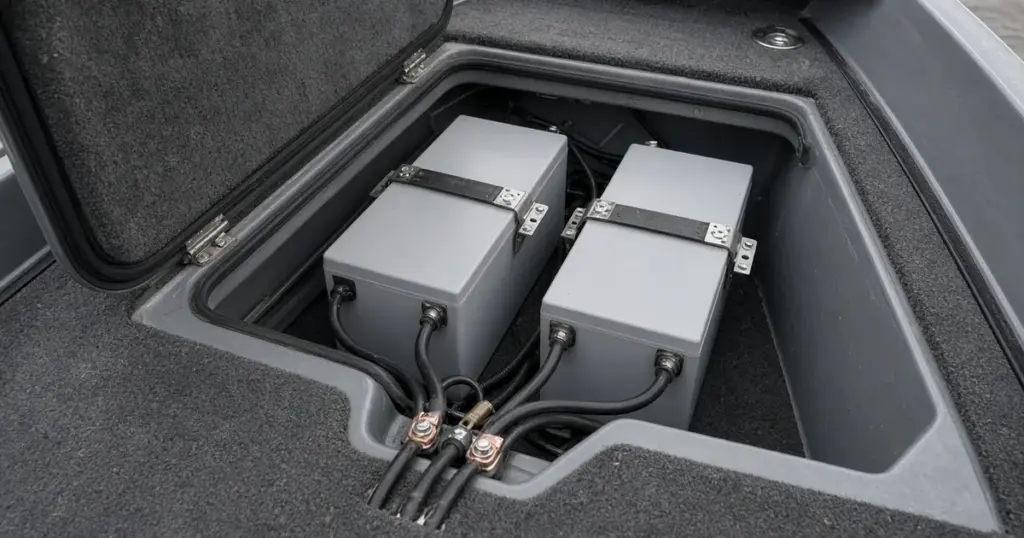
Where your trolling motor batteries sit affects much more than cable length. On a small or mid-size boat, two or three batteries can be one of the heaviest items aboard after the engine, fuel and people. Their location changes how the boat trims, how quickly it gets on plane, how it handles wind at the bow and how much strain the hull and mounts take in rough water. This guide covers trolling motor battery placement and weight distribution, with practical layouts for common boats.
Why placement matters
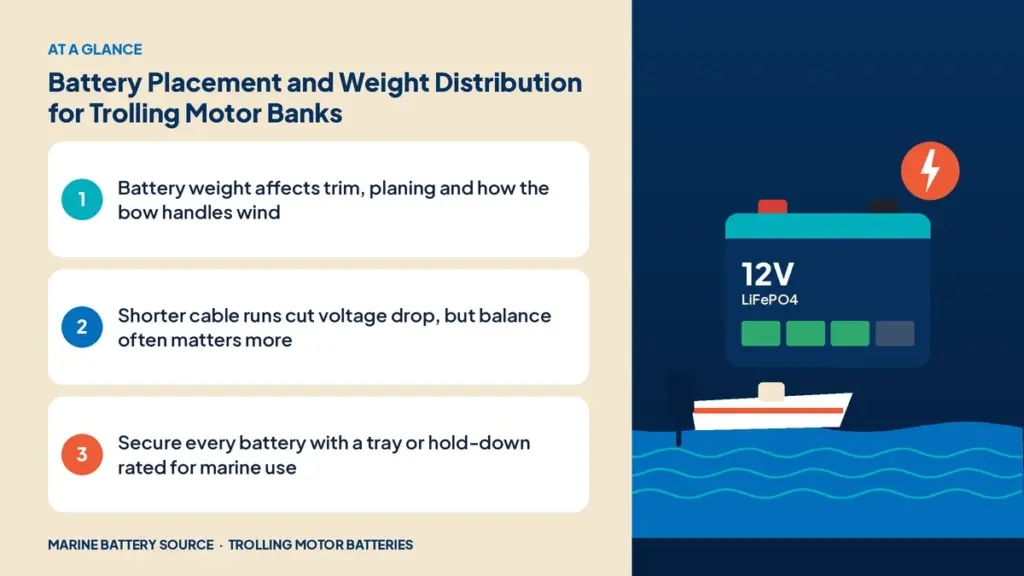
- Trim and planing. Weight far aft pushes the stern down and can make the boat slower to plane. Weight forward can make the bow plow.
- Handling. A heavy bow resists wind better when you’re on the trolling motor, but may ride wetter under power.
- Side-to-side balance. Batteries on one side cause a list, especially on narrow hulls.
- Voltage drop. Longer cable runs lose more voltage at the motor.
- Safety and access. Batteries need to be secure, ventilated where required and reachable for inspection.
How much weight are we talking about?
Lead-acid trolling banks are heavy. Deep-cycle AGM batteries in Group 27 or 31 commonly weigh 60 to 70 lb each; the store lists the Trojan 31-AES at 69 lb. A three-battery 36V bank can approach 200 lb.
Lithium changes the math. The Dakota Lithium 36V 60Ah is listed at 44 lb in a Group 31 size, and the EPOCH 36V 50Ah Essential at 35 lb. The 12V EPOCH 100Ah Eco is listed at 21 lb. Removing well over 100 lb from the stern of a bass boat makes a noticeable difference in how it rides. If you’re converting, see our 36V lithium conversion guide.
Common layouts
Bass boats
Bass boats usually carry the trolling bank in a rear compartment, along with the starting battery and onboard charger. The cable to the bow motor is long, so builders use heavy gauge wire. Switching to lithium in the same location is the easiest upgrade; the weight saving at the stern often helps holeshot and top speed.
Bay and flats boats
These boats often have batteries in a console or forward compartment. Weight forward helps the bow stay down when running into a chop but can affect poling draft. Lithium’s weight savings matter most here.
Pontoons
Pontoons are less sensitive to battery weight, but long cable runs from the stern to a bow-mounted trolling motor are common. Consider placing the trolling bank forward in a dedicated box to shorten the run.
Jon boats and small aluminum boats
On small boats, a single battery placed near the center line and slightly forward of the transom improves balance. Move it to trim the boat for your typical load.
Cable length vs balance
Moving the bank closer to a bow-mount motor shortens the cable and reduces voltage drop. But moving 200 lb of lead-acid forward can change the boat’s balance in ways you don’t want. In many cases, the better solution is to leave the batteries where the builder designed them and size the cable correctly. Our wire size and breaker guide shows how.
With lithium, weight is low enough that you have more freedom to place batteries where cable runs are shortest.
Securing the batteries
Batteries must be held firmly so they cannot shift, even in a hard pounding or a sudden stop. Good practice includes:
- A battery tray or box fastened to the hull or a stringer.
- Straps or brackets rated for the battery’s weight.
- Terminals covered so a dropped tool or shifting gear can’t short them.
The store carries trays and brackets such as the Dakota Lithium Group 24 marine battery tray and EPOCH trays sized for its batteries.
Ventilation and heat
Flooded lead-acid batteries vent hydrogen when charging and need ventilated compartments. AGM batteries vent very little in normal use but should not be sealed in airtight boxes. Lithium batteries don’t vent gas in normal operation, but all batteries last longer when they stay cool. Avoid placing a bank next to the engine or in direct sun.
Accessibility
You’ll need to reach the batteries to check terminals, connect chargers and run diagnostics. Leave enough clearance above the terminals to use a wrench and a multimeter. Plan routing for charger leads too; our guide on charging trolling motor batteries covers onboard charger installation.
Adding an electronics battery
Many anglers add a dedicated battery for graphs and sonar. Place it where it balances the trolling bank, and keep its wiring separate from the trolling motor leads to reduce interference. Our guide to running electronics off the trolling battery explains why a separate battery often works better.
Placement and GPS anchoring
A boat that holds bow-into-wind on GPS anchor benefits from a bow that isn’t too light. If you’ve removed a lot of weight from the stern with lithium, the boat may hold differently. Read how GPS anchoring affects battery drain for more.
Test before you drill
Before you commit to a new layout, test it. Set the batteries in their planned positions temporarily, secured so they can’t slide, and take the boat out with a typical load. Note:
- How quickly the boat gets on plane.
- Whether it lists to one side at rest or under way.
- How the bow behaves running into a chop.
- How the boat holds into the wind on the trolling motor.
Small changes, such as moving a battery a foot forward or across the center line, can make a noticeable difference on light hulls. Once you’re happy, mark the positions and install permanent trays and hold-downs.
Placement checklist
- Weigh the options: builder’s location versus shorter cable runs.
- Check the boat’s trim with typical load and fuel.
- Keep the bank centered side to side.
- Mount trays securely and use hold-downs.
- Provide ventilation appropriate to the chemistry.
- Leave access for charging and inspection.
- Size cable for the final run length.
For the system overview, read our trolling motor power system guide, and for picking the battery itself see how to choose a trolling motor battery. Browse trolling motor batteries and trays and accessories.
Frequently asked questions
Where should trolling motor batteries go on a boat?
Usually in the location the builder designed, often a rear compartment on bass boats. Keep them secure, centered side to side, ventilated as needed and accessible.
Does battery weight affect boat performance?
Yes. Heavy batteries far aft can slow planing and change trim. Switching to lithium can remove substantial weight.
Should I move my batteries closer to the trolling motor?
Shorter runs reduce voltage drop, but moving heavy lead-acid batteries can upset balance. Often it’s better to keep the location and use heavier cable.
Do lithium batteries need ventilation?
They don’t vent gas in normal use, but keeping them cool helps them last. Follow the battery maker’s installation guidance.