


How to Charge Trolling Motor Batteries (12V, 24V and 36V)
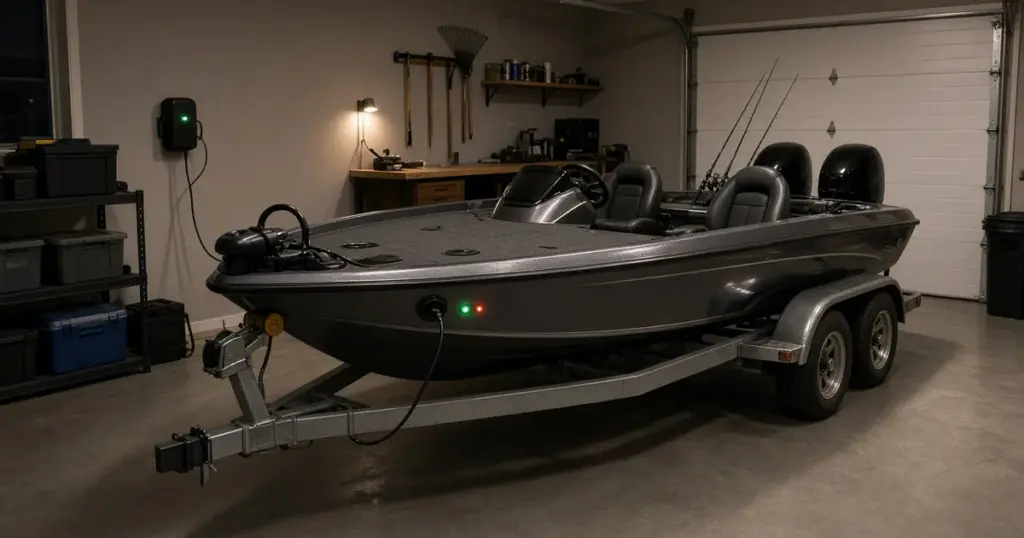
Charging is where trolling motor batteries are made or ruined. A good charging routine gives you full capacity every morning and years of service. A poor one leaves lead-acid batteries sulfated and series strings out of balance. This guide explains how to charge trolling motor batteries at 12V, 24V and 36V, how to pick a charger, and how long charging should take.
The golden rules
- Match the charger to the chemistry. Lithium, AGM and flooded batteries need different voltages.
- Charge each 12V battery in a series bank individually, or charge a single-case battery with a charger of matching voltage.
- Recharge after every trip, especially lead-acid.
- Let the charger finish. A partial charge is better than none, but a full charge keeps the bank healthy.
Charging a 12V trolling battery
A single 12V battery is the simplest case. Any quality marine charger with the correct profile works. An onboard charger is the most convenient, since you plug the boat into shore power and walk away. For a 100Ah battery, a 10A charger refills a fully used battery in roughly ten hours, while a 20A or larger charger shortens that significantly. The EPOCH 12V 15A lithium charger and the EPOCH 12V 50A lithium charger are examples at the low and high end of current.
Charging 24V and 36V series banks
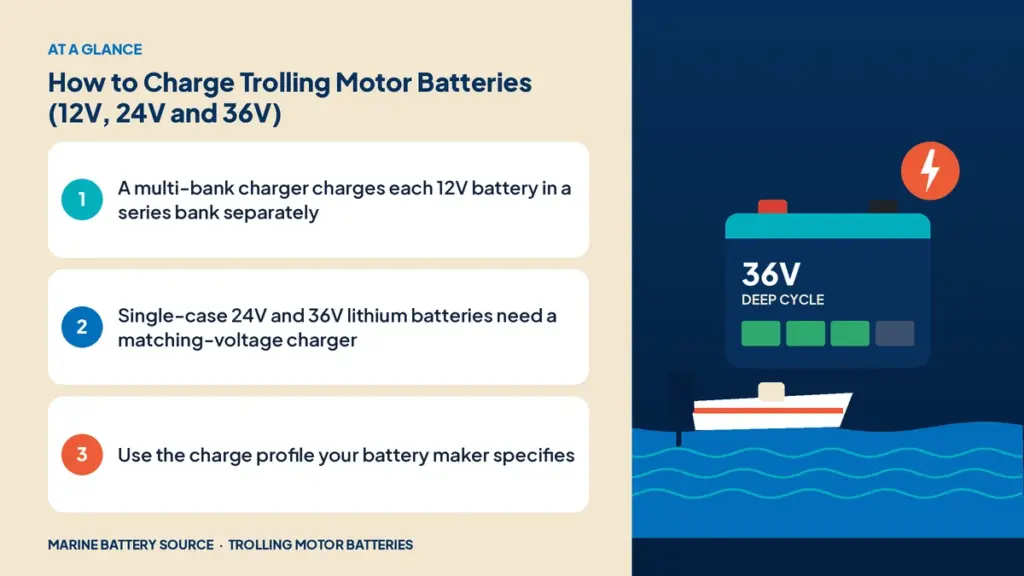
When a 24V or 36V system is built from two or three 12V batteries, the standard approach is a multi-bank onboard charger with one output per battery. Each output treats its battery as a separate 12V battery, which:
- Keeps every battery fully charged even if they discharge slightly differently.
- Avoids the imbalance that builds up when you charge a string only at its full voltage.
- Lets the charger detect a problem with one battery.
The store’s EPOCH 4-bank charger provides 10A per bank, enough for a 36V trolling bank plus a starting battery. Each output’s negative lead goes to its own battery’s negative terminal, and the positive to its positive, per the charger maker’s instructions.
Charging single-case 24V and 36V lithium batteries
A single-case 24V or 36V lithium battery has only two terminals. It needs a charger whose output voltage and profile match it:
- 24V: options include the EPOCH 24V 15A and Dakota Lithium 24V 10A lithium chargers.
- 36V: options include the EPOCH 36V 15A and the Allied Lithium 36V 15A waterproof charger.
- Multi-voltage: the EPOCH 12V-36V onboard charger is designed to support several system voltages.
An existing multi-bank 12V charger cannot charge a single 36V battery correctly. When you upgrade from three lead-acid batteries to one lithium battery, plan for a new charger. Our guide to converting a 36V bank to lithium covers that change step by step.
Lithium vs lead-acid charge profiles
| Lithium (LiFePO4) | AGM | Flooded | |
|---|---|---|---|
| Typical stages | Constant current, then constant voltage | Bulk, absorption, float | Bulk, absorption, float, occasional equalize |
| Float | Not needed; many makers prefer none or low | Yes | Yes |
| Equalization | Never | Generally no unless maker allows | Periodically, per maker |
| Charge acceptance | High, fast | Moderate | Moderate |
| Cold charging | Not below about 32°F unless heated | Possible | Possible |
Always use the battery maker’s recommended voltages. A charger with a generic “lithium” mode may or may not match, so check the numbers.
How long does charging take?
Estimate charge time by dividing the amp-hours you used by the charger current, then add time for the final stage.
- Lithium: charges efficiently, so most of the energy goes back in at the full charger rate. 80Ah used with a 15A charger is roughly five to six hours.
- Lead-acid: the absorption stage tapers slowly, so the last 20% takes a disproportionately long time. Allow overnight.
For a series bank on a multi-bank charger, each battery charges at the per-bank rate simultaneously, so a 10A-per-bank charger refills a 36V bank’s three batteries at 10A each.
Charging on the water
A DC-DC charger lets your outboard charge the trolling bank while you run. The EPOCH 12V-to-36V DC-DC charger is designed for this. It takes power from the engine’s 12V system and charges the trolling bank at the correct voltage while protecting the starting battery. Charge rates are modest compared with shore power, so think of it as a top-up during long runs. Our trolling motor power system guide explains how it fits with the rest of the wiring.
Common charging mistakes
- Using an automotive charger without the correct marine or lithium profile.
- Charging a series string at full voltage with a single-output charger meant for 12V batteries.
- Leaving lead-acid batteries discharged for days after a trip.
- Charging lithium below freezing without a heated battery.
- Corroded charger leads or loose ring terminals. Check them each season, along with the trolling motor plug and receptacle.
Charging and battery placement
Charger leads should be sized and fused per the charger maker’s instructions. Mount the onboard charger where it stays dry and gets airflow, and keep leads as short as practical. If your batteries sit in different compartments, plan lead routing before you mount anything; our battery placement guide helps with layout.
Does charging habit affect run time?
Absolutely. A lead-acid bank that never quite reaches full charge loses capacity season after season. A properly charged lithium bank gives you the same capacity every trip. If you’re always running out before the day ends, start by checking charging, then read how spot-lock affects battery drain and our wire sizing guide.
A simple post-trip routine
- Trailer or dock the boat and switch off the trolling motor breaker.
- Connect shore power to the onboard charger.
- Confirm each bank’s indicator shows charging.
- Leave it until all banks show complete.
- For lithium, disconnect or leave on maintenance per the maker’s guidance.
Read our pillar guide on choosing a trolling motor battery for sizing, and browse all battery chargers in the store.
Frequently asked questions
Can I charge two 12V trolling batteries in series with a 24V charger?
It works electrically, but a two-bank charger that charges each battery individually is the better practice because it keeps the batteries balanced.
How long does it take to charge a 36V trolling motor battery?
Divide the amp-hours used by the charger current, then add time for the final stage. A 50Ah 36V lithium battery fully used, on a 15A charger, needs roughly three and a half to four hours.
Can I use my old lead-acid charger on lithium batteries?
Only if it offers a lithium profile whose voltages match the battery maker’s specs. Many older chargers don’t, and a float or equalize stage can be inappropriate for lithium.
Should I leave my trolling motor batteries on the charger?
Lead-acid batteries benefit from a float or maintenance mode. For lithium, follow the battery maker’s recommendation; many advise against holding the battery at full voltage indefinitely.