


Generator vs Big Lithium Bank: Rethinking Onboard Power

For decades, cruising boats that needed real AC power carried a generator. Large lithium banks and inverter/chargers have changed that equation. Some owners now run for days with little or no generator time, and some smaller boats skip the generator entirely. This guide compares a boat generator vs a lithium bank and explains how hybrid systems work.
What each approach does well
Generators
- Supply large amounts of AC power on demand, including air conditioning and electric cooking.
- Recharge batteries quickly through a charger.
- Run as long as there’s fuel.
Big lithium banks with inverters
- Deliver silent power with no exhaust or vibration.
- Respond instantly to loads.
- Need little routine maintenance.
- Store energy from any source: solar, alternator, shore power or the generator.
The core difference
A generator is a power source. A battery bank is energy storage. A battery bank can’t create energy; it must be recharged from somewhere. The real question is how much of your daily energy can come from silent sources (solar, alternator while moving, shore power) and how much storage you need to bridge the gaps.
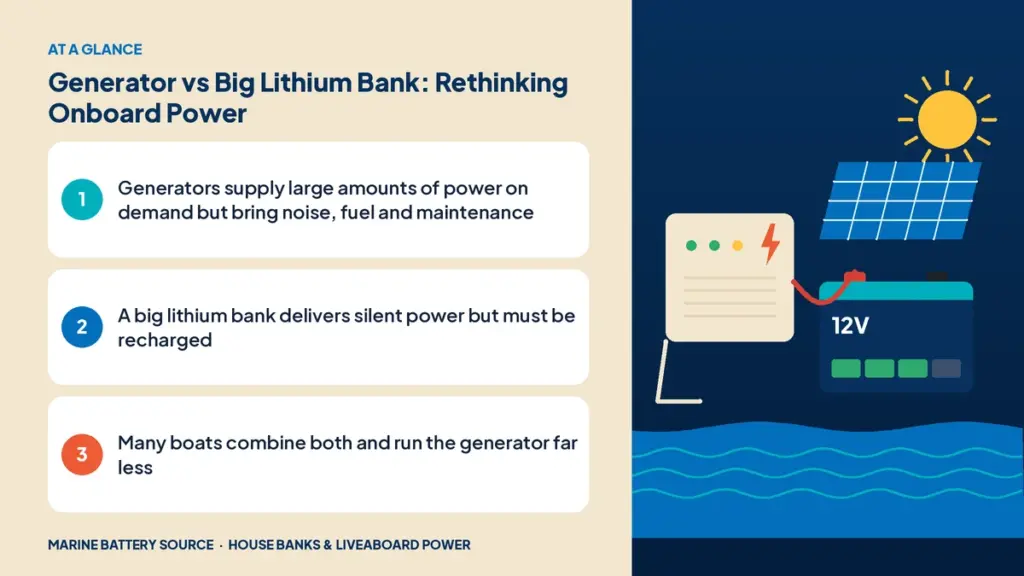
Comparing the approaches
| Factor | Generator-centric | Lithium-centric |
|---|---|---|
| Peak AC power | High | Limited by inverter and bank |
| Daily energy | Unlimited with fuel | Limited by bank and charging |
| Noise | Yes | Silent |
| Fuel use | Ongoing | None directly |
| Maintenance | Oil, impeller, filters, service | Minimal |
| Weight | Generator plus fuel | Batteries |
| Up-front cost | Generator and installation | Batteries, inverter/charger, charging upgrades |
When a generator still makes sense
- Boats with large air conditioning loads in hot climates.
- Electric cooking and water heating away from the dock.
- Long stays far from shore power where solar can’t keep up.
- Owners who value unlimited power over silence.
When a big lithium bank can replace most generator time
- Loads are mostly DC refrigeration, electronics, lighting and short inverter use.
- There’s room for a substantial solar array.
- The boat moves regularly, letting a lithium-capable alternator recharge.
- Air conditioning is used only occasionally or for short periods.
Our article on running a boat air conditioner on batteries covers the biggest load in detail.
Hybrid systems
Many owners combine both, and it’s often the best answer:
- A large lithium bank carries quiet-time loads overnight and during the day.
- Solar and the alternator replace much of the energy.
- The generator runs for a short period when the bank needs a big recharge, ideally with a high-output charger so every generator minute delivers maximum energy.
Lithium accepts high charge current almost until full, so generator time is used efficiently. With lead-acid, the slow absorption stage means the generator runs a long time for the last part of the charge.
Sizing the lithium side
Start with an energy budget; our sample liveaboard power budget shows how. Decide how many hours or days you want to go between generator runs. Then size the bank:
Bank kWh ≈ energy between charges ÷ 0.8
Large-format options from the store include the EPOCH 12V 460Ah V2 Elite and EPOCH 24V 230Ah V2 Elite, each 5.89 kWh, and the EPOCH 48V 100Ah V2 Elite at 5.12 kWh. Higher-voltage banks reduce inverter current for big AC loads.
Charging upgrades
A bigger bank needs more charging capacity. Common upgrades include more solar, a lithium-capable alternator setup with temperature sensing or a DC-DC charger, and a higher-output inverter/charger. Read shore power and chargers and charging on the water.
Costs to consider
- Generator: purchase, installation, fuel, maintenance and periodic overhauls.
- Lithium: batteries, inverter/charger, charging upgrades, fusing and monitoring.
Lithium’s long cycle life spreads its cost over many years, but up-front costs are significant. A hybrid system often lets you choose a smaller generator or run it far less.
Practical considerations
- Space and weight: a generator, sound shield and fuel take space; so does a large battery bank.
- Redundancy: two independent sources are more resilient than one.
- Noise and neighbors: many anchorages and marinas restrict generator hours.
- Safety: both require proper installation. Generators bring carbon monoxide risk; install CO detectors and follow the maker’s exhaust guidance. Large lithium banks require proper fusing and BMS-aware design.
A worked example
A couple cruising in the Bahamas uses about 200Ah per day at 12V for refrigeration, lights, electronics and laptops, plus air conditioning for two hours before bed.
Generator-centric approach: an AGM bank and a generator run twice a day for an hour or two to recharge and to run the A/C. Lead-acid absorption keeps the generator running longer than the bulk energy alone would require.
Lithium-centric approach: a 600Ah lithium bank, 600W of solar and a lithium-capable alternator setup. Solar covers much of the daily DC load on sunny days. The A/C runs from the inverter for two hours, drawing several kilowatt-hours from the bank. The generator runs only on cloudy days or when the bank falls below a set threshold, often for less than an hour because lithium accepts the charger’s full output.
The second approach costs more up front but can cut generator hours dramatically. Your numbers will differ; the method is the same.
Questions to ask yourself
- Which loads truly need AC power away from the dock?
- How much solar can you mount without compromising the boat?
- How often do you move, so the alternator can contribute?
- How much quiet do you want at anchor?
- Do local rules restrict generator hours where you cruise?
Upgrading an existing boat
If your boat has a generator and an aging AGM bank, a lithium upgrade can dramatically reduce generator time without removing the generator. Read upgrading from AGM to lithium for the process. Multihulls with large roof areas for solar are especially good candidates; see catamaran battery banks.
For the full system picture, read our pillar on sailboat and liveaboard battery systems and house bank sizing for overnight boating. Browse lithium batteries in the store.
Frequently asked questions
Can a lithium battery bank replace a boat generator?
For boats with modest AC loads and good solar or alternator charging, it can replace most or all generator time. Boats with heavy air conditioning or electric cooking usually still need a generator.
Is it cheaper to run a generator or use lithium?
It depends on usage. Generators have ongoing fuel and maintenance costs; lithium has higher up-front cost but low running costs and long life.
How big a lithium bank do I need to avoid running the generator?
Size the bank from your daily energy use and the time between charges, divided by about 0.8, and make sure your silent charging sources can replace that energy.
Why does a generator charge lithium faster than lead-acid?
Lithium accepts high current almost until full, while lead-acid slows during absorption. Generator time is used more efficiently with lithium.