


A Sample Liveaboard Power Budget, Line by Line
It’s one thing to know you should do an energy budget. It’s another to see one worked out in full. This article walks through a sample liveaboard power budget for a couple living aboard a 40-foot cruising sailboat, line by line. Use it as a template: swap in your own devices and hours, and you’ll have a realistic picture of your liveaboard power consumption.
The boat and the assumptions
- 40-foot monohull, 12V house system.
- Two people living aboard full time.
- Mostly at anchor, with occasional overnight passages.
- 12V compressor refrigerator and a small separate freezer.
- A pure sine inverter for laptops, a coffee maker and occasional small appliances.
- LED lighting throughout.
The current draws below are typical examples. Your devices may differ significantly, so measure or check manuals.
Daily budget at anchor
| Load | Draw | Hours/day | Ah/day |
|---|---|---|---|
| Refrigerator (average with duty cycle) | 2.0A | 24 | 48 |
| Freezer (average with duty cycle) | 1.5A | 24 | 36 |
| LED cabin lights | 1.5A | 5 | 7.5 |
| LED anchor light | 0.3A | 11 | 3.3 |
| Fans (two) | 1.0A | 8 | 8 |
| Freshwater pump | 6A | 0.5 | 3 |
| VHF on standby | 0.5A | 12 | 6 |
| Wi-Fi router / cellular booster | 1.0A | 12 | 12 |
| Phones and tablets via USB | 1.0A | 4 | 4 |
| Instruments on standby | 0.3A | 24 | 7.2 |
| DC subtotal | 135Ah |
AC loads through the inverter
| Load | Watts | Hours/day | Wh/day |
|---|---|---|---|
| Two laptops | 120W | 4 | 480 |
| Coffee maker | 900W | 0.2 | 180 |
| Blender and small appliances | 400W | 0.1 | 40 |
| AC subtotal | 700Wh |
Converting AC energy to DC amp-hours: 700Wh ÷ 12.8V ÷ 0.88 efficiency ≈ 62Ah. Add inverter idle draw: if it’s on for 5 hours at 0.6A, that’s 3Ah.
AC total ≈ 65Ah.
Total at anchor
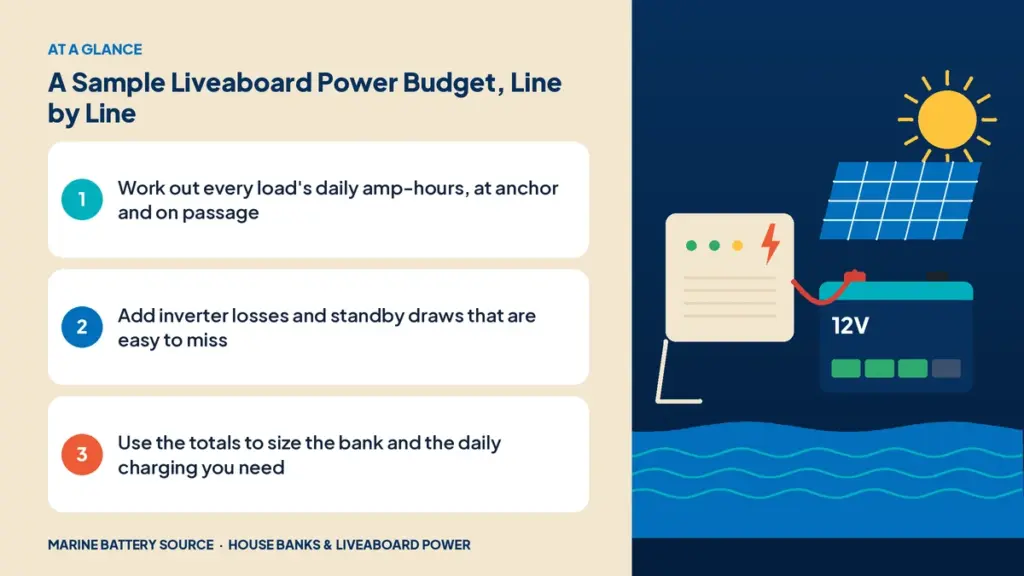
135Ah + 65Ah ≈ 200Ah per day.
Daily budget on passage
On passage, the fridge and freezer still run, but navigation loads add up:
| Additional load | Draw | Hours/day | Ah/day |
|---|---|---|---|
| Autopilot (average; varies with sea state) | 3A | 24 | 72 |
| Chartplotter and instruments | 2A | 24 | 48 |
| Navigation lights (LED) | 1A | 12 | 12 |
| Radar (intermittent) | 2A | 6 | 12 |
| AIS transponder | 0.5A | 24 | 12 |
Minus some at-anchor loads (anchor light, fans, router), passage use for this boat might be 280 to 320Ah per day. Autopilot draw is especially variable; a well-balanced boat in moderate seas uses far less than one fighting weather helm in big quartering seas.
Sizing the bank
At anchor, 200Ah per day. Aiming for two days of autonomy with lithium used to about 80%:
200 × 2 ÷ 0.8 = 500Ah of lithium at 12V
With lead-acid used to about 50%:
200 × 2 ÷ 0.5 = 800Ah of lead-acid at 12V
That difference in size and weight is why many liveaboards choose lithium. Options at this scale from the store include the EPOCH 12V 460Ah Essential, or two EPOCH 12V 300Ah Essential batteries for 600Ah. A lead-acid bank of this size might use four Trojan L16H-AC 6V batteries; see L16 and large-format batteries.
Charging needs
To stay balanced at anchor, the boat must put back about 200Ah per day, plus charging losses. Options:
- Solar: at about 4 effective sun hours and 75% system efficiency, roughly 850W of panels would produce around 200Ah at 12.8V on a good day. Many boats can’t fit that much, so solar covers part of the load.
- Alternator: a lithium-capable alternator setup can replace a large share in an hour or two of engine time.
- Generator plus charger: high output when needed.
- Shore power: when at a marina; see shore power and chargers.
Our article comparing a generator with a big lithium bank explores the trade-offs.
Where the energy goes
In this example, refrigeration accounts for over 40% of daily use at anchor. That’s typical. Improving fridge insulation, ventilation and habits can save more energy than any other single change.
Ways to cut the budget
- Add insulation to the fridge and freezer boxes.
- Run the coffee maker only when the sun is out or the engine is running.
- Switch off the router at night.
- Use the autopilot less by balancing sails on passage.
- Turn the inverter off whenever it’s not in use.
Adapting this template
- Replace each device with your own, using measured draws where possible.
- Adjust hours for your lifestyle.
- Add electric propulsion if you have it; see electric sailboat motor batteries.
- Recalculate the bank and charging targets.
Common items people forget
When owners compare their first budget with monitor data, the gap usually comes from small loads that run all the time:
- Instrument displays and networks left on standby.
- Stereo head units and amplifiers that never fully switch off.
- USB chargers left plugged in with nothing attached.
- Carbon monoxide and propane detectors, which should stay on, but should be counted.
- Bilge pump float switches and high-water alarms.
- The inverter itself, left on “just in case.”
Each might draw a fraction of an amp, but a handful together can add 10 to 20Ah per day. Turn off what you can, and budget for what must stay on.
Verifying with real data
After installation, compare a shunt monitor’s daily consumption with your budget. Most people find a few surprises, usually standby loads or a fridge that runs more than expected in hot weather.
Seasonal and climate effects
In hot climates, refrigeration and fans can use far more than in temperate ones. In cold climates, a diesel heater’s fan and pump add load, while refrigeration drops. Build separate budgets for the seasons you’ll spend the most time in.
For the full system picture, read our pillar on sailboat and liveaboard battery systems, and for reserve planning see house bank sizing for overnight boating. Charging options are compared in charging on the water. Browse house bank batteries in the store.
Frequently asked questions
How much power does a liveaboard boat use per day?
It varies widely. A couple living aboard a mid-size cruising boat might use roughly 150 to 300Ah per day at 12V, depending on refrigeration, inverter use and whether they’re on passage.
What uses the most power on a liveaboard boat?
Refrigeration is often the largest daily load at anchor. On passage, the autopilot and navigation electronics add a lot.
How do I include inverter loads in a power budget?
Add up AC watt-hours, divide by the battery voltage and inverter efficiency to get DC amp-hours, then add the inverter’s idle draw.
How many days of battery autonomy should I plan for?
Many liveaboards plan for about two days without significant charging, which covers cloudy or calm stretches.