


Electric Auxiliary Propulsion for Sailboats: Battery Basics
Electric auxiliary propulsion is gaining ground on sailboats. Swapping a small diesel for an electric motor means quiet, clean, low-maintenance motoring in and out of harbors and anchorages. But an electric motor is only as useful as the battery behind it. This guide explains electric sailboat motor battery basics: how much capacity you need, which voltages and chemistries are used, and how to keep the bank charged.
How electric auxiliaries differ from diesel
A diesel tank holds a lot of energy, and refueling is quick. A battery holds far less energy per pound, and recharging takes time. That means an electric auxiliary is best suited to:
- Getting in and out of harbors and marinas.
- Short motoring legs in calm conditions.
- Boats that sail most of the time.
Long motoring passages into wind and waves require very large banks or a generator.
Voltage
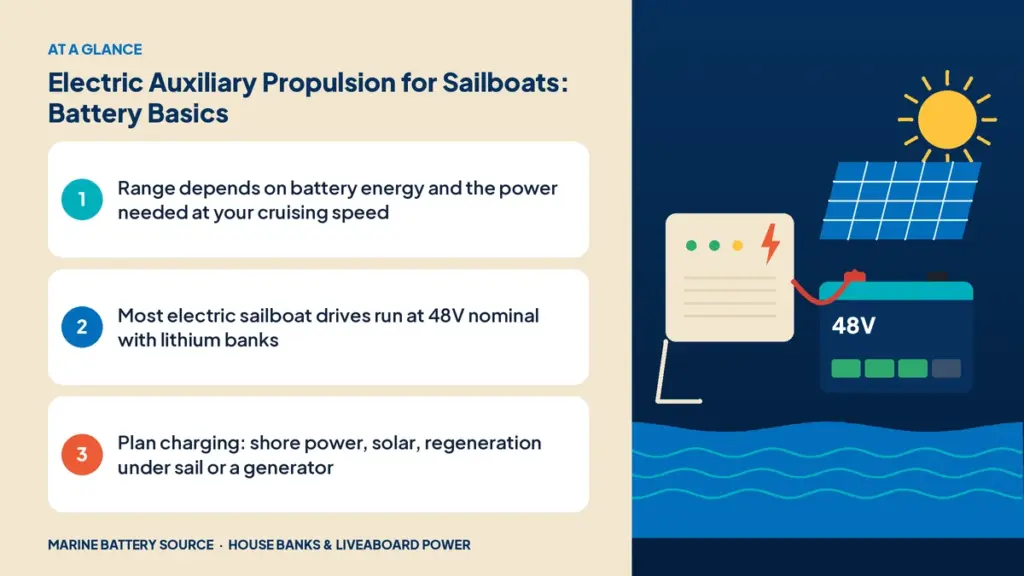
Most electric inboard and pod drives for cruising sailboats run at 48V nominal, which keeps current and cable sizes manageable for motors in the several-kilowatt range. Some smaller outboards and drives use lower voltages, and some larger systems use higher voltages. Always confirm the motor’s voltage and approved battery types.
How much battery do you need?
Range depends on how much power the motor needs at your chosen speed:
Hours of motoring ≈ usable battery energy ÷ motor power at cruise
Example: a motor drawing 2kW at a modest harbor speed, with a 10 kWh lithium bank used to 80%, gives roughly 8 kWh ÷ 2 kW = 4 hours. At higher speeds the power rises steeply, so running a knot faster can cut range dramatically. Motor makers publish power-versus-speed data for typical hulls, and real-world numbers depend on your boat, sea state and wind.
Lithium is the practical choice
At 48V and several kilowatt-hours, lead-acid banks become extremely heavy, and you can use only about half their capacity. LiFePO4 offers far more usable energy per pound and handles deep cycling. Store examples at 48V:
- EPOCH 48V 100Ah V2 Elite: 5.12 kWh, 8D footprint, 97 lb, Bluetooth and heating.
- EPOCH 48V 100Ah V2-T Elite: the same energy with additional features per the product listing.
- Dakota Lithium 48V 105Ah: 5,376 Wh listed, 81.6 lb, Bluetooth.
Two 5 kWh batteries give roughly 10 kWh, a common starting point for small cruising boats. Check the motor maker’s approved battery list and parallel limits.
Charging an electric propulsion bank
Shore power
A 48V charger restores the bank at the dock. Options in the store include the Dakota Lithium 48V 22A onboard charger and the EPOCH and Allied Lithium 48V 15A chargers. Charge time is roughly energy to replace divided by charger power: replacing 8 kWh with a charger delivering about 1 kW takes roughly 8 hours.
Solar
Solar can contribute meaningfully, especially at anchor for several days. A few hundred watts of panels won’t recharge a big propulsion bank in a single day, but over several days it adds up. See charging sailboat batteries without the engine.
Regeneration under sail
Many electric drives can regenerate power when the boat sails, using the propeller to turn the motor as a generator. Output depends on boat speed and the system design, and it adds some drag.
Generator
Some owners carry a generator for long motoring legs or as a backup, creating a hybrid system.
House loads and the propulsion bank
Some boats run house loads from the propulsion bank through a 48V-to-12V DC-DC converter. Others keep a separate 12V house bank. A single large bank simplifies charging, while separate banks protect your ability to motor if house loads run high. Read building a lithium house bank for house bank design.
Planning with a power budget
Include propulsion in your energy planning just like the fridge and autopilot. Our sample liveaboard power budget shows how loads add up, and house bank sizing for overnight boating covers reserve planning.
Safety
- Use fuses and disconnects rated for the system voltage and the bank’s short-circuit current.
- Use marine-grade tinned copper cable sized for the motor’s current.
- Secure batteries against heeling and knockdowns.
- Follow the motor maker’s installation manual and ABYC standards.
- Consider professional installation for high-power systems.
Is electric right for your boat?
Electric propulsion suits sailors who sail most of the time, motor short distances, and value quiet operation and low maintenance. It’s less suited to boats that motor long distances regularly. Many owners find that with a well-sized lithium bank and solar, electric auxiliary power covers nearly all their motoring.
Comparing large-format lead-acid
If you’re curious how large lead-acid batteries compare for energy storage, see L16 and large-format batteries. At propulsion scale, their weight usually rules them out.
Weight and placement
Removing a diesel engine, its fuel tank and fuel takes weight out of the boat, and adding a large lithium bank puts some back. Placement matters: batteries should sit low and near the boat’s center of gravity, secured so they can’t move in a knockdown. A 10 kWh lithium bank built from two 48V batteries in the 80 to 100 lb range is far easier to place well than an equivalent lead-acid bank, which could weigh several times as much.
Questions to ask before converting
- How many hours do you typically motor per trip, and at what speed?
- What’s your worst-case motoring scenario, such as entering a harbor against tide?
- Where can you mount batteries low and secure?
- What charging sources will you have away from the dock?
- Does the motor maker approve your chosen batteries?
For the bigger picture, read our pillar on sailboat and liveaboard battery systems, and compare the store’s 48V options in the lithium category. Our guide to charging on the water covers additional charging sources.
Frequently asked questions
How big a battery do I need for an electric sailboat motor?
Divide the energy you need (motor power at cruising speed × hours) by about 0.8 for lithium. Many small cruising boats start around 10 kWh.
What voltage do electric sailboat motors use?
Many cruising sailboat drives run at 48V nominal. Check your motor’s specifications.
Can solar recharge an electric propulsion bank?
It helps, especially over several days at anchor, but a typical solar array won’t fully recharge a large bank in one day.
Can an electric sailboat motor regenerate while sailing?
Many systems can, using the propeller to generate power while the boat sails. Output depends on speed and system design.