


Keeping Sailboat Batteries Charged Without Running the Engine
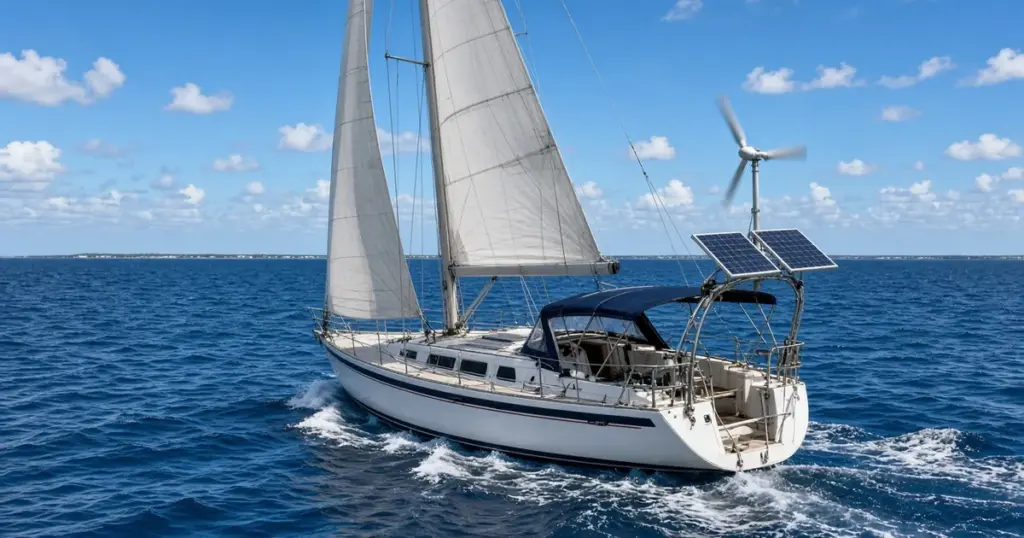
Sailors would rather sail than motor, and few things spoil a quiet anchorage like an engine running to charge batteries. Keeping sailboat batteries charged without the engine is very achievable with the right mix of solar, wind, hydro and efficient loads. This guide explains each option and how to combine them.
Start with your energy budget
Know how much energy you use per day before choosing charging sources. If you use 120Ah per day, your engine-free sources must put back 120Ah plus losses on an average day. Our pillar on sailboat and liveaboard battery systems covers the energy budget.
Solar panels
Solar is the most popular engine-free charging source: silent, reliable and nearly maintenance-free.
How much will a panel produce?
A panel’s daily output depends on its rated wattage, the sun hours at your location and season, its angle, and shading. A simple planning estimate is:
Daily Wh ≈ panel watts × effective sun hours × system efficiency
Example: 400W of panels × 4 effective sun hours × 0.75 for losses and imperfect angles ≈ 1,200Wh, or roughly 94Ah at 12.8V. In winter, at higher latitudes, or with shading, it can be much less.
Mounting
Common spots include a stern arch, a bimini top, the dodger and the deck. Shading from the boom, mast, rigging and sails can significantly cut output, especially on panels wired in series. Arrange panels to minimize shading and consider separate controllers for panels in different locations.
Charge controllers
MPPT controllers extract more power than PWM controllers in most marine setups, particularly with higher-voltage panel strings. Set the controller to your battery maker’s profile, whether lithium or lead-acid.
Wind generators
Wind generators produce power day and night when there’s enough wind. They’re popular in trade-wind areas and windy anchorages.
- Output rises sharply with wind speed and is minimal in light air.
- They make some noise and vibration.
- They need a safe mounting location and a way to stop them in storms.
Hydrogenerators
A hydrogenerator uses a water-driven propeller to generate power while the boat sails. It can be very productive on passages at sailing speeds, but it adds drag and produces nothing at anchor.
Shore power
At a marina, a shore charger or inverter/charger keeps the bank full. See shore power and chargers.
Combining sources
| Source | Best conditions | Weak conditions |
|---|---|---|
| Solar | Sunny days, at anchor or under way | Night, clouds, shade from sails |
| Wind | Windy anchorages, trade winds | Calm, sheltered anchorages |
| Hydro | Passages under sail | At anchor, slow speeds |
| Shore | Marinas | Away from the dock |
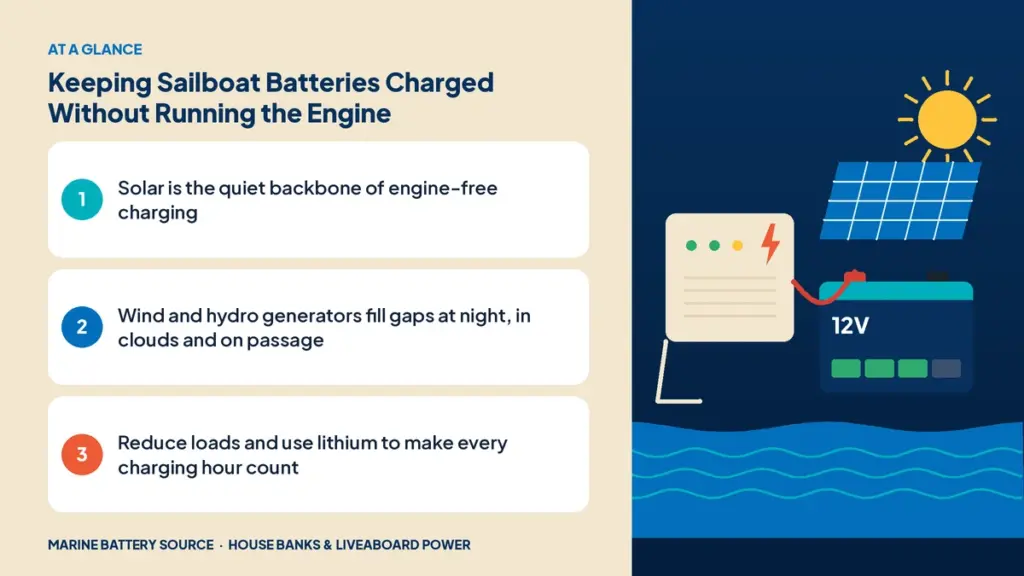
Many cruising boats combine solar with either wind or hydro, giving coverage in most conditions.
Use lithium to make every charging hour count
Lithium batteries accept charge efficiently and quickly, and they don’t need regular full charges to stay healthy. Lead-acid batteries charge slowly near full, and solar can struggle to complete their absorption stage on short winter days. That’s one reason many cruisers who rely on solar choose lithium. Examples include the EPOCH 12V 300Ah Essential and the Battle Born 100Ah 12V, which can be paralleled for larger banks. Read building a lithium house bank for system design.
If you stay with lead-acid, large-format batteries are a traditional choice; see L16 and large-format batteries.
Reduce loads
The cheapest watt is the one you don’t use:
- LED lighting throughout, including the anchor light.
- An efficient, well-insulated fridge with good compressor ventilation.
- Turn off the inverter when not needed.
- Charge devices from 12V USB outlets.
- Use the autopilot wisely; balancing the sails reduces its work.
Getting more from the panels you have
- Keep them clean. Salt and dust reduce output. Rinse panels with fresh water.
- Reduce shading. Even a shadow from a halyard can cut output on some panel layouts. Move lines and flags where possible.
- Tilt when you can. Adjustable mounts on an arch let you angle panels toward the sun at anchor, which helps in winter and at higher latitudes.
- Use heavy enough wire. Voltage drop between panels, controller and battery wastes energy. Keep runs short and size wire generously.
- Check connectors. Corroded solar connectors are a common cause of lower-than-expected output.
Seasonal and regional differences
Solar output varies a lot by season and latitude. A system that keeps up comfortably in the Bahamas in spring may fall short in New England in October, when days are shorter and the sun is lower. Wind patterns vary too. When planning, use conservative sun-hour figures for the season and region where you’ll spend the most time, and size the battery bank to carry you through a few poor days.
Monitoring
A battery monitor shows exactly how much each source contributes. Many solar controllers also log daily yield. Compare production with use to see whether you’re keeping up.
When you still need the engine
Even with excellent renewable charging, there will be cloudy, calm stretches. Running the engine occasionally is fine; with lithium, a lithium-capable alternator setup can put back a lot of energy quickly. The goal is to make engine charging the exception, not the routine.
Electric propulsion considerations
Boats with electric auxiliary motors have much larger energy needs, and propulsion charging often relies heavily on solar and regeneration under sail. See electric auxiliary propulsion.
Catamarans
Catamarans usually have more roof area for solar, making engine-free charging easier. See catamaran battery banks.
A sample setup
A 38-foot cruising sailboat using about 110Ah per day might pair 400W to 600W of solar on an arch and bimini with a 300Ah to 400Ah lithium bank and a small wind generator. On sunny days, solar alone covers the load; the wind generator and the bank’s reserve cover cloudy, windy stretches. Exact sizing depends on location and season.
For sizing reserve, read house bank sizing for overnight boating. Browse house bank batteries in the store.
Frequently asked questions
How much solar do I need for a sailboat?
Divide your daily energy use by your effective sun hours and a system efficiency factor. Many cruising boats install several hundred watts or more.
Can solar keep up with a boat fridge?
Often, yes, in sunny conditions with enough panel area. Refrigeration is a large load, so size the array and bank with it in mind.
Is a wind generator or hydrogenerator better?
Wind generators work at anchor and under way when there’s wind. Hydrogenerators are productive on passages but produce nothing at anchor.
Is lithium better for solar charging?
Lithium accepts charge efficiently and doesn’t need regular full charges, which makes it a good partner for solar.