


Can You Run a Boat Air Conditioner on Batteries?
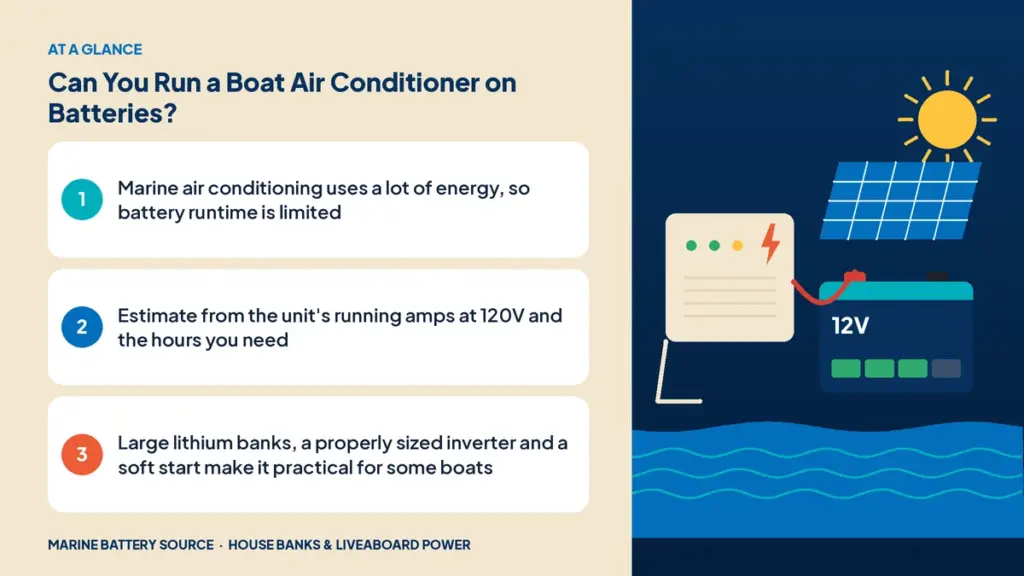
Running air conditioning at anchor without the generator is the dream of many boat owners in hot climates. With large lithium banks and modern inverters, it’s possible on some boats, for some hours. But air conditioning is one of the most energy-hungry loads aboard, and the battery bank and charging must be sized for it. This guide explains how to estimate whether you can run your boat air conditioner on batteries and what it takes.
How much energy does marine A/C use?
Marine air conditioners are usually rated in BTU per hour and run on 120V or 240V AC. The energy they use depends on the unit’s size, efficiency, water temperature, outside temperature and how often the compressor cycles.
To estimate, find the unit’s running current at its rated voltage in the manual or on the label.
Running watts ≈ running amps × AC voltage
Example: a unit drawing 10A at 120V uses about 1,200W while the compressor runs. If it runs 70% of the time on a hot night, it averages about 840W. Over 8 hours, that’s about 6.7 kWh at the AC side, plus inverter losses, so roughly 7.5 kWh from the battery.
Use your own unit’s figures. Actual numbers vary widely.
What that means for battery size
Using the example above:
- Lithium bank: to deliver 7.5 kWh while using about 80% of capacity, you need roughly 9.4 kWh of battery. That’s around 735Ah at 12.8V, 367Ah at 25.6V, or 184Ah at 51.2V.
- Lead-acid bank: using about 50%, you’d need around 15 kWh, which is impractically heavy for most boats.
That’s why battery-powered A/C is almost always a lithium project.
Store examples of large-format lithium batteries:
- EPOCH 24V 230Ah V2 Elite: 5.89 kWh in an 8D footprint, 97 lb, Bluetooth and heating. Two provide about 11.8 kWh.
- EPOCH 48V 100Ah V2 Elite: 5.12 kWh at 48V, which keeps inverter current lower.
- EPOCH 12V 460Ah Essential: 5.89 kWh at 12V.
The inverter
The inverter must handle the A/C’s running load plus its startup surge, along with anything else running at the same time. Compressors can draw a startup surge several times their running current. A soft-start device reduces that surge substantially and is often what makes battery-powered A/C feasible with a reasonably sized inverter. Our guide to sizing an inverter explains continuous and surge ratings.
System voltage matters
At 12V, a 1,200W A/C load draws over 100A DC, plus other loads. That requires very heavy cables and fusing. At 24V or 48V, current is half or a quarter. Many boats designed for battery-powered A/C use 24V or 48V house banks; see 12V vs 24V house banks.
Recharging after a night of A/C
Using 7.5 kWh overnight means putting about that much back the next day:
- Generator: a few hours of generator run time with a large charger.
- Alternator: a high-output alternator with a DC-DC charger or regulator designed for lithium.
- Solar: usually not enough on its own to replace a full night of A/C, but it helps.
- Shore power: at the dock, of course.
If the plan is to avoid the generator entirely, the numbers often don’t work for full-night cooling. Many owners use batteries to cover quiet hours, then run the generator in the morning to recharge.
Reducing A/C energy use
- Cool the boat down before sunset on shore power or the generator.
- Use shades, window covers and insulation to reduce heat gain.
- Close off unused cabins.
- Set a moderate temperature.
- Keep the raw-water strainer and condenser clean for efficiency.
- Consider a variable-speed or inverter-driven A/C unit, which can be more efficient at partial load.
Where battery A/C makes sense
- Short periods of cooling, such as a few hours in the afternoon or before bedtime.
- Boats with very large lithium banks and strong charging.
- Owners willing to run the generator part of the time.
Where it doesn’t
- Small boats with limited space for batteries.
- Full-night cooling on hot nights with small banks.
- Boats without a way to recharge large amounts of energy daily.
Measuring your real A/C use
Estimates are a starting point. If your boat already has an inverter/charger or a battery monitor, measure:
- Note the battery’s state of charge at a set time in the evening.
- Run the A/C on the inverter for an hour with other loads steady.
- Note the state of charge and subtract the other loads’ typical use.
Repeat on a warm and a hot evening. The difference between the two can be large, because the compressor’s duty cycle rises sharply as the water and air get warmer. Those measurements tell you whether a bigger bank, better insulation or a different routine will get you the hours you want.
A realistic plan for many boats
Rather than trying to run A/C all night on batteries, many owners use a hybrid approach:
- Run the generator in the early evening to cool the boat and charge the bank.
- Switch to the battery bank and inverter for quiet hours, with the thermostat set a few degrees warmer.
- Let the bank carry the A/C until a set state of charge, then switch the A/C off or run the generator again in the morning.
That routine can cut generator hours significantly without requiring an enormous bank.
Fit the A/C into your energy audit
Add the A/C to your daily budget along with refrigeration and other loads. Our fridge guide and house bank sizing guide show how. If you’re comparing big lithium against a generator, see our pillar on sailboat and liveaboard battery systems. Golf-cart lead-acid banks are discussed in 6V batteries for house banks, though they’re rarely practical for A/C.
Safety and installation
Large battery banks and inverters carry high currents and stored energy. Use proper fusing with adequate interrupting capacity, heavy cables sized to the inverter maker’s specs, and follow ABYC standards for AC and DC systems. A qualified marine electrician should design and install systems of this size.
Browse lithium batteries in the store.
Frequently asked questions
Can a boat air conditioner run on a lithium battery?
Yes, for a limited time, with a large enough lithium bank, a properly sized inverter and usually a soft-start device. Full-night cooling requires a very large bank.
How many batteries do I need to run a boat A/C overnight?
Estimate the A/C’s energy use from its running amps, duty cycle and hours, add inverter losses, and divide by the usable capacity of each battery. Many boats need several kilowatt-hours or more.
What is a soft start for an air conditioner?
A device that reduces the compressor’s startup surge current, making it easier for an inverter or small generator to start the A/C.
Is 24V or 48V better for running A/C on batteries?
Higher voltage reduces DC current for the same power, which means smaller cables and less loss. Many battery-A/C systems use 24V or 48V house banks.