


Powering a Boat Fridge: Battery and Charging Needs
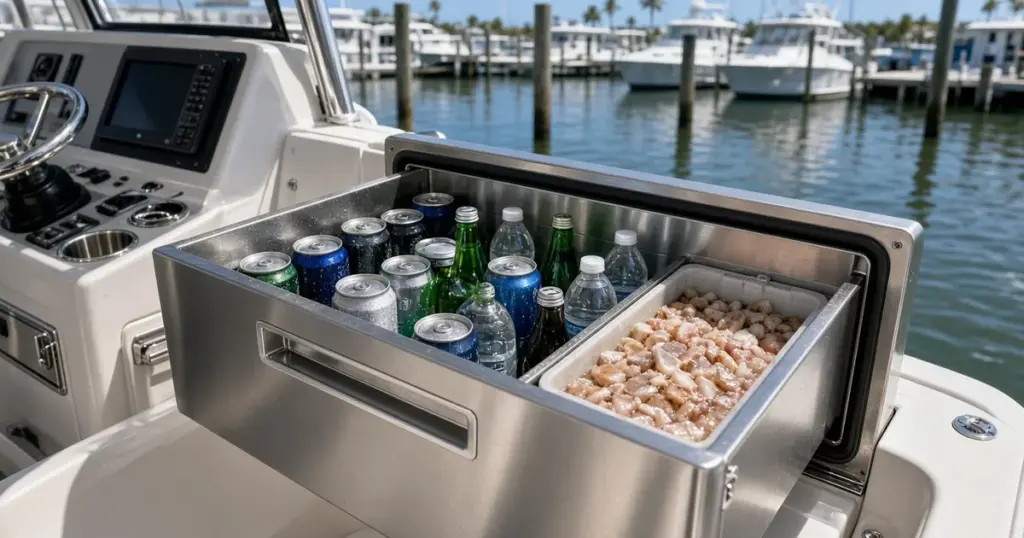
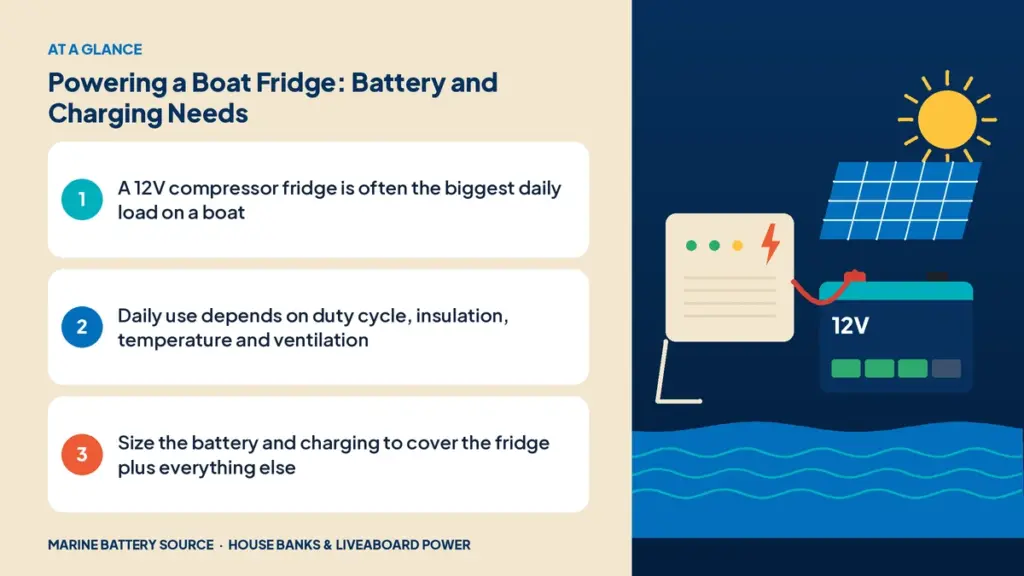
Cold drinks and fresh food make a day on the water or a weekend at anchor much better. But refrigeration is often the single biggest energy user on a boat. Planning the battery and charging around it is essential if you want a fridge that runs reliably without killing the house bank. This guide explains how much energy a boat refrigerator uses, how to size the battery, and how to keep it charged.
Types of boat refrigeration
- 12V compressor fridges and freezers, either built-in or portable. The most common on small and mid-size boats.
- Holding-plate systems, which freeze a plate that keeps the box cold between runs. Found on cruising boats.
- AC refrigerators run on shore power, a generator or an inverter.
- Thermoelectric coolers, which are simple but generally inefficient for long-term cooling.
This guide focuses on 12V compressor fridges, which are the most common battery-powered option.
How much power does a boat fridge use?
A 12V compressor draws a few amps when running, but it doesn’t run all the time. It cycles on and off to maintain temperature. The fraction of time it runs is the duty cycle.
Average current = running current × duty cycle
Example: a compressor that draws 4A while running and runs 40% of the time averages 1.6A, or about 38Ah per day. In hot weather, with frequent door opening, that duty cycle might rise to 60%, or about 58Ah per day.
Many fridge makers publish typical daily consumption figures at given ambient temperatures. Use those as a starting point, then verify with a battery monitor.
What affects consumption
| Factor | Effect |
|---|---|
| Ambient temperature | Hot cabins and cockpits raise the duty cycle substantially |
| Insulation | Thicker insulation reduces energy use |
| Ventilation around the compressor | Poor airflow makes the compressor work harder |
| Door openings | Each opening lets cold air out |
| Set temperature | Freezer settings use far more than fridge settings |
| Load | Warm food or drinks added at once take energy to cool |
Sizing the battery for the fridge
Add the fridge’s daily use to your other loads using an energy audit; see how to do a boat energy audit. Then size the bank:
- Lead-acid: daily use ÷ 0.5, plus reserve.
- Lithium: daily use ÷ 0.8, plus reserve.
A fridge using 50Ah per day alone calls for about 100Ah of lead-acid or about 63Ah of lithium just for one day, before other loads and reserve.
Store examples:
- EPOCH 12V 105Ah Essential: 1.34 kWh, 22.1 lb, Bluetooth and heating, suited to a weekend fridge plus light loads.
- ECO Battery 12V 120Ah: Group 31 size, 29 lb, with heating and Bluetooth.
- EPOCH 12V 300Ah Essential: 3.84 kWh for a fridge plus a full cruising load.
Lithium’s steady voltage helps fridge compressors, which can be sensitive to low voltage and may shut off when voltage sags under load.
Charging to keep up
Running a fridge means you have to put back roughly its daily use every day, plus losses.
Solar
Solar is the natural partner for refrigeration: it produces most when it’s hottest and the fridge works hardest. The daily output of a panel depends on its rating, location, season and shading. Size the array so a typical day’s production covers the fridge and other loads. See charging lithium batteries on a boat for how solar fits with other charging methods.
Engine
Running the engine charges the house bank through an alternator, a DC-DC charger or a combiner. Short runs may not keep up with a fridge over several days.
Shore power
At the dock, a shore charger keeps everything topped up.
Wiring the fridge
- Use the wire size the fridge maker recommends for the run length. Compressor fridges are sensitive to voltage drop and may shut down if the voltage at the fridge falls too low.
- Fuse the circuit at the panel or close to the battery.
- Run the fridge directly from the house bank, not the starting battery.
Saving energy
- Pre-chill the fridge and its contents at the dock on shore power.
- Add extra insulation where possible.
- Ensure good airflow around the compressor and condenser.
- Minimize door openings and keep the fridge full; cold mass holds temperature.
- Set the temperature only as cold as needed.
Fridge vs inverter-powered appliances
Running an AC household fridge through an inverter is less efficient than a 12V compressor fridge because of inverter losses and idle draw. If you’re designing a system around AC appliances, see sizing an inverter and, for big loads, running air conditioning on batteries.
Other loads that share the bank
The fridge rarely runs alone. Windlasses, pumps and electronics also draw from the house bank. If your windlass runs from the same bank, see powering an anchor windlass.
Portable fridges on small boats
Portable 12V compressor fridges have become popular on center consoles, bay boats and pontoons for day trips. They typically plug into a 12V outlet. For a day on the water, the engine’s charging system and a healthy house or dual-purpose battery can usually handle one, but watch two things:
- Outlet and wiring capacity. Accessory outlets on small boats are often wired with light-gauge wire. A fridge that draws several amps while running can see significant voltage drop and shut off. A dedicated, properly fused circuit helps.
- Engine-off time. If you anchor for hours with the fridge running, it draws from the battery the whole time. If that battery also starts the engine, make sure enough remains.
For overnight use on a small boat, a dedicated house battery is the safer choice.
Monitoring
A shunt-based battery monitor or Bluetooth battery app lets you see how much the fridge uses on your boat in your conditions. That data is the best way to size solar and confirm your bank is adequate.
For overnight planning, read house bank sizing for overnight boating, and for longer stays see sailboat and liveaboard battery systems. Browse house bank batteries in the store.
Frequently asked questions
How long will a 100Ah battery run a boat fridge?
It depends on the fridge’s average draw. At an average of 2A, a 100Ah lithium battery used to about 80% runs it for roughly 40 hours. A 100Ah lead-acid battery used to about 50% gives roughly 25 hours.
How much power does a 12V boat fridge use per day?
Commonly tens of amp-hours per day, depending on size, insulation, ambient temperature and use. Check the maker’s figures and verify with a monitor.
Can I run a boat fridge on solar?
Yes. Solar is well suited to refrigeration because production peaks when cooling demand is highest. Size the array to cover the fridge plus other loads.
Why does my boat fridge shut off?
Low voltage at the fridge is a common cause, often from undersized wiring or a depleted battery. Check voltage at the fridge while the compressor runs.