


Marine Wire Color Codes Explained
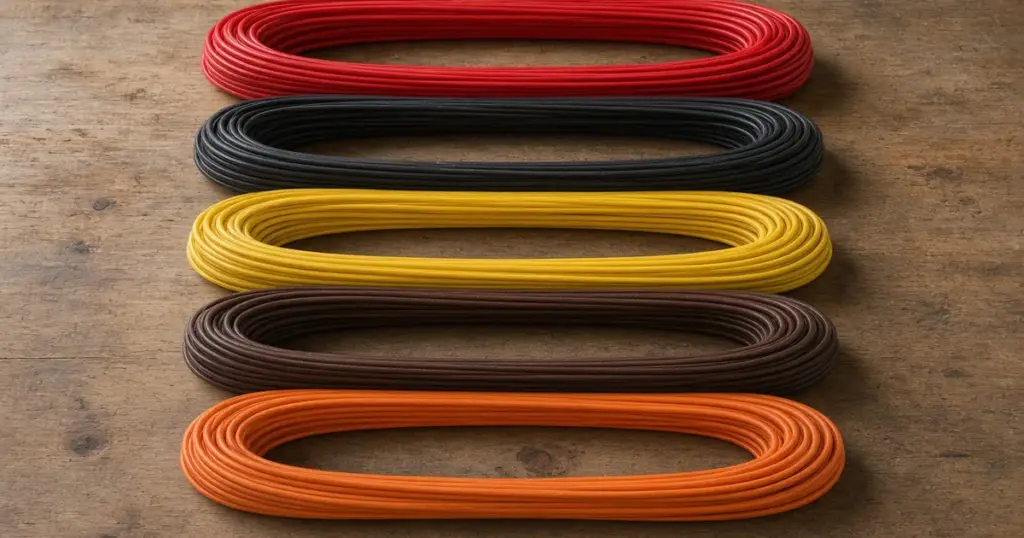
Color codes make a boat’s wiring readable. When every bilge pump wire is brown and every negative is yellow, you can trace circuits quickly, troubleshoot on the water and avoid dangerous mistakes. Marine wiring follows standards set by ABYC (the American Boat and Yacht Council), which are a bit different from automotive and household colors. This guide covers marine wire color codes for DC and AC circuits and how to use them.
Why color codes matter
- Safety. Mixing up positive and negative, or using a green wire for a current-carrying circuit, can cause shorts, corrosion or shock.
- Troubleshooting. A consistent color scheme lets you find circuits without tracing every wire.
- Future work. The next person working on the boat, including you in a few years, will know what each wire does.
- Resale and surveys. Surveyors note nonstandard wiring.
DC main colors
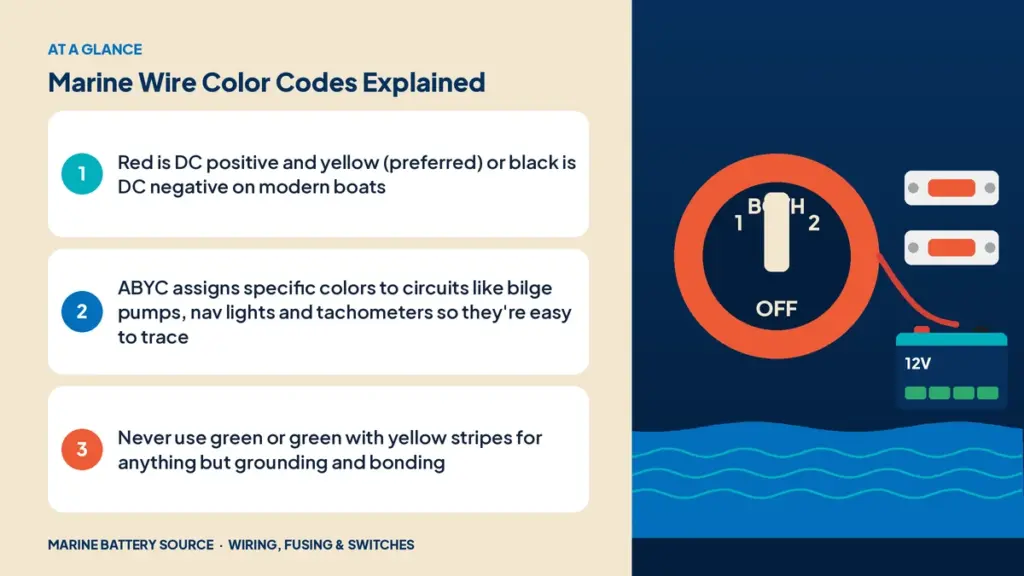
- Red: DC positive conductors, main feeds and unswitched circuits
- Yellow: DC negative (preferred on modern boats, to avoid confusion with AC hot)
- Black: DC negative, common on older boats, acceptable if the boat has no AC system
- Green or green with yellow stripe: DC grounding and bonding conductors, never current-carrying
Why yellow for negative? On boats with both AC and DC systems, black is the AC hot wire. Using yellow for DC negative avoids confusing the two.
ABYC DC circuit colors
ABYC recommends specific colors for common circuits:
- Yellow with red stripe: starting circuit, starter switch to solenoid
- Brown with yellow stripe or yellow: bilge blower
- Dark gray: navigation lights, fuse or switch to lights
- Dark gray: tachometer sender to gauge
- Brown: generator armature and alternator charge indicator; also bilge and other pumps (fuse or switch to pumps)
- Orange: accessory feed, ammeter to alternator output and accessory fuses or switches
- Purple: ignition, instrument feed, distribution panel to electric instruments
- Dark blue: cabin and instrument lights
- Light blue: oil pressure sender to gauge
- Tan: water temperature sender to gauge
- Pink: fuel gauge sender to gauge
- Green with stripe (except yellow): tilt down and trim in
- Blue with stripe: tilt up and trim out
Not every boat follows every color, especially older boats or builder-modified systems. Check your boat’s wiring diagram where available.
AC colors on boats
Boats with shore power, a generator or an inverter use AC colors:
- Black or brown: AC hot (ungrounded)
- White or light blue: AC neutral (grounded)
- Green or green with yellow stripe: AC grounding conductor
AC circuits must be kept separate from DC wiring, in their own bundles and panels where possible. AC work is best left to a qualified marine electrician.
Trolling motor wiring colors
Trolling motor circuits are typically red positive and black negative, matching the motor’s leads. On a 24V or 36V system, the series links between batteries are often red or black as well. Labeling each battery and link prevents mistakes. Connection kits like the Dakota Lithium 24V trolling motor connection kit come with color-coded leads.
Reading an unfamiliar boat’s wiring
On a used boat, don’t assume the colors are right. Previous owners often added circuits with whatever wire was handy. Before you work on a circuit:
- Turn off the battery switch and confirm the circuit is dead with a meter.
- Trace the wire from both ends rather than trusting its color.
- Check continuity with a meter to confirm which wire goes where.
- Label it as you go, and note any nonstandard colors on your diagram.
- Replace damaged or nonstandard wires with correct marine wire when you have the chance.
A red wire that turns out to be a negative return, or a black wire that’s actually a switched positive, is more common than you’d think on older boats. Testing takes a few minutes and avoids a short.
Labeling beyond colors
Colors only go so far. Add labels:
- Label both ends of every wire with the circuit name or number.
- Use heat-shrink labels or printed sleeves, which hold up better than tape.
- Keep a wiring diagram aboard with circuit names, fuse sizes and wire gauges.
Choosing the right wire
Use tinned copper marine wire in the correct color and gauge for each circuit. Tinned copper resists corrosion far better than bare copper. Size the wire for both current and voltage drop. Fuse each circuit for its wire; see our marine battery fuse guide and our MRBF terminal fuse guide for the main feeds.
Common color code mistakes
- Using green for current-carrying wires. Green is reserved for grounding and bonding.
- Black for DC negative on a boat with AC. Use yellow to avoid confusion.
- All-red wiring where every circuit looks the same.
- Automotive wire colors that don’t match marine standards.
- No labels, relying on memory.
Color codes when adding equipment
When you add a second battery, install a new panel or add electronics, follow the existing color scheme if it’s standard, or switch to ABYC colors for the new work. Keep a record of what you changed. A new switch panel is a good time to clean up and relabel the circuits behind it.
Battery cable colors
Large battery cables follow the same scheme: red for positive and yellow or black for negative. Keep a few feet of each color aboard for repairs. Cables between the battery and the battery switch are red.
Wire color and battery chemistry
Lithium batteries don’t change the color code, but they do raise the importance of fusing and cable sizing because of their high current capability. Batteries like the EPOCH 12V 105Ah LiFePO4 have clearly marked terminals; match red cables to the positive terminal every time.
Quick reference
- Red: DC positive
- Yellow or black: DC negative
- Green: grounding and bonding only
- Gray: nav lights
- Brown: bilge pumps
- Orange: accessory feeds
- Purple: ignition and instruments
- Dark blue: cabin and instrument lights
- AC black/brown, white/light blue, green: hot, neutral, ground
For complete system wiring, see our marine battery wiring guide and the marine battery safety guide. Find cables and hardware in our marine battery accessories.
Frequently asked questions
What color is the negative wire on a boat?
Yellow is preferred on modern boats, especially those with AC systems. Black is acceptable on DC-only boats.
What color wire is used for bilge pumps?
Brown is the ABYC color for bilge pump circuits.
What color are navigation light wires?
Dark gray is the ABYC color for navigation lights.
Can I use green wire for positive?
No. Green and green with yellow stripe are reserved for grounding and bonding conductors.
Do I have to follow ABYC color codes?
They’re the industry standard and recommended for safety and troubleshooting. Following them makes your boat easier to maintain and survey.