


How to Add a Second Battery to Your Boat
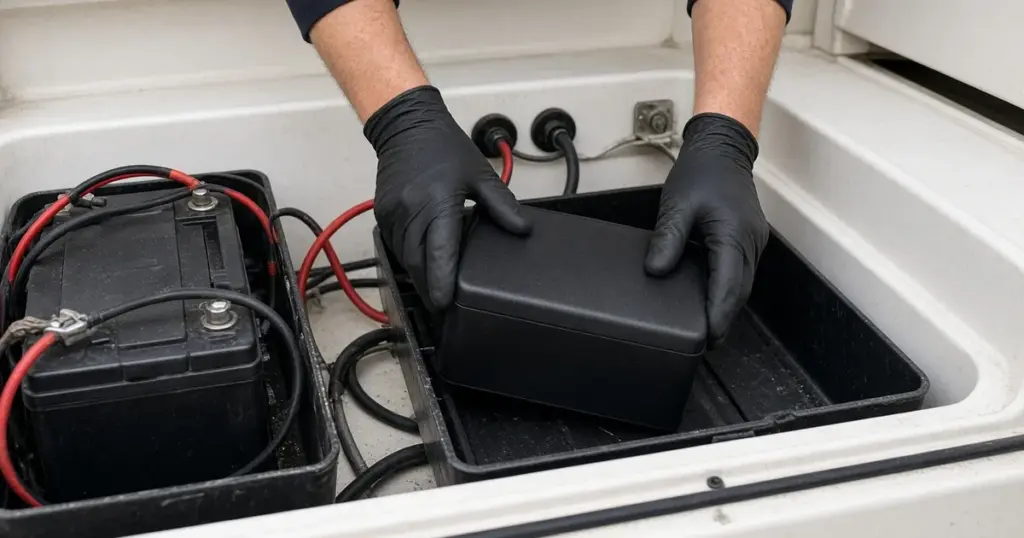
Adding a second battery is one of the most popular electrical upgrades for a boat. It protects your ability to start the engine while you run electronics, pumps, lights and a stereo all day. It also gives you a backup if one battery fails. This guide covers how to add a second battery to a boat, from choosing the battery and charging method to mounting, wiring and fusing.
Why add a second battery
- Reliable starting. Run accessories from one battery and keep the other charged for the engine.
- More capacity for electronics, livewells and audio.
- Backup if one battery dies.
- Room to grow, such as adding an inverter or more electronics later.
Choose your system layout
There are three common ways to manage two batteries:
1. Battery selector switch
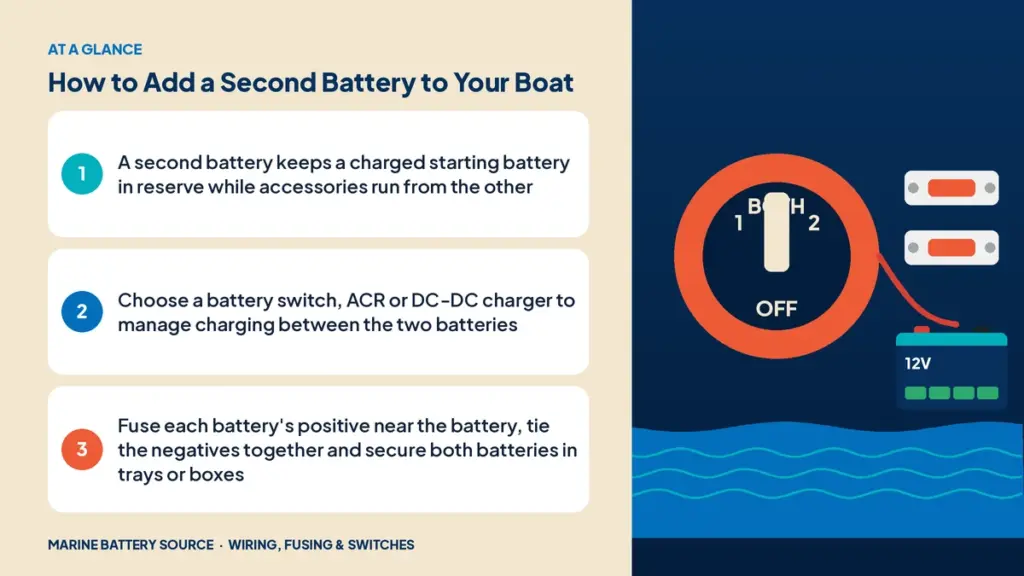
A 1-2-Both-Off switch lets you choose which battery connects to the engine and loads. It’s simple and inexpensive, but charging both batteries depends on switching to Both while running and remembering to switch back. Our dual battery switch wiring guide and battery switch basics cover this setup.
2. Automatic charging relay (ACR)
An ACR connects the two batteries automatically when the alternator is charging, and separates them when it stops. The starting battery is protected from accessory drain without any switching. This is the most popular choice for two lead-acid batteries, or two batteries of the same chemistry.
3. DC-DC charger
A DC-DC charger takes power from the starting battery and alternator and charges the second battery with its own charge profile. It’s the right choice when the second battery is lithium and the starting battery is lead-acid, or when the alternator is far from the second battery. Chargers like the EPOCH dual-output 12V/36V DC-DC charger also handle trolling motor banks.
Choose the second battery
- Deep cycle battery for accessories. It handles repeated discharges.
- Dual-purpose battery if you want it to start the engine in an emergency.
- Lithium for lighter weight and more usable capacity.
- Same chemistry as the first if you’ll ever connect them with a switch on Both or an ACR.
Popular options include the EPOCH 12V 105Ah LiFePO4 for a lithium accessory battery or an Interstate 31M AGM dual-purpose if you’re staying with lead-acid. Browse our dual-purpose marine batteries for more.
Find a place to mount it
- Close to the first battery to keep cables short
- Low and near the centerline for weight distribution
- In a ventilated, dry compartment, especially for flooded batteries
- Secured in a tray or box with a hold-down strap that won’t let the battery move in rough water
- Accessible for inspection and maintenance
What you need
- Second battery and tray or box
- Switch, ACR or DC-DC charger
- Battery cables sized for the current and length, with crimped lugs
- Fuses near each battery positive
- Heat-shrink, terminal covers and labels
- Negative cable to tie the batteries together
Step-by-step wiring with an ACR
- Disconnect the existing battery, negative first.
- Mount the second battery and secure it.
- Connect the negatives. Run a cable from the new battery’s negative to the existing battery negative or negative bus. Size it like the positive cable.
- Mount the ACR near the batteries.
- Connect the ACR between the two battery positives, with a fuse near each battery on the cable to the ACR.
- Connect the ACR ground wire to the negative bus.
- Rewire loads. Move accessory circuits to the second battery’s switch or fuse block, and keep the engine on the starting battery.
- Fit a switch for each battery, or a selector switch, so either can be isolated.
- Label everything, reconnect and test.
Step-by-step wiring with a DC-DC charger
- Mount the charger near the second battery.
- Connect the input to the starting battery through a fuse sized per the charger maker.
- Connect the output to the second battery through another fuse.
- Connect the negatives as specified, usually to a common negative.
- Connect the ignition or engine-run sense wire if the charger needs one.
- Set the charge profile to match the second battery’s chemistry.
Fusing the system
Each positive cable connected to a battery needs a fuse close to that battery. That includes cables to the ACR or DC-DC charger and feeds to fuse blocks. Size each fuse for the cable it protects. Our marine battery fuse guide covers sizing and placement. Large lithium batteries may need a Class T fuse because of their high short-circuit current.
Rewiring the accessories
A common approach is to move all accessory circuits to a panel or fuse block fed from the second battery. Our switch panel wiring guide explains how to feed and lay out the panel. The engine, starter and essential systems stay on the starting battery. Keep the automatic bilge pump connected to a battery through its own fuse so it works even with switches off.
Wire colors
Use red for positive and yellow or black for negative, with standard colors for specific circuits. See marine wire color codes for the full list.
Charging on shore power
If your boat has an onboard charger, make sure it can charge both batteries. Multi-bank chargers like the EPOCH 4-bank charger charge each battery separately with its own output.
Common mistakes
- No fuse on the second battery’s positive.
- Mixing lithium and lead-acid through an ACR or switch on Both.
- Undersized negative cable between batteries.
- Battery not secured, which can damage terminals or cause a short in rough water.
- Loads still connected to the starting battery, so the second battery doesn’t protect anything.
Testing
- With the engine off, run accessories and confirm the starting battery voltage stays steady.
- Start the engine and confirm the second battery begins charging, either through the ACR or DC-DC charger.
- Turn the engine off and confirm the ACR separates the batteries.
For full system layouts, see our marine battery wiring guide.
Frequently asked questions
Can I add a second battery to any boat?
Most boats have room for a second battery. You’ll need a secure mounting spot, proper cables and fuses, and a way to manage charging.
Do I need an ACR or a battery switch?
A switch alone works, but you have to manage charging manually. An ACR handles it automatically. If one battery is lithium, use a DC-DC charger instead.
Should the second battery be the same type?
If they’ll ever be connected together through a switch or ACR, yes. With a DC-DC charger, the second battery can be lithium even if the first is lead-acid.
How do I connect the negatives?
Run a cable from the second battery’s negative to the first battery’s negative or a common negative bus, the same size as the positive cables.
Can my alternator charge two batteries?
Yes, through a switch, ACR or DC-DC charger. Make sure the alternator’s output is adequate for both batteries and your loads.