


How to Use a Multimeter on Boat Batteries
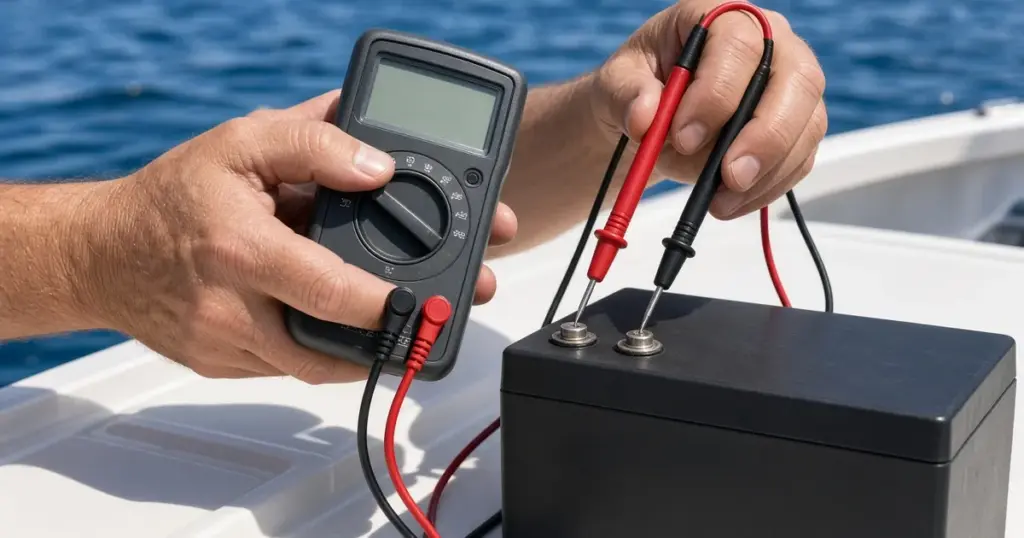
A digital multimeter is the single most useful electrical tool a boater can carry. It tells you whether a battery is charged, whether the charger and engine are charging it, whether connections are losing power and whether something is draining the battery while the boat sits. This guide covers how to use a multimeter for marine battery testing, step by step.
Choosing a multimeter
- Digital, auto-ranging meters are easiest to use.
- DC voltage accurate to at least 0.01V for battery work.
- 10A DC current range for parasitic drain tests.
- Continuity beeper for checking fuses and wires.
- Fused current inputs to protect the meter.
- A clamp meter that measures DC current is a great addition for higher currents.
You don’t need an expensive meter. A decent mid-range model will do everything here.
Safety basics
- Set the function and range before connecting.
- Never measure current across a battery’s terminals; that’s a short circuit through the meter.
- Keep probes and fingers away from bare terminals at the same time.
- Remove jewelry.
- Wear eye protection around lead-acid batteries.
Test 1: Resting voltage
- Turn off loads and chargers; rest the battery (several hours for lead-acid).
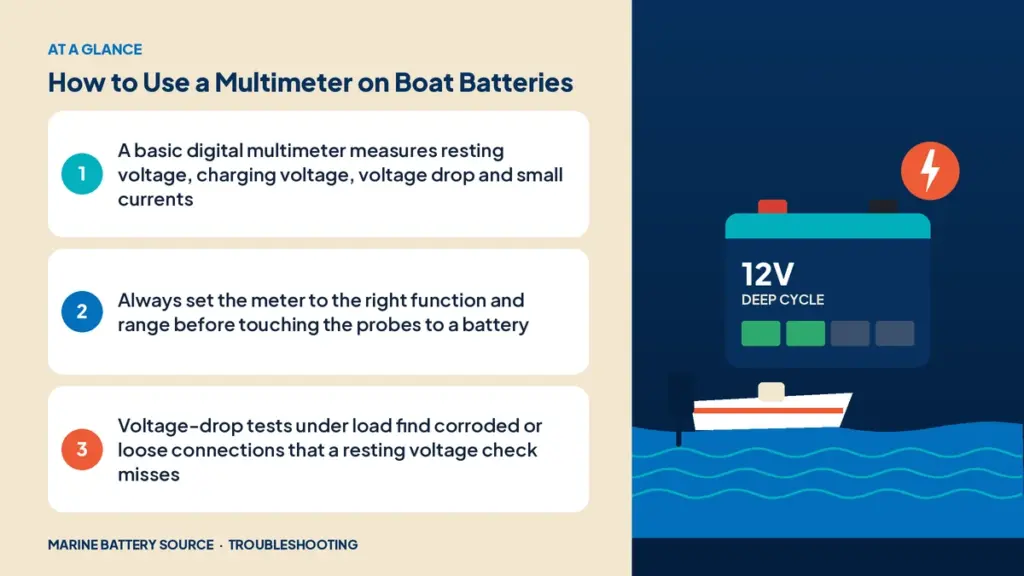
- Set to DC volts (V with a straight line).
- Red probe on positive, black on negative.
- Read and compare with the marine battery voltage chart.
This tells you state of charge, not health. For health, see how to test a marine battery.
Test 2: Charging voltage
Shore charger
With the charger running, measure at the battery. During bulk and absorption, a 12V battery typically reads about 14.2–14.8V depending on chemistry and profile. In float, lower.
Engine
With the engine running above idle, a 12V lead-acid start battery typically reads about 13.8–14.6V. If it’s close to resting voltage, the engine isn’t charging.
Test 3: Cranking voltage
Have someone crank the engine while you watch voltage at the battery. A healthy 12V start battery usually stays above about 9.6–10V. Big dips point to a weak battery or poor connections.
Test 4: Voltage drop
Voltage drop finds bad connections that look fine. Measure while current flows:
- Turn on the load (or crank the engine for starter circuits).
- Put one probe on the battery positive post and the other on the load’s positive terminal. The reading is the drop on the positive side.
- Repeat on the negative side: load negative to battery negative.
- For most circuits, the combined drop should be small, ideally under 3% of system voltage for critical loads like electronics.
- If it’s high, move a probe along the circuit, connection by connection, until the drop appears.
Corroded terminals, loose lugs and undersized cables show up clearly.
Test 5: Battery post to cable clamp
Measure from the battery post to its cable clamp while cranking or under load. Any noticeable reading means the connection itself is losing power. Clean and tighten.
Test 6: Parasitic drain (current)
- Move the red lead to the 10A jack and set the meter to DC amps.
- Turn everything off.
- Disconnect the negative cable and connect the meter between the post and the cable.
- Read current. Switch to mA if it’s low.
- Don’t crank or turn on big loads with the meter in series.
Our parasitic drain test guide covers finding the source. If drains explain a battery that keeps dying, you’ll find them here.
Test 7: Continuity and fuses
Set to continuity and test fuses out of the circuit, or check a suspect wire end to end with power off.
Test 8: Battery bank balance
In series or parallel banks, measure each battery individually. Big differences between batteries in the same bank point to a weak battery or poor connections.
Testing lithium batteries
LiFePO4 voltage is flat across most of the charge range. A multimeter confirms the battery is connected and roughly where it is, but use the app or a monitor for state of charge. A reading of zero or near-zero usually means the BMS has disconnected.
Common mistakes
- Leaving leads in the current jack and then measuring voltage: shorts the battery through the meter.
- Measuring voltage right after charging: surface charge reads high.
- Measuring on cable clamps instead of posts: hides connection problems.
- Relying on voltage alone to judge health.
- Using a low meter battery: gives odd readings.
Interpreting results
| Reading | Meaning |
|---|---|
| Resting 12.6–12.7V (flooded) | Fully charged |
| Resting 12.2V (flooded) | About half charged |
| Engine running, little rise | Engine not charging |
| Large voltage drop across a connection | Clean or replace it |
| Drain over 50 mA with everything off | Find the source |
| Cranking below 9.6V | Weak battery or poor cables |
If a battery is hot or swollen, don’t test it; read hot, swollen or smelly batteries.
Building a test routine
- Monthly: resting voltage after charging.
- Seasonally: charging voltage, cranking voltage and a drain check.
- Any time you add accessories: drain check and voltage drop on new circuits.
Add these to your marine battery maintenance guide routine. For the complete diagnosis process, see the marine battery troubleshooting guide and boat electrical problems troubleshooting.
When the battery is the problem
Replace batteries that fail. A sealed dual-purpose option like the Interstate 27M AGM or an EPOCH 12V 105Ah LiFePO4 are common replacements. A clean distribution point, like the EPOCH heavy-duty power distribution block, makes future testing easier. Find more in marine battery accessories.
Frequently asked questions
What setting do I use to test a car or boat battery with a multimeter?
DC volts, usually the 20V range on a manual meter or auto on an auto-ranging meter.
Can a multimeter tell if a battery is bad?
It can show state of charge and charging problems, but a load or capacity test is needed to judge health.
How do I check if my boat engine is charging the battery?
Measure battery voltage with the engine off, then with it running above idle. A rise to roughly 13.8–14.6V means it’s charging.
Can I measure current with a multimeter across the battery?
No. That’s a short circuit. Measure current in series, between the post and the disconnected cable.
What is a voltage-drop test?
A test under load that measures how much voltage is lost across wires and connections, revealing corrosion or loose terminals.