


Fusing Lithium Banks: Interrupt Ratings and Class T Fuses
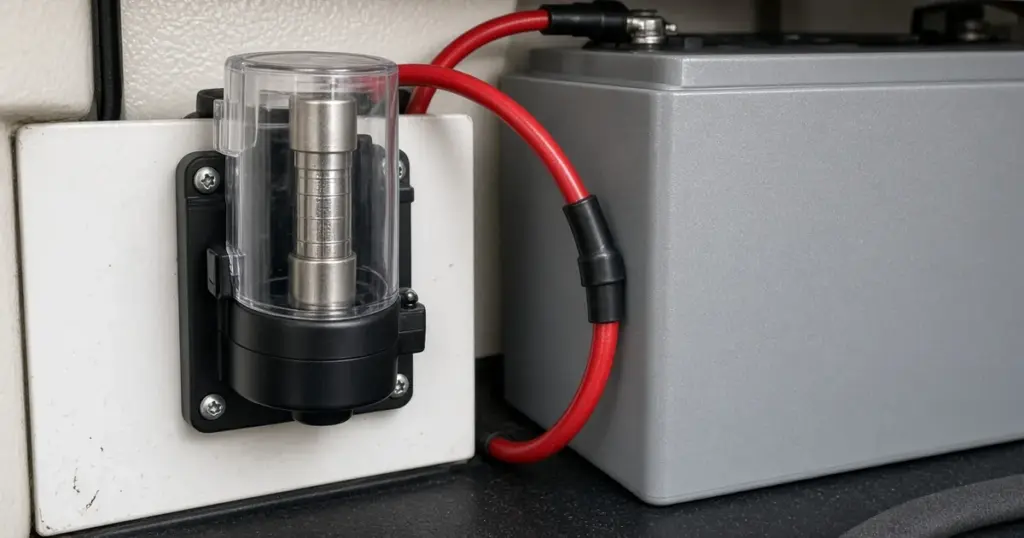
Lithium batteries changed what boat owners need from a main fuse. A LiFePO4 bank can deliver short-circuit current in the tens of thousands of amps for a moment, far more than a lead-acid bank of the same size. A fuse that can’t interrupt that much current can arc across instead of opening, which defeats the purpose of having one. Class T fuses exist to handle exactly that problem. This guide explains what a Class T fuse is, when a boat needs one, and how to size and install it.
What makes a Class T fuse different
Every fuse has an amp rating (the current it’s designed to blow at) and an interrupt rating, sometimes written as AIC (the maximum fault current it can safely stop). Class T fuses are fast-acting fuses with very high interrupt ratings, commonly 20,000A at up to 125V or 160V DC, depending on the model. They use a sand-filled body that quenches the arc as the element melts.
Compared with other common marine fuses:
- ANL: inexpensive and common, but interrupt ratings are often much lower, a few thousand amps.
- MEGA/AMI: mid-range, with modest interrupt ratings.
- MRBF: around 10,000A at 14V, with lower ratings at higher voltages. Great for many systems.
- Class T: 20,000A or more, the highest of the common options.
Why lithium banks need higher interrupt ratings
Lithium iron phosphate cells have very low internal resistance. That’s why they hold voltage under load so well, but it also means a dead short can pull enormous current. A large 12V bank of several hundred amp-hours can deliver a fault current well above an ANL’s interrupt rating. Paralleling multiple lithium batteries increases it further, because each battery adds its own short-circuit capability.
The battery’s BMS will eventually disconnect on a short, but it isn’t designed to be the primary protection for the cable, and its reaction time may not be fast enough. A properly rated fuse is still required.
When you need a Class T fuse
You likely need one if:
- Your lithium bank is large, roughly 200Ah or more at 12V, or several batteries in parallel
- You run an inverter of 1,000W or more from the bank
- The battery or inverter manufacturer specifies a Class T fuse
- Your main cable is 2/0 or larger
For a single 100Ah lithium trolling battery or a small accessory bank, a terminal-mounted MRBF fuse is often enough. Check the battery maker’s guidance. Our marine battery fuse guide covers the full range of fuse types.
Sizing a Class T fuse
Use the same rule as any fuse: protect the wire.
- Find your main cable’s ampacity based on gauge, insulation rating and location.
- Find your maximum continuous current. For an inverter, divide its continuous wattage by the low battery voltage and add about 10% to 15% for inefficiency.
- Choose a fuse above the continuous current and at or below the cable’s ampacity.
Example: a 2,000W inverter on a 12V lithium bank. 2,000W ÷ 12V ≈ 167A, plus 15% ≈ 192A continuous. With 2/0 cable rated around 300A, a 250A or 300A Class T fuse fits.
Where to mount it
- As close to the battery positive as possible, within about 7 inches per ABYC guidance where practical.
- Before the battery switch. The order is battery, Class T fuse, battery switch, then the positive bus.
- On a solid, non-flammable surface, away from spray.
- With a cover over the fuse holder to prevent accidental contact.
For parallel lithium banks, some installers fuse each battery with an MRBF at its terminal, then put a Class T fuse on the bank’s main output. This protects each battery and the main cable.
How to install a Class T fuse
- Turn off all loads and chargers, open the battery switch and disconnect the battery.
- Mount the Class T holder near the battery positive.
- Run a short cable from the battery positive to the holder input.
- Install the fuse in the holder and torque to the specified value.
- Connect the output cable to the battery switch or disconnect switch.
- Fit the holder cover.
- Reconnect and check voltage on both sides of the fuse.
Pre-charging inverters
Large inverters have input capacitors that draw a big surge the instant they’re connected. With a lithium bank’s low resistance, that surge can spark at the switch or even trip the BMS. Many installers use a pre-charge resistor across the switch for a few seconds before closing it, or a switch with a built-in pre-charge. Check your inverter’s instructions.
Common mistakes
- Using an ANL fuse on a large lithium bank because it was cheaper or already installed.
- Mounting the fuse too far from the battery, leaving a long unprotected cable.
- Oversizing the fuse beyond the cable’s ampacity.
- Loose connections at the holder, which cause heat at high current.
- Mismatched voltage rating on 48V systems.
Lithium banks that benefit
Common marine lithium setups where a Class T fuse makes sense include large house banks like the EPOCH 12V 460Ah LiFePO4, parallel banks of 100Ah batteries such as Battle Born 100Ah units, and 48V systems like the EPOCH 48V 100Ah. Browse our house bank batteries for more options.
Branch fusing after the Class T
The Class T protects the main cable. Every branch circuit downstream still needs its own fuse or breaker sized for its own wire, at the fuse block or panel. See our boat switch panel wiring guide and the marine battery wiring guide for layouts.
Adding a second battery?
If you add a second battery to an existing lithium setup, recalculate the short-circuit current and check whether your existing fuse is still adequate. Parallel batteries increase fault current, and a fuse that was fine for one battery may not be for two. On boats with a dual battery switch, each battery’s positive gets its own fuse.
Frequently asked questions
Do I need a Class T fuse for my lithium battery?
For large lithium banks or systems with a big inverter, yes. For a single small lithium battery, an MRBF fuse may be enough. Follow the battery maker’s recommendation.
What’s the difference between Class T and ANL fuses?
Both protect cables, but Class T fuses have much higher interrupt ratings, often 20,000A, while many ANL fuses are rated only a few thousand amps.
What size Class T fuse do I need?
Size it above your maximum continuous current and at or below your main cable’s ampacity. For a 2,000W inverter on 12V with 2/0 cable, 250A to 300A is common.
Where should a Class T fuse be mounted?
As close to the battery positive as possible, before the battery switch.
Can the lithium battery’s BMS replace a fuse?
No. The BMS protects the battery, not the cable, and isn’t intended to be the primary short-circuit protection.