


MRBF Terminal Fuses: Fusing Right at the Battery
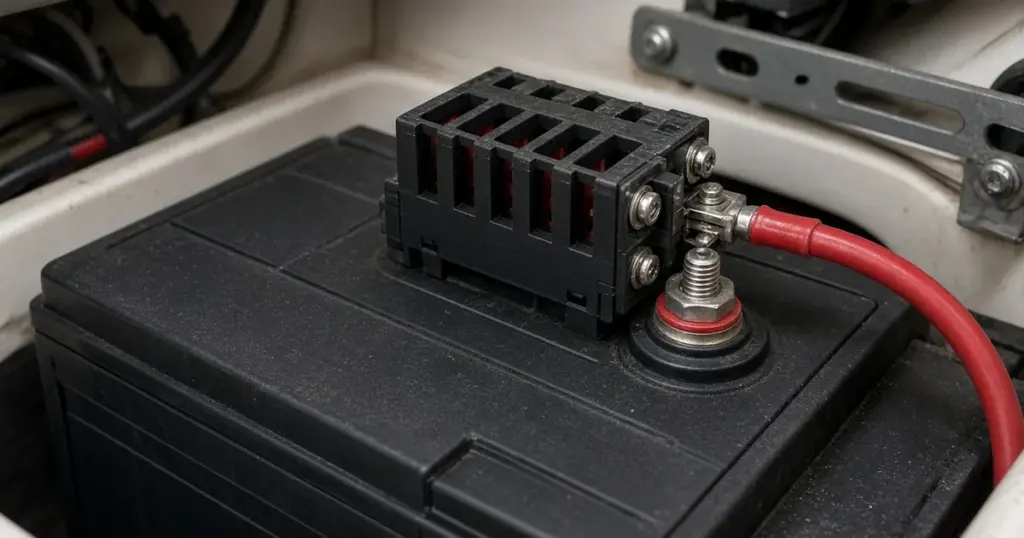
The best place for a battery fuse is as close to the battery as you can get it. A marine rated battery fuse, or MRBF, takes that idea to its limit by mounting directly on the battery terminal stud. There’s no unprotected cable between the battery and the fuse at all. MRBF fuses have become the default main fuse for many trolling motor setups, small lithium banks and accessory circuits. This guide explains how MRBF terminal fuses work, how to size and install them, and where they fit in a boat’s electrical system.
What an MRBF fuse is
An MRBF fuse is a compact, flat fuse element designed to sit in a holder that bolts onto a battery terminal stud. The holder’s base slips over the stud, the fuse links the base to a second stud, and your cable connects to that second stud. Current flows from the battery post, through the fuse, and out to the cable.
Key characteristics:
- Mounts on 3/8″ or 5/16″ battery studs, depending on the holder.
- Ratings from about 30A to 300A, covering most trolling motor, charger and accessory feeds.
- Interrupt rating around 10,000A at 14V, with lower ratings at higher voltages. Check the specific fuse’s data sheet.
- Sealed against moisture and designed for engine room and bilge conditions.
- Ignition-protected versions are available for gasoline engine spaces.
Why mount the fuse on the terminal
ABYC guidance calls for overcurrent protection within about 7 inches of the battery for most conductors. With an inline fuse, it’s easy to end up with a foot or more of unprotected cable, especially in a cramped compartment. A terminal fuse removes that problem entirely. If the cable chafes through anywhere along its run, the fuse is upstream of the fault. For the fundamentals of sizing and placement, see our marine battery fuse guide.
When to use an MRBF fuse
- Trolling motor main feed, fused at the bank’s positive output.
- Main positive of a small house or accessory bank.
- Charger and DC-DC charger leads at the battery end.
- Lithium batteries in parallel, with one fuse per battery so a fault in one battery can’t be fed by the others.
- Feeding a fuse block or busbar from the battery.
For very large lithium banks with big inverters, a Class T fuse may be needed for its much higher interrupt rating. MRBF fuses are a great fit for most small to mid-size systems.
Sizing an MRBF fuse
- Look up the ampacity of the cable leaving the fuse. Our cable size guide lists typical values.
- Find the maximum continuous current of the load.
- Pick a fuse above the load current and at or below the cable’s ampacity.
- Confirm the fuse’s voltage rating covers your system. Many MRBF fuses are rated to 58V, which covers 12V, 24V, 36V and 48V systems.
Typical examples:
- 36V trolling motor on 6 AWG: often a 60A fuse, per the motor maker’s recommendation.
- 12V accessory bank feeding a fuse block on 4 AWG: often 100A to 125A.
- 12V lithium house battery with 2/0 cable: up to 250A to 300A, depending on the inverter and cable.
The marine-rated 58V 300A battery fuse covers the high end of that range.
MRBF fuse blocks
Where several cables leave one battery, a multi-position MRBF block lets you fuse each one separately at the terminal. The Battle Born fuse block for MRBF fuses mounts on the battery post or a bus and accepts several fuses, so the trolling motor, charger and accessory feed each get their own protection.
How to install an MRBF terminal fuse
- Disconnect the battery and remove the existing positive cable.
- Check the stud size against the holder. Most batteries have 3/8″ or 5/16″ studs; lithium batteries often use M8 bolts, which may need an adapter or a holder sized for them.
- Fit the holder base directly on the battery terminal. Nothing goes between the battery terminal and the holder, other than any washer specified by the holder maker.
- Install the fuse on the holder studs, then fit the cable lug on the output stud.
- Torque the nuts to the holder manufacturer’s specification. Over-torquing can crack the holder; under-torquing causes heat.
- Fit the cover. MRBF holders come with protective covers that prevent accidental contact.
- Reconnect and test. Check voltage on the output side and confirm the load works.
Common mistakes
- Putting a ring terminal under the holder base. It raises resistance and can loosen. The holder base should sit flat on the terminal.
- Stacking extra lugs on the battery-side stud. Anything on the battery side of the fuse isn’t protected by it.
- Using the wrong stud size. A loose fit on a small stud heats up.
- Undersized fuse for the motor’s startup current. Trolling motors draw a surge on start; follow the motor maker’s fuse size.
- No cover. An exposed fuse stud is an easy target for a dropped tool.
- Over-tightening on lithium battery terminals. Lithium terminals often have lower torque specs than lead-acid posts.
MRBF vs other fuse types
- MRBF vs ANL: ANL fuses are cheaper and mount in an inline holder, but they add cable length and often have a lower interrupt rating.
- MRBF vs Class T: Class T offers much higher interrupt ratings, often 20,000A, and is the choice for big lithium banks feeding large inverters. It’s bulkier and more expensive.
- MRBF vs circuit breaker: a breaker is resettable and doubles as a switch, which many anglers like on trolling motor circuits. See circuit breaker vs fuse for the trade-offs.
Where MRBF fits in the system
In a typical layout, the MRBF fuse sits on the battery positive. Its cable runs to the battery switch, then to a fuse block or busbar where branch circuits get their own smaller fuses. On a two-battery boat, each battery gets its own terminal fuse before the dual battery switch. Use the right wire colors throughout so the circuit is easy to trace; see our marine wire color codes.
Carrying spares
MRBF fuses aren’t something you’ll find at every bait shop. Keep a spare of each size on board, plus a wrench that fits the holder nuts. Replacing one takes a couple of minutes once you know what’s blown and why.
Checking an MRBF fuse
A blown MRBF fuse may not look blown. To check:
- Turn off loads and open the battery switch.
- Measure voltage from the battery-side stud to battery negative. You should see battery voltage.
- Measure from the output stud to battery negative. If it reads zero while the battery side reads full voltage, the fuse is open.
- Find the cause before replacing it.
For complete system diagrams, see our marine battery wiring guide and browse fuse hardware in our marine battery accessories.
Frequently asked questions
What does MRBF stand for?
Marine Rated Battery Fuse. It’s a fuse designed to mount directly on a battery terminal stud.
What size MRBF fuse do I need for my trolling motor?
Use the trolling motor manufacturer’s recommended fuse or breaker size, and confirm it’s at or below the ampacity of your cable. Many 36V motors call for 60A.
Can MRBF fuses be used on lithium batteries?
Yes. They’re common on lithium batteries, with one fuse per battery in parallel banks. For very large lithium banks with big inverters, a Class T fuse may be recommended instead.
Can I put more than one cable on an MRBF fuse?
You can stack a couple of lugs on the output stud if the stud length and holder rating allow it, but every cable on that stud shares one fuse. A multi-position fuse block is better for separate circuits.
Are MRBF fuses waterproof?
They’re sealed and built for marine conditions, but they still need a cover and should be kept as dry as practical to prevent corrosion.