


Why Lithium Holds Its Voltage: Discharge Curves vs Lead-Acid

Two batteries can have the same amp-hour rating and still behave very differently on the water. Much of that difference comes down to the discharge curve, the way a battery’s voltage changes as you use its energy. If you’ve ever noticed your trolling motor slowing in the afternoon, or your fish finder rebooting when the outboard cranks, you’ve seen a lead-acid discharge curve in action. This guide explains the lithium discharge curve vs lead-acid, why LiFePO4 holds its voltage, and what that means for motors, electronics and reading state of charge.
What a discharge curve shows
A discharge curve plots battery voltage against how much capacity has been used. Picture voltage on the vertical axis and state of charge running from full on the left to empty on the right. The shape of that line tells you how much the voltage sags as the battery drains.
Two things affect the curve:
- Chemistry: each chemistry has its own characteristic voltage profile.
- Load: heavier current draw pulls voltage down further, and the effect is much stronger with lead-acid.
The lead-acid curve: a steady slope
A fully charged 12V lead-acid battery rests at roughly 12.6 to 12.8V, depending on type. As it discharges, resting voltage falls fairly steadily, to around 12.2V at about half charge and lower from there. Under load, the voltage you see at the terminals is lower still, and a big trolling motor at full speed pulls it down noticeably.
Lead-acid also delivers less capacity at high discharge rates. Batteries are commonly rated at the 20-hour rate, and running one hard at a much higher current yields fewer amp-hours than the label says. This rate-dependence is often described by Peukert’s law.
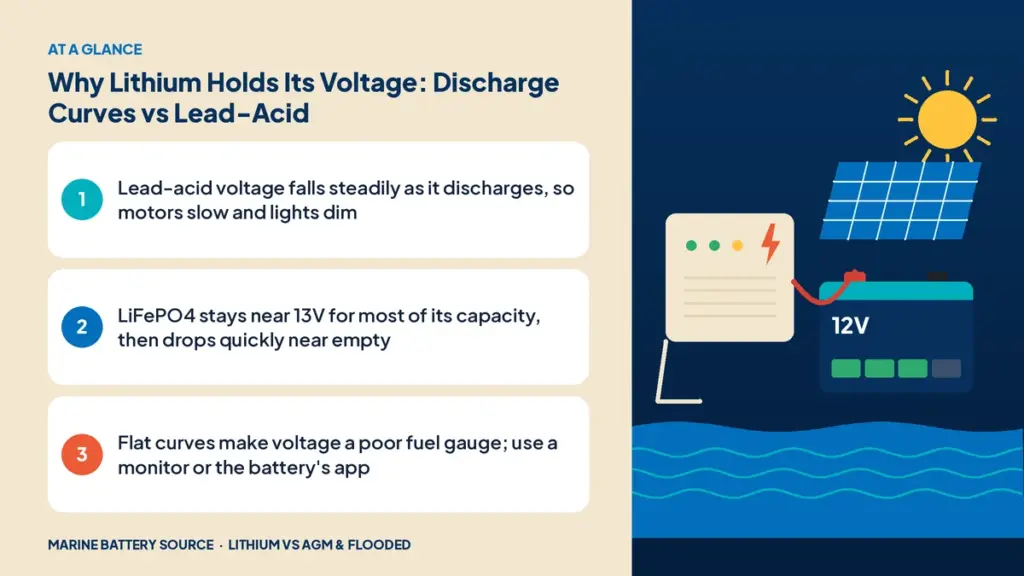
The LiFePO4 curve: a long, flat plateau
A 12V LiFePO4 battery is built from four cells in series with a nominal voltage of 12.8V. After charging, it rests somewhat higher, then settles onto a long plateau. Through most of its usable capacity, the voltage changes only a few tenths of a volt. Near the bottom, voltage drops off sharply, and the BMS disconnects the battery before the cells are damaged.
LiFePO4 is also much less affected by heavy loads. Its capacity at high current stays close to its rating, and voltage sag under load is smaller.
Approximate resting voltages
These are approximate resting values for 12V batteries at moderate temperatures. Exact figures vary by brand, so check your battery maker’s chart.
| Approx. state of charge | Flooded | AGM | LiFePO4 |
|---|---|---|---|
| 100% | about 12.6–12.7V | about 12.8V | about 13.3–13.4V |
| 50% | about 12.1–12.2V | about 12.2–12.3V | about 13.1–13.2V |
| 20% | about 11.8V | about 11.9V | about 12.9–13.0V |
Notice how little the LiFePO4 column changes between 100% and 20%.
What it means on the water
Trolling motors keep their speed
Most trolling motors’ speed depends on the supply voltage. With lead-acid, the same speed setting gets slower as voltage drops. Anglers compensate by turning the motor up, which draws more current and drains the battery faster. With lithium, the motor holds its speed for most of the day. That’s one reason lithium is popular for spot-lock and anchor modes, as our guide to choosing a trolling motor battery explains.
Electronics stay stable
Chartplotters, sonar and radios have minimum operating voltages. When an engine cranks from a lead-acid battery that also powers electronics, the dip can trigger resets. A steadier supply from lithium, or separating starting and house loads, prevents that.
Lights stay bright and pumps stay strong
Livewell pumps, bilge pumps and LED lights all behave better at a steady voltage.
The downside: voltage is a poor fuel gauge
Because the LiFePO4 curve is so flat, voltage tells you little about state of charge in the middle of the range. A few hundredths of a volt can represent a big change in remaining capacity, and any load or recent charging skews the reading. That’s why lithium owners rely on:
- Bluetooth apps built into batteries like the EPOCH 12V 105Ah Essential and the ECO Battery 12V 120Ah, which report state of charge from the BMS.
- Shunt-based battery monitors, which count amp-hours in and out.
- Built-in indicators on some batteries.
A trolling motor’s simple battery meter, designed for lead-acid voltage, may read “full” for hours and then fall quickly. Don’t be surprised when the last part of the day goes fast.
What happens at the bottom of the curve
When a LiFePO4 battery reaches its low-voltage limit, the BMS disconnects the load to protect the cells. On a trolling motor, that can feel sudden: full speed one minute, nothing the next. Plan your capacity with margin and watch the app, so you’re never relying on the BMS cutoff. Lead-acid gives more warning as voltage sags, but by then you’ve often discharged it deeper than is good for its life.
Charging curves differ too
Charging mirrors the discharge picture. LiFePO4 accepts high current for most of the charge, then rises quickly to its absorption voltage near the end. Lead-acid needs a long absorption phase to finish. That’s why lithium usually recharges much faster with a suitably sized charger. Match the charger profile to the chemistry; mixing up profiles can undercharge lithium or overcharge lead-acid.
Choosing with the curve in mind
If steady motor speed and stable electronics matter to you, lithium’s flat curve is a major benefit. If you stay with lead-acid, size the bank generously so you rarely work in the lower part of the curve. For the full chemistry comparison, see lithium vs AGM vs flooded. EFB and gel batteries follow lead-acid behavior; we cover them in our EFB explainer and gel vs AGM. Browse the store’s LiFePO4 batteries or trolling motor batteries to compare options.
Frequently asked questions
Why does my trolling motor slow down during the day?
With lead-acid batteries, voltage drops steadily as they discharge, and most trolling motors slow down as their supply voltage falls. Lithium holds its voltage much longer, so the motor keeps its speed.
Can I tell a lithium battery’s charge from its voltage?
Only roughly. LiFePO4’s flat curve means voltage changes very little across most of its capacity. Use the battery’s app or a shunt-based monitor for an accurate reading.
What voltage is a fully charged 12V lithium battery?
Resting voltage after a full charge is typically around 13.3 to 13.4V, settling lower over time. Check your battery maker’s chart for exact figures.
Why does my lithium battery shut off suddenly?
The BMS disconnects the battery when it reaches its low-voltage limit, among other protections. Because the voltage stays flat until near empty, the cutoff can feel abrupt.