


Lithium vs AGM Cost per Cycle: Total Cost of Ownership
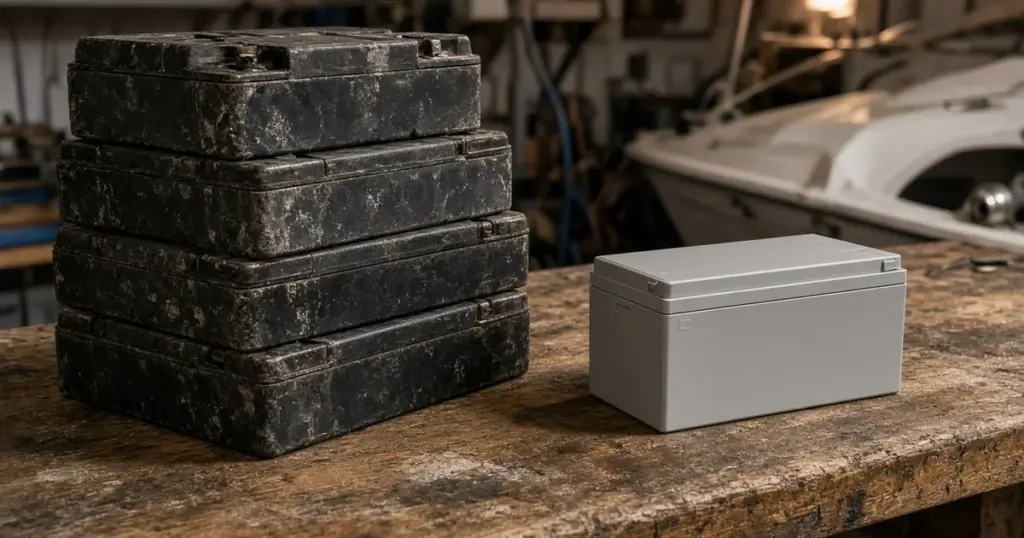
A lithium battery can cost three to five times as much as an AGM with a similar rating. Price tags don’t tell you what each battery costs to own, though. A battery that lasts many times as long and gives you more usable energy each cycle can cost less over its life. This guide shows how to calculate lithium vs AGM cost per cycle and per kilowatt-hour delivered, using the store’s listed prices and the makers’ published ratings, so you can work out the numbers for your own boat.
The two numbers that matter
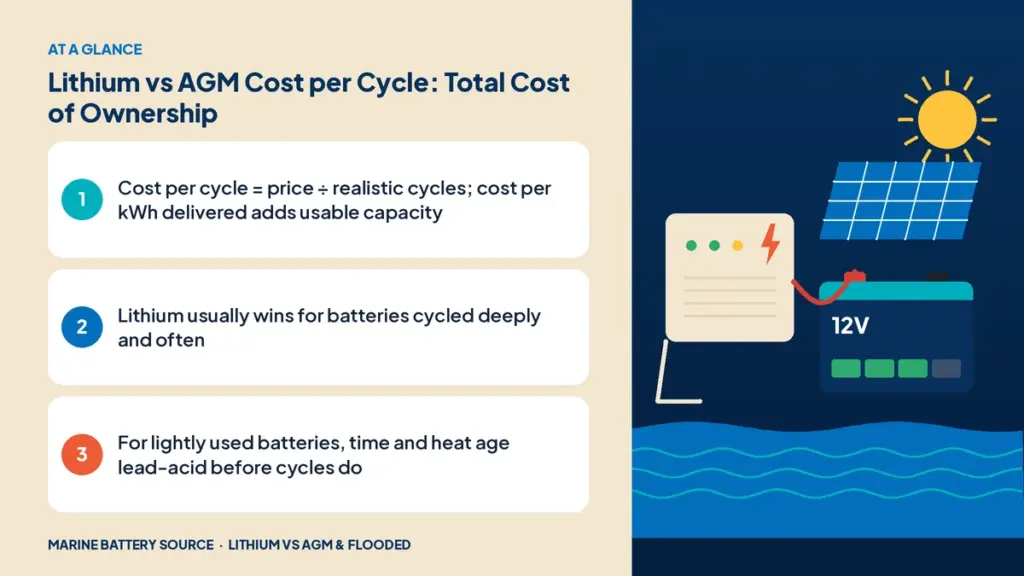
Cost per cycle is the price divided by how many cycles you realistically expect. It’s simple but ignores how much energy each cycle delivers.
Cost per kWh delivered is more useful. It’s the price divided by total energy delivered over the battery’s life:
Total kWh delivered ≈ rated kWh × usable depth of discharge × expected cycles
Then: cost per kWh delivered = price ÷ total kWh delivered.
Inputs you’ll need
- Price, from the product page.
- Rated energy in kWh, or amp-hours × nominal voltage ÷ 1,000.
- Usable depth of discharge you’ll actually use. Common planning figures are about 50% for lead-acid and 80% for LiFePO4.
- Expected cycles at that depth, from the maker’s data sheet. Be conservative, and remember that heat, undercharging and deep discharges shorten lead-acid life.
Worked example with store listings
Take two batteries with similar rated energy:
- EPOCH 12V 105Ah Essential LiFePO4: listed at $549 and 1.34 kWh, with a rating of 4,000 cycles with at least 80% capacity remaining.
- Trojan 31-AES AGM: listed at $402.57 and 1.38 kWh at the 20-hour rate.
For the AGM, use a cycle figure from Trojan’s data sheet at your depth of discharge. We won’t invent one here. To show the method, assume you plan on 500 cycles at 50% depth; substitute the real figure for your battery.
| EPOCH 105Ah LiFePO4 | Trojan 31-AES AGM (example cycles) | |
|---|---|---|
| Price | $549 | $402.57 |
| Usable energy per cycle | 1.34 × 0.8 = 1.07 kWh | 1.38 × 0.5 = 0.69 kWh |
| Cycles used in the math | 4,000 (maker’s rating) | 500 (illustrative) |
| Lifetime energy | about 4,290 kWh | about 345 kWh |
| Cost per kWh delivered | about $0.13 | about $1.17 |
Even if the AGM’s real cycle figure is double the illustrative 500, lithium still comes out well ahead per kWh delivered for a hard-working battery. That’s why lithium has taken over trolling motor banks.
The catch: you have to actually use those cycles
The math above assumes you cycle the battery enough to wear it out. Most recreational boaters don’t. If you fish 40 days a year and run the trolling bank down on each trip, 4,000 cycles would take decades, and the battery’s calendar life, warranty and your future plans become the limit. Lead-acid batteries, meanwhile, often age out from time, heat and sulfation before they reach their cycle rating, especially if they sit partly charged.
So the real-world comparison often looks like this: how many lead-acid batteries would you buy over the years you’ll own one lithium battery?
A more realistic owner’s calculation
- Estimate how many years a lead-acid battery lasts for you. Your own replacement history is the best data.
- Estimate how long the lithium battery will last, and use its warranty as a conservative floor. EPOCH’s Essential batteries carry an 11-year warranty in the store’s listings, and Dakota Lithium’s carry 11 years too.
- Over the same period, add up the number of lead-acid replacements and their prices.
- Add one-time lithium costs: charger, any DC-DC charger and fusing.
- Add the value of benefits you care about, such as weight savings and steady voltage.
Hidden costs on both sides
Lead-acid
- Replacement labor, or your own time and back.
- Distilled water and maintenance for flooded types.
- Lost capacity late in life that cuts trips short.
- Higher charging losses: lead-acid is less efficient to charge, so more of your shore power or engine time goes into heat.
Lithium
- A lithium-compatible charger if yours lacks the profile.
- A DC-DC charger if the alternator charges the bank.
- Fuses and hardware rated for lithium’s short-circuit current.
- Heated models or careful habits if you charge in freezing weather.
Charging efficiency and running costs
Every charge cycle costs something, whether it’s shore power, generator fuel or engine run time. Lead-acid batteries turn more of the charging energy into heat, especially in the final absorption stage, which can take hours. LiFePO4 accepts charge efficiently and finishes much faster. For a boat at a marina with metered power, the difference is small in dollars. For a cruiser running a generator or engine to charge at anchor, shorter charging time means less fuel, less noise and fewer engine hours. Those savings are real but hard to put a precise number on, so treat them as a bonus rather than the core of your calculation.
Running the numbers for a trolling bank
Trolling banks multiply the battery count, so the comparison changes. A 36V lead-acid system needs three batteries, and they should all be replaced together because a new battery in an old series bank gets unbalanced quickly. A single 36V lithium battery, such as the EPOCH 36V 100Ah, replaces all three. When you price the lead-acid side, price a full set of three each time you’d replace them, and count how many sets you’d buy over the lithium battery’s expected life. Add your own labor or installation charges for each swap.
Where each chemistry wins on cost
- Lithium tends to win: trolling banks cycled every trip, liveaboard and cruising house banks, boats in hot climates where lead-acid life is short, and any case where weight saves fuel.
- AGM or flooded tends to win: starting batteries, boats used only a few times a year, and short ownership horizons.
For more context, read our chemistry comparison, the real weight savings of lithium and flooded vs AGM if you’ll stay with lead-acid. To compare more models, browse the store’s lithium range and AGM and lead-acid batteries.
Frequently asked questions
Is lithium cheaper than AGM in the long run?
For batteries cycled deeply and often, usually yes, because LiFePO4 delivers more usable energy per cycle and is rated for many more cycles. For lightly used batteries, the advantage shrinks or disappears.
How do I find the cycle life of my AGM battery?
Check the manufacturer’s data sheet for cycle life at a stated depth of discharge. Cycle life varies a lot with depth, so compare figures at the depth you’ll actually use.
Should I include charger costs in the comparison?
Yes. If you need a lithium-compatible charger or a DC-DC charger, add it to the lithium side. Those parts usually outlast several sets of batteries, though.