


Flooded vs AGM: Choosing a Lead-Acid Marine Battery
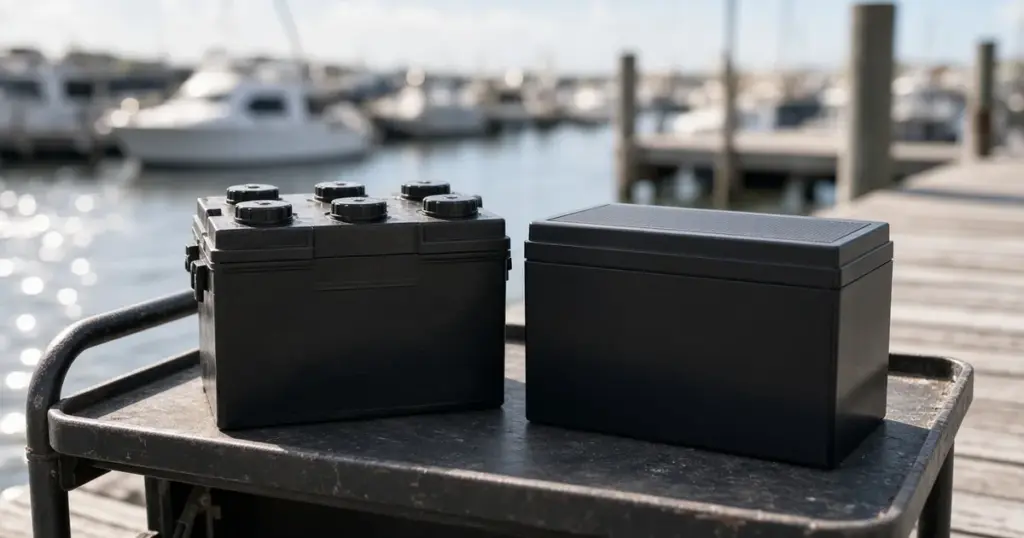
If you’ve decided lithium isn’t right for a particular battery, you still have a choice to make. Lead-acid marine batteries come in two main types, flooded and AGM, and the right one depends on how your boat is used, where the battery lives and how much attention you want to give it. This guide compares flooded vs AGM marine batteries for buying decisions. If you already own one and want upkeep tips, our separate guide to AGM vs flooded maintenance covers that side.
How they’re built
Both are lead-acid batteries with lead plates and sulfuric acid electrolyte. The difference is how the electrolyte is held.
- Flooded (wet cell): the plates sit in free liquid electrolyte. Removable caps let you check levels and add distilled water. The battery vents hydrogen and oxygen during charging.
- AGM (absorbed glass mat): the electrolyte is soaked into fiberglass mats pressed between the plates. The case is sealed and uses pressure-relief valves, so most of the gas recombines inside. Nothing sloshes, and there’s nothing to top up.
The key differences
| Flooded | AGM | |
|---|---|---|
| Purchase price | Lower | Higher |
| Watering | Required | Never |
| Spill risk if cracked | Acid can leak | Very low |
| Mounting | Upright only | Per the maker; often any orientation except inverted |
| Gassing | Vents during charge; needs ventilation | Minimal under correct charging |
| Vibration tolerance | Good to fair | Generally better |
| Self-discharge in storage | Faster | Slower |
| Charging sensitivity | Tolerant | Needs correct voltage; overcharging dries it out |
| Equalizing | Periodically, if the maker recommends | Usually not, unless the maker says so |
Cost and value
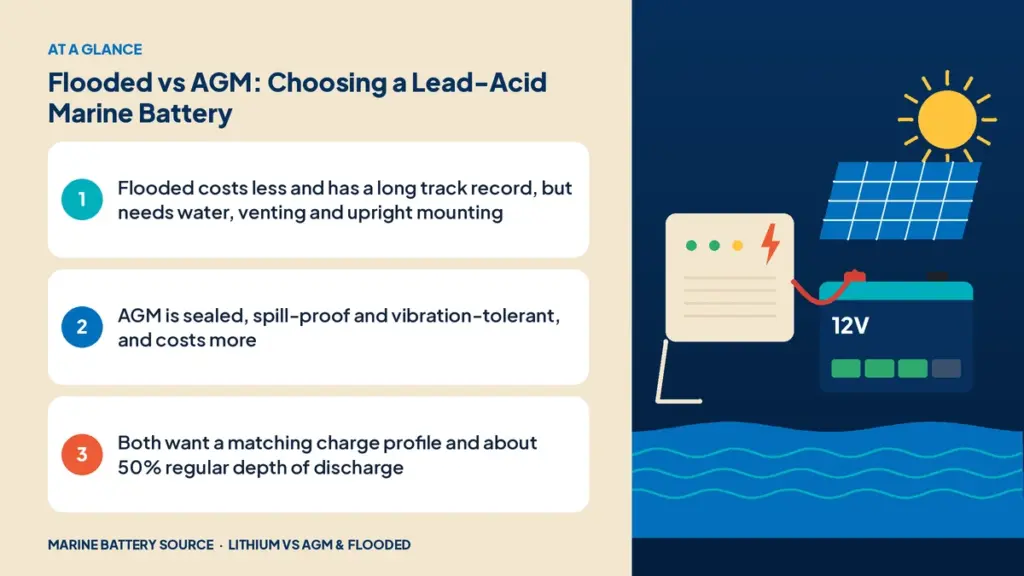
Flooded batteries deliver the most amp-hours per dollar of any marine battery. Compare two Group 27 deep-cycle batteries in the store: the Trojan 27TMX flooded and the Trojan 27-AES AGM. The flooded model costs less and is listed at 1.40 kWh at the 20-hour rate and 55 lb. The AGM is listed at 1.19 kWh and 66 lb. Here, the flooded battery is cheaper, lighter and stores more energy, and the AGM’s advantages are sealing, spill resistance and low maintenance. That’s often the trade.
Maintenance: the deciding factor for many owners
Flooded batteries need regular checks. After charging, the electrolyte should cover the plates by the amount the maker specifies, and you top up with distilled water only. You’ll also clean acid residue from the case top and terminals. On a boat where batteries sit under a hatch you rarely open, or in a tight compartment where you can’t see the caps, that’s a real drawback. Neglected flooded batteries that run low on water are permanently damaged.
AGM batteries skip all of that. Keep them charged, keep the connections clean and tight, and they’re happy.
Mounting and ventilation
Flooded batteries must stay upright, and the compartment needs ventilation so hydrogen can’t accumulate. Hydrogen is explosive in the right concentration. AGM batteries vent much less under correct charging, but they’re not completely gas-free, especially if overcharged, so don’t seal any battery in an airtight box. AGM’s flexibility in mounting orientation, within what the maker allows, can help in cramped hulls.
Charging differences
Flooded batteries tolerate a range of charge voltages and benefit from occasional equalization if the maker recommends it. AGMs are less forgiving: overcharge one and you vent electrolyte you can never replace. Use a charger with an AGM setting, and check that your onboard charger, alternator regulator and any solar controller all use appropriate voltages. Never equalize an AGM unless the maker specifically allows it.
Heat, vibration and storage
In hot climates like Florida, both types lose life faster. Flooded batteries also lose water faster in heat, so they need more frequent checks. AGMs have lower self-discharge, so they hold charge better during storage, which helps boats that sit between trips. For boats that pound through chop, AGM’s packed construction generally tolerates vibration better.
Which to choose for each job
Starting battery
Both work well. Flooded is the budget choice if you can reach the caps. AGM is a good upgrade when access is poor or the boat sees rough water. Interstate’s lineup includes both, for example the Interstate SRM-27 flooded and the Interstate 27M-AGM-A.
Trolling motor or house bank
Flooded deep-cycle batteries are the cost-effective choice for owners who’ll maintain them. AGM suits owners who want sealed batteries with no watering. If you’re cycling hard every trip, also look at lithium. Our lithium vs AGM vs flooded guide covers all three, and our cost-per-cycle guide shows how the long-run costs compare.
Hard-to-reach locations
AGM, almost every time.
Don’t mix them in one bank
Within a single bank, use batteries of the same type, age, capacity and maker. Flooded and AGM batteries charge to different voltages, and mixing them means one is always overcharged or undercharged. Separate banks with separate charging are fine.
Is there a middle option?
Enhanced flooded batteries (EFB) sit between standard flooded and AGM in durability and price, and some marine dual-purpose models use the design. See what an EFB marine battery is. Gel batteries are another sealed lead-acid type, compared in gel vs AGM.
Browse the store’s AGM and lead-acid batteries to compare flooded and AGM models by group size.
Frequently asked questions
Is AGM better than flooded for a boat?
AGM is sealed, maintenance-free and more tolerant of vibration, which suits many boats. Flooded batteries cost less and can store more energy for the money if you’re willing to check water and keep them upright in a ventilated space.
Can I replace a flooded battery with an AGM?
Usually, if it fits and your charging sources can be set to AGM voltages. Check your onboard charger, alternator regulator and any solar controller settings.
How often should I check water in a flooded marine battery?
Check regularly, more often in hot weather and during heavy use. Add distilled water after charging, to the level the maker specifies, unless the plates are exposed, in which case add just enough to cover them before charging.
Do AGM batteries last longer than flooded?
Not automatically. Life depends on design, depth of discharge, charging and heat. A well-maintained flooded deep-cycle battery can outlast an AGM that’s chronically undercharged or overcharged.