


What Is an EFB Marine Battery?
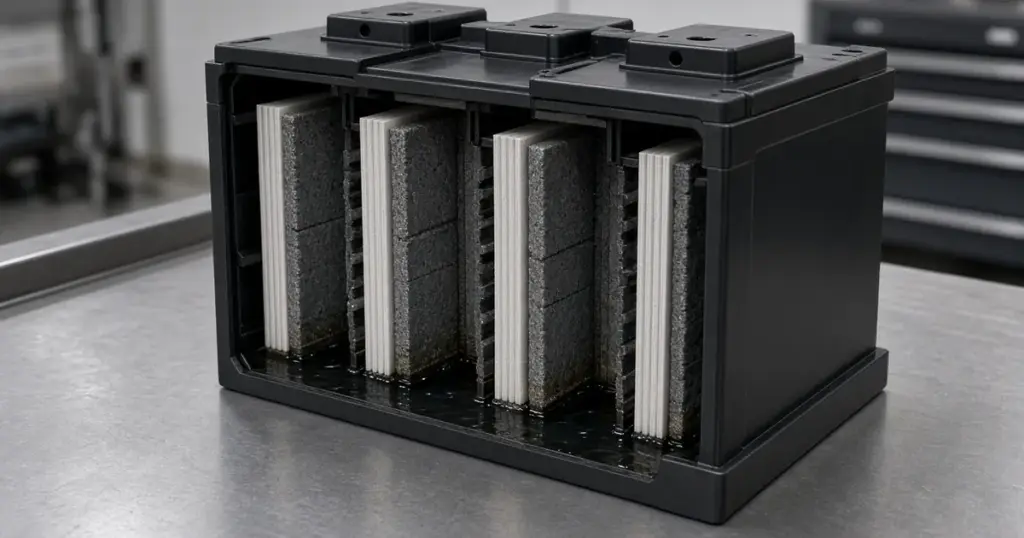
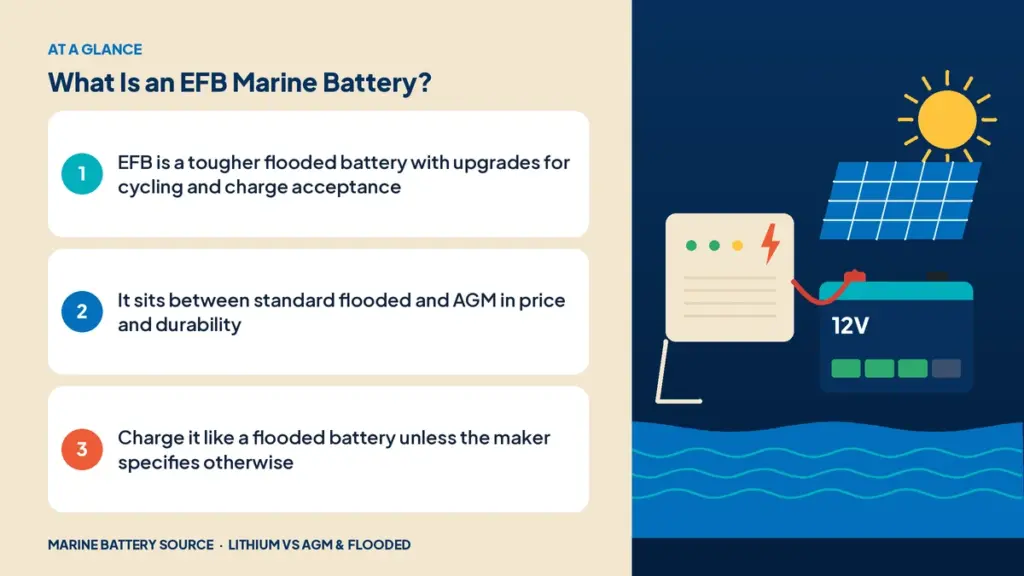
Walk past the marine battery shelf and you’ll see labels like flooded, AGM, lithium and, more recently, EFB. EFB stands for enhanced flooded battery. The design originally spread through cars with start-stop engines, which needed something tougher than a basic flooded battery but cheaper than AGM. Now it’s showing up in marine starting and dual-purpose batteries. So what is an EFB marine battery, and when does it make sense on a boat?
EFB in plain terms
An EFB is still a flooded lead-acid battery. It has liquid electrolyte, lead plates and vents. Manufacturers improve on the standard design in ways meant to help it handle more cycling and accept charge more readily. The specifics vary by maker, but common enhancements include:
- Carbon or other additives in the plate material to improve charge acceptance and reduce sulfation.
- Extra material, such as a fiber scrim, on the plates to hold active material in place during cycling.
- Construction tweaks that reduce acid stratification, where heavier acid settles at the bottom of the cells.
The goal is a flooded battery that survives repeated partial discharges better than a standard one.
Where EFB sits between flooded and AGM
| Trait | Standard flooded | EFB | AGM |
|---|---|---|---|
| Electrolyte | Free liquid | Free liquid | Absorbed in glass mat |
| Price | Lowest | Middle | Higher |
| Cycling durability | Baseline | Improved | Generally better still |
| Charge acceptance | Baseline | Improved | Good |
| Spill-proof | No | No | Yes |
| Mounting | Upright | Upright | Per maker |
EFB isn’t a replacement for AGM in every case. If you need a sealed, spill-proof battery, AGM or lithium is still the answer. But if you’d otherwise buy a standard flooded battery and want more durability for the money, EFB is worth a look.
EFB marine batteries in the store
Interstate offers EFB models in common marine sizes. Compare these Group 24M batteries using their listed specs:
| Battery | Type | CCA | MCA | Reserve capacity | Listed price |
|---|---|---|---|---|---|
| Interstate SRM-24 | Flooded | 550 | 690 | 140 min | $159.95 |
| Interstate 24M-EFB | EFB | 590 | 700 | 140 min | $214.95 |
| Interstate 24M-AGM-A | AGM | 750 | 940 | 140 min | $259.95 |
All three list the same 140-minute reserve capacity. The EFB adds a little cranking current over the standard flooded model and a longer free-replacement period: the store lists 24 months for the 24M-EFB against 12 months for the SRM-24. The AGM adds significantly more cranking amps and sealed construction. There’s also a Group 27M EFB, listed at 675 CCA, 800 MCA and 160 minutes reserve capacity.
Where EFB fits on a boat
Good fits
- Starting batteries on outboards and small inboards where you want more durability than a basic flooded battery.
- Dual-purpose roles on small boats, where one battery starts the engine and also runs electronics and a few accessories at anchor.
- Boats that sit partly charged between short trips, because the enhancements target the sulfation that comes with partial charge.
Less ideal
- Heavy deep-cycle duty, such as a trolling motor bank discharged deeply every trip. A true deep-cycle flooded battery, an AGM, or lithium is the better tool.
- Hard-to-reach locations where you can’t check water. EFB is still flooded and may need topping up depending on the design.
- Locations where the battery can’t stay upright.
Charging an EFB marine battery
Unless the manufacturer says otherwise, charge an EFB with a flooded lead-acid profile. Some chargers have a specific EFB or start-stop setting; check the battery maker’s recommended voltages and pick the closest match. Like any lead-acid battery, an EFB lasts longest when it’s recharged promptly after use and not left sitting partly discharged. Alternator charging works the same as with standard flooded batteries.
Maintenance
Treat an EFB like other flooded batteries:
- Keep it upright and in a ventilated compartment.
- Check electrolyte levels if the battery has removable caps, and top up with distilled water as needed.
- Keep terminals clean and tight, and use a protectant in saltwater environments.
- Store it fully charged, and use a maintainer during long layups.
Reading EFB specs on a product page
When you compare an EFB with other batteries, look at the same handful of numbers. CCA and MCA tell you about cranking: CCA is measured at 0°F and MCA at 32°F, so MCA is always the higher figure. Reserve capacity tells you how many minutes the battery can supply 25 amps before it reaches a cutoff voltage, which is a useful proxy for running electronics with the engine off. Group size tells you whether it fits your tray, and the “M” on Interstate’s sizes such as 24M and 27M marks marine versions of those sizes. Finally, check the free-replacement period, since it’s a reasonable signal of how long the maker expects the battery to hold up.
EFB vs lithium
If your main goals are long life under deep cycling, light weight and steady voltage, EFB doesn’t compete with lithium; it’s a lead-acid battery with lead-acid behavior. Our article on discharge curves shows why. But for a starting or light dual-purpose battery on a budget, EFB can be a smart middle ground. For a full comparison of all the chemistries, read lithium vs AGM vs flooded, and if you’re weighing the cost of moving to lithium entirely, see lithium vs AGM cost per cycle.
Choosing between flooded, EFB and AGM
Ask three questions:
- Can I reach the battery to check water? If not, choose AGM or lithium.
- How hard does this battery cycle? For starting and light accessory loads, EFB is a good upgrade. For deep daily cycling, look at deep-cycle AGM or lithium.
- What’s my budget? EFB costs more than flooded and less than AGM.
Browse the store’s dual-purpose batteries to compare EFB, AGM and lithium options side by side.
Frequently asked questions
What does EFB stand for on a battery?
EFB stands for enhanced flooded battery. It’s a flooded lead-acid battery with design upgrades that improve cycling durability and charge acceptance.
Is an EFB battery better than AGM?
Not generally. AGM is sealed and spill-proof and usually more durable under cycling. EFB is a lower-cost step up from standard flooded batteries.
Can I use an AGM charger setting on an EFB battery?
Use the setting the battery maker recommends. Most EFBs charge on a flooded or dedicated EFB profile, and voltages differ from AGM.
Is an EFB battery good for a trolling motor?
For light trolling on a small boat it can work, but for regular deep cycling a true deep-cycle battery or lithium is a better choice.