


How Much Weight Does a Lithium Marine Battery Save?
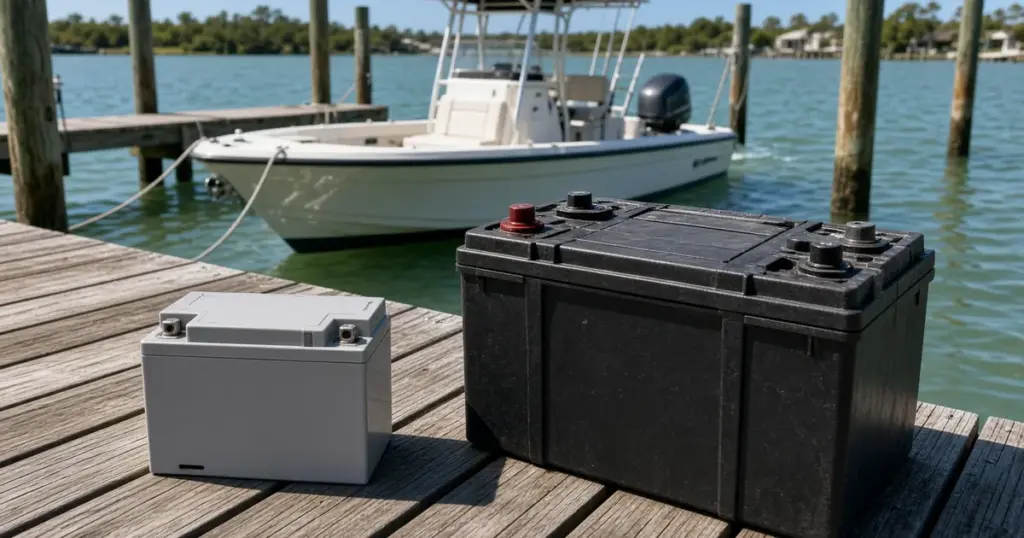
Lithium’s weight advantage is the benefit boaters notice first. But “lithium weighs a third as much” is a slogan, not a number you can plan with. To know what you’ll actually save, compare listed weights for batteries that do the same job and deliver similar usable energy. This guide uses the published weights of batteries the store carries to show how much a lithium marine battery saves in 12V, 24V and 36V setups, and what that weight is worth on the water.
Compare usable energy, not just amp-hours
A fair comparison accounts for how much of each battery you’ll actually use. A common planning rule is about 50% depth of discharge for regular lead-acid cycling, while LiFePO4 is typically used to 80% or more. So a lead-acid battery with the same rated capacity as a lithium battery gives you far less everyday energy. When you match usable energy, the weight gap gets even bigger than the label suggests.
12V examples using listed weights
| Battery | Type | Listed capacity | Listed weight |
|---|---|---|---|
| Trojan 31-AES | AGM, Group 31 | 1.38 kWh (20-hr) | 69 lb |
| Trojan 24TMX | Flooded, Group 24 | 1.13 kWh (20-hr) | 47 lb |
| EPOCH 12V 105Ah Essential | LiFePO4, Group 24 size | 1.34 kWh | 22.1 lb |
| Battle Born 100Ah | LiFePO4, Group 27/31 size | 100Ah at 12V | 31 lb |
The Trojan 31-AES and the EPOCH 105Ah store similar rated energy. The lithium weighs about a third as much, and because you can use more of it, it delivers more everyday energy too. To match the lithium’s usable energy with lead-acid at 50% depth, you’d need roughly two AGM batteries, close to 140 lb, against 22 lb.
24V and 36V trolling banks
Trolling motor banks are where weight adds up fastest.
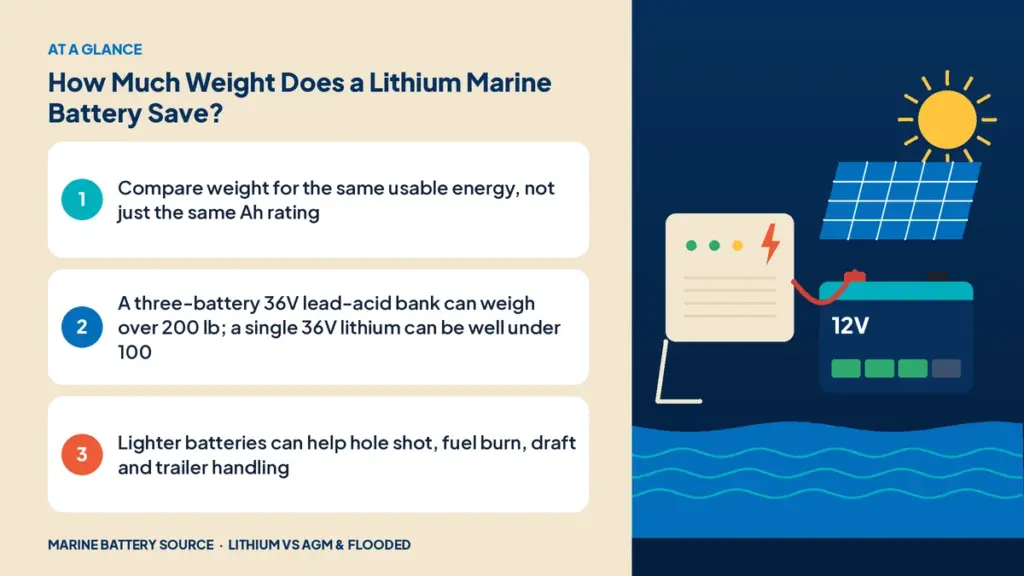
- 36V lead-acid bank: three Group 31 AGMs like the Trojan 31-AES total about 207 lb.
- 36V lithium, single case: the Dakota Lithium 36V 60Ah is listed at 44 lb, and the larger EPOCH 36V 100Ah at 75 lb.
- 24V lithium, single case: the Dakota Lithium 24V 60Ah is listed at 24.9 lb.
Even the big EPOCH 36V 100Ah, which is listed at 3.84 kWh, weighs about 130 lb less than three Group 31 AGMs that store about 4.1 kWh rated and much less usable. For a bass or bay boat, that’s like leaving a large passenger at the dock.
Where the weight savings show up
Hole shot and planing
Less weight, especially in the stern where batteries usually live, helps the boat climb onto plane faster and stay on plane at lower speeds.
Fuel burn and range
Lighter boats need less power at cruise. The effect depends on the hull and engine, but shedding 100 lb or more is noticeable on small and mid-size boats.
Draft and shallow-water access
Flats and bay boat owners care about every inch of draft. Removing weight lets the hull float higher.
Balance and trim
Heavy batteries in one corner can list a small boat. With lithium, you have more freedom to place batteries for balance. Our guide to choosing a trolling motor battery covers fit and placement.
Trailer, tow vehicle and handling
Lower trailer weight is easier on the tow vehicle and makes launching and retrieving easier.
Your back
A lead-acid Group 31 battery is a heavy, awkward lift into a deep compartment. Lithium makes installation, removal and winter storage much easier.
Weight isn’t the only thing that changes
Lithium also holds steady voltage, which our article on lithium vs lead-acid discharge curves explains. It needs a lithium-ready charger and appropriate fusing. And it costs more up front, so weigh the savings against the price with our cost-per-cycle breakdown.
Do you have to replace everything to save weight?
No. The biggest single saving on a fishing boat usually comes from the trolling bank, which often has two or three batteries. Many owners convert that bank first and keep a lead-acid starting battery. Keep separate chemistries in separate banks with their own charging.
What about very small boats?
On kayaks and canoes, weight matters in a different way: you carry the battery. A compact battery like the Dakota Lithium 12V 46Ah U1, listed at 10.5 lb, can run a small trolling motor or electronics in a package that’s easy to carry to the launch.
A worked example: a 24V bay boat bank
Say your bay boat runs a 24V trolling motor from two Group 27 AGMs, plus a Group 24 flooded starting battery. Using the store’s listings, two Trojan 27-AES batteries weigh 66 lb each, or 132 lb together. A single 24V lithium battery such as the Dakota Lithium 24V 60Ah, listed at 24.9 lb, or the EPOCH 24V 100Ah, listed at 48.5 lb, replaces both. That’s a saving of roughly 85 to 107 lb, depending on which capacity you need, before you touch the starting battery. If the old AGMs were usually run to about half charge, the lithium options also give you similar or more usable energy per trip.
Where that weight came out matters too. Batteries usually sit aft or in the console. Taking 100 lb out of the stern changes how the boat trims at idle and how quickly it gets on plane. You may find you need less trim tab or can carry an extra passenger without the boat squatting.
Weight and the rest of the boat
Lighter batteries don’t change the weight of everything else, so the gain is proportionally largest on small boats. On a 16-foot jon boat with a tiller outboard, a 50 lb saving is a big share of the payload. On a 30-foot center console with twin engines, the same saving is barely noticeable, and the case for lithium rests more on usable capacity and cycle life.
Checking weight before you buy
Product pages list weight, dimensions, capacity and group size. When comparing:
- Add up the weight of your current batteries.
- Find lithium options that fit the compartment and meet your capacity and current needs.
- Compare total weight and usable energy, not just Ah.
- Check that your hold-downs and trays still secure the lighter battery properly.
For the bigger picture on chemistry, start with our lithium vs AGM vs flooded guide, or see flooded vs AGM if you’re staying with lead-acid.
Frequently asked questions
How much lighter is a lithium marine battery than AGM?
Using the store’s listings, a 12V 105Ah EPOCH LiFePO4 is 22.1 lb, while a Group 31 Trojan AGM with similar rated energy is 69 lb. Because more of the lithium’s capacity is usable, the real-world gap is even larger.
Does a lighter battery make a boat faster?
It can improve hole shot, planing and efficiency, particularly on small and mid-size boats where 100 lb or more is a meaningful share of total weight. Top speed gains depend on the hull and engine.
Is a lighter battery still secure in a battery box?
It must be. Check that your tray and hold-down fit the new battery’s dimensions and hold it firmly. Some lithium batteries have their own trays or mounting brackets.