


One 24V Lithium Battery vs Two 12V Batteries in Series
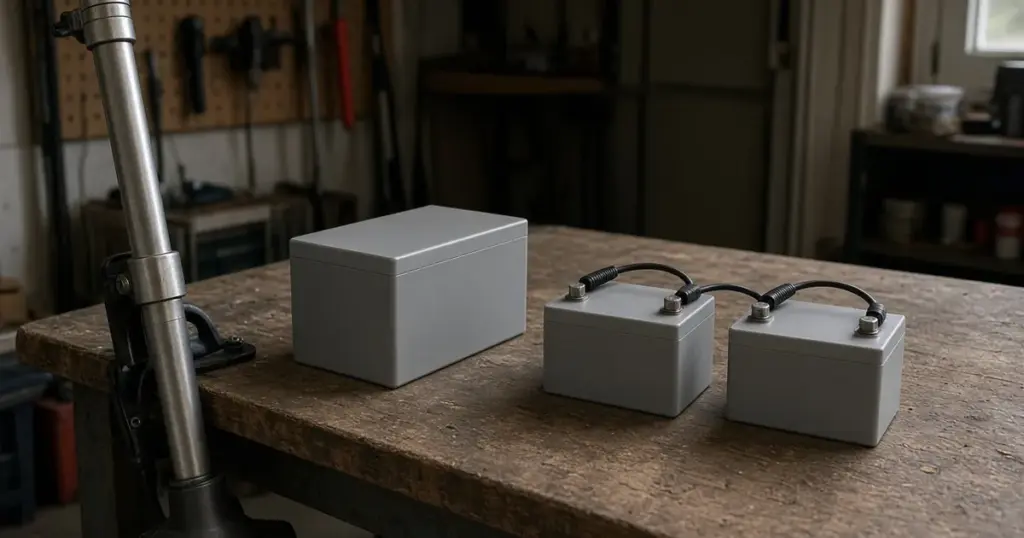
A 24V trolling motor needs 24 volts, and there are two ways to get it. The traditional route is two 12V batteries wired in series. The newer route is a single 24V lithium battery in one case. Both work well. The right choice depends on your compartment, your charger, what else you power, and how you feel about putting all your eggs in one battery box. This guide compares the two side by side.
How each option works
Two 12V in series. Connect the positive of battery one to the negative of battery two. The free negative of battery one and the free positive of battery two feed the motor at 24V. Capacity stays at the amp-hour rating of one battery. Two 100Ah 12V batteries in series give 24V at 100Ah.
One 24V battery. The cells are already arranged in series inside the case, so you get 24V from two terminals. A 24V 100Ah battery holds the same energy as two 12V 100Ah batteries in series: about 2.56 kWh nominal for LiFePO4.
So energy is not the deciding factor. Packaging, charging and flexibility are. For the basics of each voltage, see our 24V trolling motor battery guide.
Side-by-side comparison
| Factor | One 24V lithium | Two 12V in series |
|---|---|---|
| Battery count | One | Two |
| Interconnect jumper | None | One series jumper |
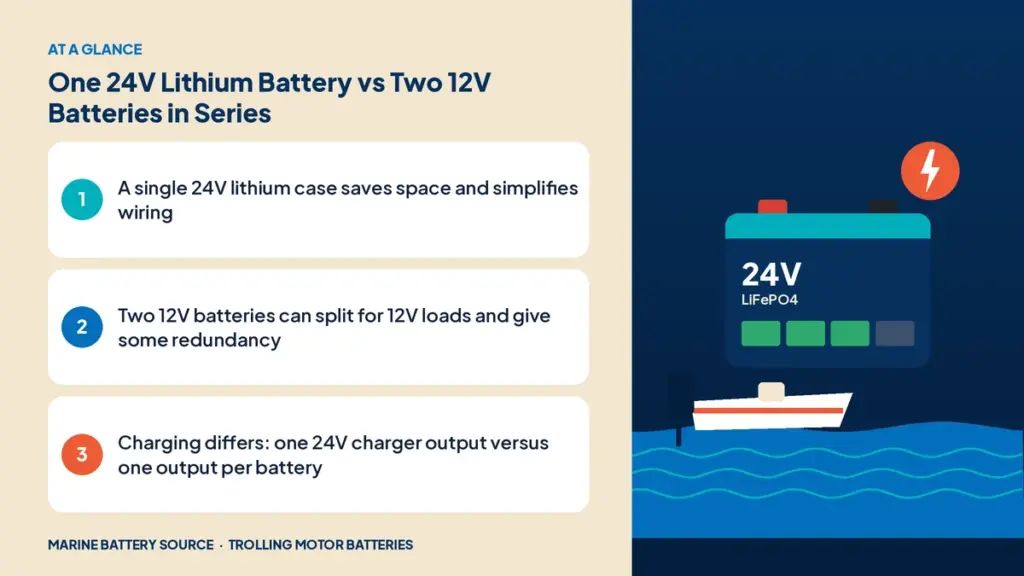
| Charger | 24V lithium charger or a 24V output | One 12V output per battery (multi-bank) |
| Space | One footprint, often taller or longer | Two footprints, can be split between spots |
| 12V loads | Need a DC-DC converter | Possible but unbalances the string, so not recommended |
| Failure impact | One battery down = motor down | One battery down = motor down |
| Replacement | Replace one unit | Can replace one battery if both are lithium and matched |
Real examples from the store
Single-case 24V options include:
- EPOCH 24V 100Ah: 2.56 kWh, listed at 48.5 lb with Bluetooth and heating.
- Interstate Li31M 24V 60Ah: a Group 31M case for anglers who need 24V in a single standard footprint.
- The EPOCH 24V 60Ah Pro Series in a Group 27 size, listed at 30 lb.
- The Battle Born 50Ah 24V in a Group 27/31 case, listed at 31 lb.
For the two-battery route, two 12V 100Ah lithium batteries such as the EPOCH 12V 100Ah Eco (21 lb each) give the same 24V 100Ah result. Dakota Lithium also sells matched 24V sets of two 12V batteries.
Space and weight
A single 24V battery usually saves the most space when your compartment fits its footprint. Many 24V 100Ah batteries are bigger than a Group 31 case, so measure carefully. Two 12V batteries can be placed side by side or in different compartments, which helps balance a small boat. For trim considerations, see our battery placement guide.
Weight is close either way for the same chemistry and capacity. The larger difference is between lithium and lead-acid. If you’re considering a sealed lead-acid set instead, our AGM trolling motor battery guide covers the trade-offs.
Charging differences
This is where the two approaches really differ.
Two 12V batteries
A two-bank onboard charger charges each battery separately at 12V. That’s the classic bass boat setup, and it keeps each battery balanced without relying on the series connection. If your boat already has a two-bank charger with a lithium profile, two 12V lithium batteries drop right in.
One 24V battery
You need a 24V charger, or a charger with a 24V output, set to a lithium profile. The store carries options such as the EPOCH 24V 15A lithium charger and the Dakota Lithium 24V 10A charger. An existing two-bank 12V charger won’t charge a single 24V battery correctly.
The full charging picture is in our guide on charging trolling motor batteries.
Powering 12V accessories
Some anglers tap one battery of a 24V series pair to run a 12V fish finder. That unbalances the string, because one battery is discharged more than the other, and it can introduce electrical noise. The cleaner options are a separate 12V battery for electronics, or a 24V-to-12V DC-DC converter sized for the load. With a single 24V battery, a converter is the only way to get 12V from it.
Redundancy and replacement
Neither layout gives true redundancy for the motor, since both batteries must work to make 24V. But two 12V batteries give some flexibility: if one fails out of warranty, you may be able to replace only that one, provided you match it to the survivor. With lead-acid, replace both together. With lithium, follow the maker’s guidance on mixing batteries of different ages.
A single battery with Bluetooth monitoring gives you one place to check state of charge, which many owners find simpler.
Cost
Pricing varies, but a single 24V lithium battery is often in the same range as two quality 12V lithium batteries of the same capacity. Factor in the charger. If you already own a good two-bank lithium charger, two 12V batteries may cost less overall. If you’re buying a new charger anyway, a single 24V setup becomes more attractive.
Which should you choose?
Choose one 24V battery if:
- Your compartment fits its footprint.
- You want the simplest wiring with no series jumper.
- You’re buying a new charger anyway.
- You like a single state-of-charge readout.
Choose two 12V batteries if:
- You already have a two-bank charger with a lithium profile.
- Your compartment favors two smaller cases.
- You may later reconfigure batteries for another boat or a 12V motor.
Thinking bigger? Higher-voltage systems are covered in 48V trolling motors and batteries, and the 12V side is in our 12V trolling motor battery guide. For the full system view, start with the trolling motor power system guide or our pillar on choosing a trolling motor battery. Browse trolling motor batteries to compare sizes.
Frequently asked questions
Is one 24V battery better than two 12V batteries?
Neither is better in energy terms. A 24V 100Ah battery and two 12V 100Ah batteries in series hold the same energy. The single battery saves wiring and space; two 12V batteries work with existing two-bank chargers and offer more placement flexibility.
Can I charge a 24V lithium battery with a two-bank 12V charger?
No. A single 24V battery needs a 24V charger or a 24V charger output with the correct lithium profile.
Can I run a 12V fish finder from a 24V battery?
Use a 24V-to-12V DC-DC converter rated for the load, or power electronics from a separate 12V battery.
Do two 12V batteries in series double the amp-hours?
No. Series wiring doubles voltage while capacity stays at one battery’s amp-hour rating.