


How Long Does It Take to Charge a Marine Battery?
After a long day on the water, the question is simple: will the batteries be ready for tomorrow? The answer depends on how much energy you used, how big your charger is and what chemistry you run. This guide explains how long it takes to charge a marine battery, with simple math, worked examples and the factors that slow things down.
The basic formula
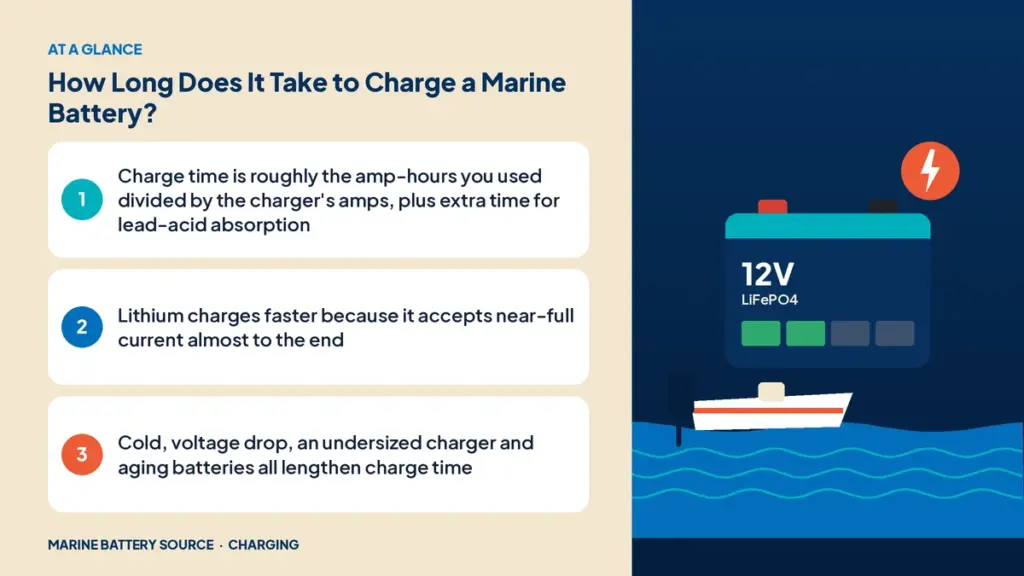
Charge time (hours) ≈ amp-hours to replace ÷ charger output (amps)
That gives the bulk charging time, when the charger delivers close to its full rated current. Then adjust for chemistry:
- Lead-acid (flooded and AGM): add about 2 to 4 hours for the absorption stage, when current tapers as the battery approaches full.
- Lithium (LiFePO4): add only a short time, often 15 to 30 minutes, because lithium accepts high current until it’s nearly full.
Also add a little for charger efficiency and cable losses. A 10% to 20% allowance is reasonable.
How much did you use?
You need to know how many amp-hours to replace. Ways to estimate:
- Battery monitor or Bluetooth app: the most accurate. Many lithium batteries report state of charge directly.
- Resting voltage for lead-acid: after several hours of rest, 12.7V is roughly full and 12.2V roughly half.
- Load math: add up your loads in amps multiplied by hours used.
Worked examples
| Battery | Used | Charger | Estimated time |
|---|---|---|---|
| 12V 100Ah AGM | 50Ah | 10A | 5 h bulk + 2–4 h absorption ≈ 7–9 h |
| 12V 100Ah AGM | 50Ah | 25A | 2 h bulk + 2–3 h absorption ≈ 4–5 h |
| 12V 100Ah lithium | 80Ah | 15A | About 5.5–6 h |
| 12V 100Ah lithium | 80Ah | 50A | About 1.75–2 h |
| 36V 100Ah lithium | 70Ah | 15A (36V) | About 5 h |
| 12V 300Ah lithium house bank | 200Ah | 50A | About 4.5 h |
Note that a 36V battery’s charge time depends on its own amp-hours and the 36V charger’s amps. A 36V 15A charger replaces 15Ah per hour from a 36V battery, just as a 12V 15A charger does from a 12V battery.
Why lead-acid takes longer
Lead-acid batteries can’t accept full current all the way to full. As they approach about 80% state of charge, internal resistance rises and the charger must hold a constant voltage while the current slowly falls. That absorption stage is essential for battery life: chronically skipping it leads to sulfation and lost capacity. It’s also why lead-acid batteries take a long time to go from 80% to 100%.
Why lithium is faster
Lithium batteries have low internal resistance and a flat voltage curve. They take near-full current until they’re close to full, then finish quickly. Many lithium batteries also accept higher charge rates than lead-acid of the same size. That’s why a lithium bank can be refilled in an afternoon at the dock, while a lead-acid bank of similar usable capacity may need overnight. Learn more in charging lithium batteries on a boat.
The charger matters
- Amp rating: a larger charger shortens bulk time, within the battery’s limits.
- Profile: the right profile ensures full charge. See charge profiles explained.
- Banks: on multi-bank chargers, each bank charges its battery separately at its own rated current.
- Type: portable and onboard chargers work the same way; see portable vs onboard chargers.
Store examples include the EPOCH 12V 15A lithium charger for overnight charging and the EPOCH 12V 50A lithium charger for faster turnaround on larger batteries.
Things that slow charging down
- Cold temperatures: lead-acid accepts charge more slowly in the cold; most lithium batteries won’t charge below about 32°F unless heated.
- Heat: some chargers reduce output when hot, and batteries may limit charge current.
- Voltage drop: long, thin charger cables reduce the voltage at the battery and slow the final stages.
- Parasitic loads: a bilge pump, stereo memory or electronics left on take some of the charger’s output.
- Aging batteries: sulfated lead-acid batteries charge slowly and may never reach full.
- Wrong profile: a lithium battery on a lead-acid profile may stop short, and vice versa.
Charging underway
Charging time on the water depends on alternator output, DC-DC charger rating or solar input. A 20A DC-DC charger replaces about 20Ah per hour of running; a 100W solar panel might add 25Ah to 35Ah on a sunny day. See charging on the water for details.
Mixed systems
If you run a lithium trolling bank and a lead-acid starting battery, the starting battery usually needs little charge while the trolling bank needs a lot. A multi-bank charger handles both, each at its own rate. Our guide to charging lithium trolling and lead-acid starting batteries covers the setup.
Can I charge faster?
- Use a larger charger, staying within the battery maker’s maximum charge current.
- For lead-acid, accept that the last 20% takes time; consider lithium if fast turnarounds matter.
- Shorten and upsize charger cables.
- Charge at moderate temperatures.
Avoid trying to speed lead-acid charging by using a lithium charger or vice versa. See charging lithium with a lead-acid charger for why profiles matter.
How do I know it’s done?
- Most smart chargers show a “full” or “float” indicator.
- Lithium batteries with Bluetooth report 100% state of charge.
- For lead-acid, resting voltage several hours after charging should be about 12.7V or more for AGM and flooded.
Planning around your schedule
If you fish on back-to-back days, plan charging around the night in between. Estimate a typical day’s usage, check your charger size, and confirm the batteries can be full by morning. For example, a 36V lead-acid trolling bank with three 100Ah batteries drained 60% needs about 60Ah per battery. A four-bank charger at 10A per bank needs roughly 6 hours of bulk plus several hours of absorption, so it should be plugged in as soon as you’re home. A lithium setup with the same usage might finish in 4 to 5 hours on a 15A charger.
A quick checklist after each trip
- Plug in the charger as soon as you can; lead-acid batteries last longer when they aren’t left partially discharged.
- Turn off unnecessary loads so the charger isn’t feeding them.
- Check that each bank’s indicator shows charging.
- Confirm full charge before the next trip.
Browse marine chargers in the store.
Frequently asked questions
How long does it take to charge a 100Ah marine battery?
With a 10A charger from 50% on lead-acid, about 7 to 9 hours. With a 15A charger from 20% on lithium, about 5.5 to 6 hours.
Why does the last part of a lead-acid charge take so long?
During absorption, the battery accepts less current as it nears full, so the charger tapers current to finish safely.
Do lithium batteries charge faster than lead-acid?
Yes. They accept near-full current until almost full and often allow higher charge rates.
Can I leave my boat battery charging overnight?
Yes, with a smart charger designed for your battery chemistry. It will switch to maintenance or stop when full.