


How Many Amps Should Your Battery Charger Be?
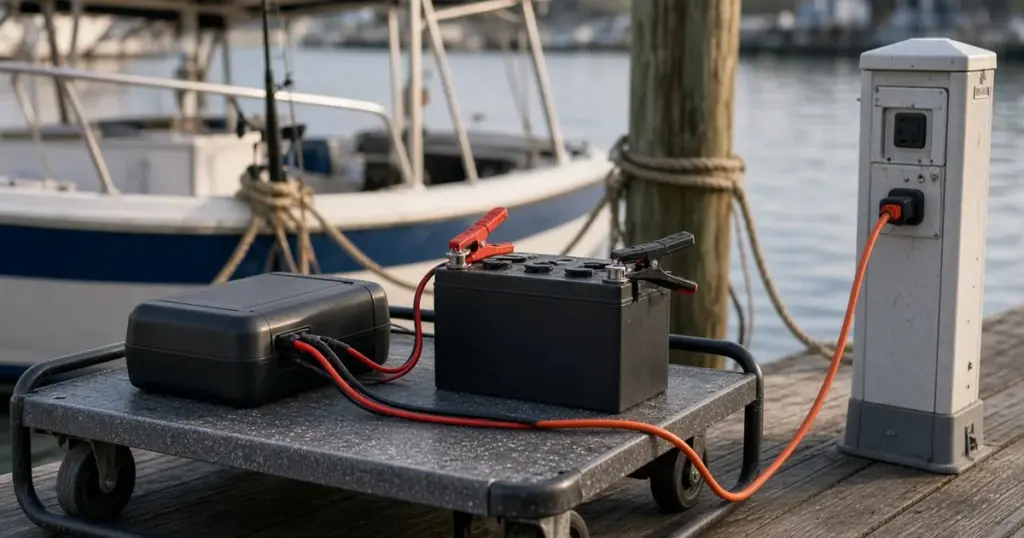
Charger amp ratings range from 2A maintainers to 50A or more for large house banks. Choose too small and your batteries take all night or longer to recover; choose too large and you may exceed what the battery can safely accept or pay for capacity you don’t need. This guide explains how to choose a battery charger amp rating for marine batteries.
What the amp rating means
A charger’s amp rating is its maximum output current. During the bulk stage, the charger delivers close to that current. As the battery approaches full, current tapers during absorption. For lithium batteries, current stays high until close to full, then tapers quickly.
Rules of thumb
Lead-acid (flooded and AGM):
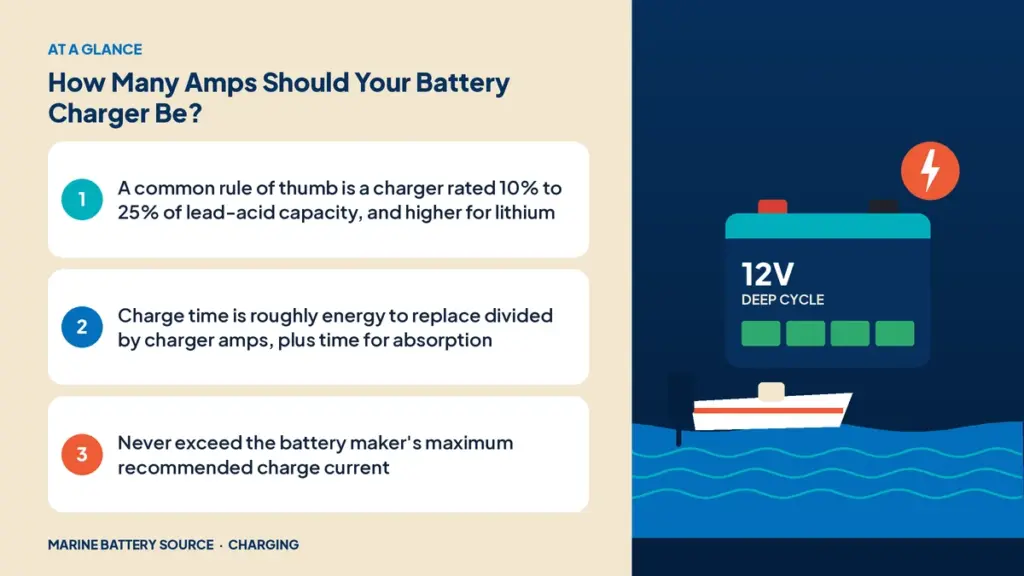
- Many makers recommend a charge rate of about 10% to 25% of the battery’s amp-hour capacity.
- A 100Ah AGM battery: 10A to 25A charger.
- Check the battery’s spec; some AGMs accept higher rates.
Lithium (LiFePO4):
- Lithium accepts much higher charge rates, often up to 50% of capacity or more, as long as you stay within the maker’s maximum charge current.
- A 100Ah lithium battery charges well at 20A to 50A.
- Charging at very high rates is possible but may not be necessary; moderate rates are gentle on the battery.
Charge time math
Charge time (hours) ≈ amp-hours to replace ÷ charger amps
For lead-acid, add 2 to 4 hours for the absorption stage, since current tapers as the battery fills.
Examples:
| Battery and depth | Charger | Approximate time |
|---|---|---|
| 100Ah AGM, 50Ah used | 10A | 5 hours bulk + absorption ≈ 7–9 hours |
| 100Ah AGM, 50Ah used | 20A | 2.5 hours bulk + absorption ≈ 5–6 hours |
| 100Ah lithium, 80Ah used | 15A | About 5.5 hours |
| 100Ah lithium, 80Ah used | 50A | About 1.7 hours |
Our guide to how long it takes to charge a marine battery goes deeper.
Choosing by use case
- Overnight charging after a day of fishing: 10A to 15A per bank for 100Ah lead-acid, or 15A for 100Ah lithium, usually finishes overnight.
- Quick turnaround between trips: higher amps, especially for lithium.
- Maintaining in storage: a small 1A to 5A maintainer.
- Large house banks: 40A or more, often from an inverter-charger.
Lithium examples
- EPOCH 12V 15A lithium charger: overnight charging for 50Ah to 150Ah batteries.
- EPOCH 12V 50A lithium charger: fast charging for larger lithium batteries and house banks.
- EPOCH 36V 15A lithium charger: for 36V lithium trolling batteries; at 36V, 15A delivers about the same power as 45A at 12V.
Voltage matters
At higher voltages, the same current delivers more power: a 36V 15A charger delivers about 540W, and a 48V 15A charger about 720W. But charge time still depends on the battery’s own amp-hours at its own voltage. A 36V 100Ah battery on a 15A charger takes about as many hours as a 12V 100Ah battery on a 15A charger, even though the 36V battery stores three times the energy. Size the charger by the battery’s amp-hour rating and its maximum charge current, not by comparing watts across voltages.
Multi-bank chargers
On multi-bank chargers, the rating may be listed per bank or total. A “4-bank 40A” charger may deliver 10A per bank. Check which. For more, see the multi-bank charger guide and the onboard charger guide.
Don’t exceed the battery’s limit
Every battery has a maximum recommended charge current. Exceeding it shortens life and, for lithium, can trigger the battery management system to disconnect. Check the spec sheet. Small lithium batteries often have low charge limits; a 10Ah battery may accept only a few amps.
Matching the charge profile
Amp rating is only half the choice. The charger must also have the correct profile for the chemistry. See charge profiles explained and whether you can charge lithium with a lead-acid charger.
AC power limits
At the dock, larger chargers draw more from shore power. A 50A 12V charger may draw around 7A to 8A from a 120V outlet. On a 15A or 30A shore circuit shared with other loads, check your total draw.
Charging underway
Charger amp rating applies to shore power. Underway, alternator output and DC-DC chargers determine charging speed. See charging on the water for those options and charging lithium batteries on a boat for lithium specifics.
House banks
For cruising boats, size charger output to recharge the house bank in a reasonable time from generator or shore power. A 400Ah lithium house bank with a 60A charger refills from 20% in about 5 to 6 hours. See house bank sizing.
Bigger isn’t always better
A very large charger on a small lead-acid battery can overheat it or cause excessive gassing. A large charger on a small lithium battery may exceed its limits. And oversized chargers cost more and draw more shore power. Pick the size that fits your batteries and schedule.
Worked example: choosing for a fishing boat
A boat has a 12V AGM cranking battery and a single 12V 100Ah lithium trolling battery. After a typical day, the cranking battery is barely discharged, while the trolling battery is down about 70Ah. The owner charges overnight in the garage, roughly 10 hours. A 10A bank is plenty for the cranking battery. For the lithium battery, 70Ah ÷ 10 hours is only 7A, so even a 10A lithium bank would finish overnight, while 15A to 20A leaves time to spare and handles longer days. The owner chooses a two-bank charger with a lithium-capable bank of at least 15A, which also allows a quick top-up before an early trip.
Common mistakes
- Using a tiny maintainer to recharge a deeply discharged battery.
- Exceeding a small lithium battery’s charge limit.
- Assuming a multi-bank charger’s total rating applies to each bank.
- Ignoring absorption time when estimating lead-acid charge time.
Quick reference
| Battery | Suggested charger range |
|---|---|
| 50Ah lead-acid | 5–12A |
| 100Ah lead-acid | 10–25A |
| 50Ah lithium | 10–25A (check max) |
| 100Ah lithium | 15–50A (check max) |
| 300Ah lithium house bank | 40–100A |
Browse marine chargers in the store.
Frequently asked questions
What size charger do I need for a 100Ah battery?
For lead-acid, about 10A to 25A. For lithium, 15A to 50A, within the battery’s maximum charge current.
Is a bigger charger better?
Not always. It must stay within the battery’s charge limits, and it costs more and draws more AC power.
How long does a 10A charger take to charge a 100Ah battery?
From 50% on lead-acid, roughly 7 to 9 hours including absorption. From 20% on lithium, about 8 hours.
Can I use a high-amp charger on a small battery?
Only if it stays within the battery’s maximum charge current. Small lithium batteries often have low limits.