


36V Trolling Motor Batteries: A Complete Guide
High-thrust 36V trolling motors are the standard on full-size bass boats, big bay boats and walleye rigs. They hold position in wind and current, power advanced spot-lock features and run sonar-integrated systems all day. They’re also demanding on batteries: three batteries’ worth of energy, high current and a lot of weight if you stay with lead-acid. This 36V trolling motor battery guide explains your options, how to size them, and how to wire and charge a 36V system properly.
Two ways to build 36V
Three 12V batteries in series
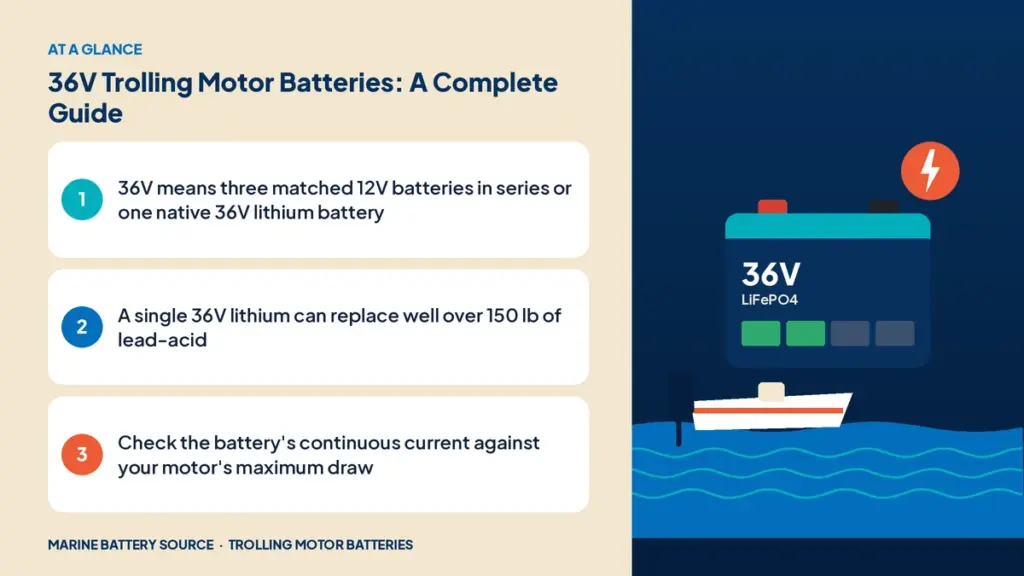
The classic setup. Batteries one and two are joined positive-to-negative, then two and three the same way. The free negative on battery one and the free positive on battery three provide 36V. All three batteries must match in chemistry, capacity, brand and age.
A single native 36V battery
One lithium battery built as 36V, with one positive and one negative terminal. It’s lighter, simpler to wire and simpler to charge. The trade-off is a single large case that has to fit one compartment, and if it fails, you lose the whole bank.
36V options compared
These figures come from the store’s listings:
| Battery | Listed energy | Listed weight | Notes |
|---|---|---|---|
| Dakota Lithium 36V 60Ah | 2,304Wh | 44 lb | Group 31 footprint; heated; 60A continuous, 180A 30-second pulse |
| Dakota Lithium 36V 110Ah | 3,960Wh | 75 lb | 200A continuous |
| EPOCH 36V 100Ah | 3.84 kWh | 75 lb | Bluetooth and heating; 11-year warranty |
| EPOCH 36V 50Ah Essential | 1.92 kWh | 35 lb | Group 31 size; Bluetooth and heating |
| Lithium Rhino 36V 65Ah kit | 36V, 65Ah | n/a | IP67; Bluetooth; 150A continuous; 8-year warranty |
| Lithium Rhino 36V 120Ah kit | 36V, 120Ah | n/a | IP67; Bluetooth; 150A continuous |
| Interstate Li31M 36V 50Ah | 36V, 50Ah | n/a | Group 31M size; 60-month free replacement |
For comparison, three Group 31 AGMs such as the Trojan 31-AES, listed at 69 lb each, total about 207 lb.
Sizing a 36V bank
Capacity in series
Three 12V 100Ah batteries in series give 36V at 100Ah, about 3,600 to 3,840Wh nominal. A native 36V 100Ah lithium battery is the same 3.84 kWh in one case.
Estimate average current
Check your motor’s maximum draw at 36V in the manual. Spot-lock in heavy wind can hold the motor near high power for long periods; slow cruising draws much less.
Usable Ah ≈ average amps × hours.
Example: averaging 18A for 8 hours needs about 144Ah usable. With lithium at about 80% usable, that’s a 36V battery of roughly 180Ah, or more realistically a 120Ah battery if your average is lower than this example. With lead-acid at about 50% usable, it’s nearly 290Ah, more than three Group 31 batteries provide.
Many 36V anglers find a 60Ah lithium battery fine for half days and calm conditions, and 100Ah or more is the safer choice for tournament days and windy water. Learn your real numbers with a battery app; the run-time guide and amp draw guide explain the math.
Check continuous current
The battery’s continuous discharge rating must exceed your motor’s maximum draw with margin. Compare the motor manual’s figure with the ratings in the table above. If the motor can draw more than the battery’s continuous rating, choose a higher-rated battery.
Wiring a 36V system
- Use series jumpers of the same gauge as the main leads.
- Install the breaker or fuse specified by the motor maker on the positive lead, close to the battery.
- Size cable for the motor’s maximum current and the round-trip length.
- Keep terminals covered; 36V can produce a nasty arc if shorted.
Dakota Lithium’s 36V trolling motor connection kit with onboard charging bundles jumpers, breaker and charging leads. Wiring step by step is in our 24V and 36V wiring guide.
Charging a 36V system
Three 12V batteries
Use a three-bank or four-bank onboard charger with one 12V bank per battery. Each charges independently, which keeps the series bank balanced. A four-bank charger like the EPOCH 4-bank 12V 10A per bank can also charge the starting battery.
Native 36V battery
Use a 36V charger matched to the chemistry, such as the EPOCH 36V 15A lithium charger or the Allied Lithium 36V 15A waterproof charger. The EPOCH 12V and 36V onboard charger combines a 36V lithium output with a 12V output for the starting battery.
Charging while running
A DC-DC charger that boosts 12V engine output to 36V, like EPOCH’s 12V to 36V DC-DC charger, can top up the trolling battery during long runs.
12V electronics on a 36V boat
Don’t tap 12V from one battery in a 36V series bank. Power electronics from the starting battery, a dedicated electronics battery, or a DC-DC converter sized for the load.
Upgrading from lead-acid
Swapping three lead-acid batteries for one 36V lithium battery is the most common 36V upgrade. You’ll need a 36V lithium charger or lithium-capable charger banks, rewired leads and a secure mount for the new battery. Our 36V upgrade guide walks through it.
Common 36V mistakes
- Mixing old and new batteries in a series bank.
- Charging a series bank from a single 12V output.
- Choosing a battery whose continuous rating is below the motor’s maximum draw.
- Forgetting a fuse or breaker, or placing it far from the battery.
Related reading
For the core selection process, see how to choose a trolling motor battery. If you’re deciding between system voltages, compare with the 24V guide and 12V guide. Boat-by-boat setups are covered in battery setups by boat type. Browse all trolling motor batteries to compare.
Frequently asked questions
How many batteries does a 36V trolling motor need?
Three 12V batteries in series, or one native 36V battery.
What size lithium battery do I need for a 36V trolling motor?
It depends on your average draw and hours. Many anglers use 60Ah for shorter days and 100Ah or more for full tournament days or windy water.
Can I use a 36V battery with a 24V motor?
No. Match the battery voltage to the motor. Overvoltage can damage the motor’s electronics.
How do I charge three 12V batteries in series?
Use a multi-bank charger with one bank connected to each battery. Each battery charges independently, which keeps the bank balanced.