


Trolling Motor Amp Draw: Estimating Real-World Current
Current draw is the number that connects your trolling motor to your battery. It decides how long you can fish, what cable size you need and which breaker protects the circuit. Yet most anglers only know their motor’s thrust rating. This guide explains trolling motor amp draw, how it relates to thrust and voltage, why real-world draw is usually well below the maximum, and how to measure your own numbers.
Thrust, power and current
Thrust, measured in pounds, describes how hard the motor pushes. Current, measured in amps, is what it pulls from the battery. The link between them is power:
Power (watts) = voltage × current
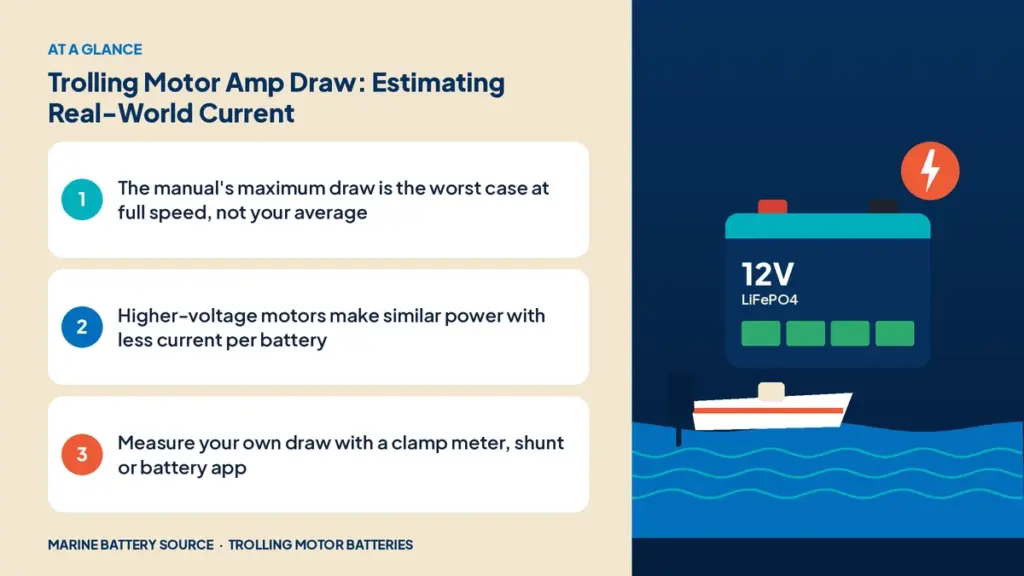
A motor needs a certain amount of electrical power to produce its thrust. Supply that power at a higher voltage and the current is lower. That’s the main reason high-thrust motors use 24V or 36V: they’d need impractically high current at 12V, with heavy cables and big losses.
There’s no universal conversion from pounds of thrust to amps. It depends on the motor’s design, efficiency, prop and speed setting. Your motor’s manual or the maker’s specifications list the maximum current draw, and that’s the number to start with.
Maximum draw vs average draw
The maximum draw in the manual is the current at full speed under load. It’s essential for sizing cables and breakers. For runtime, though, what matters is the average across your day, which depends on:
- Speed settings: most fishing happens well below full speed.
- Variable-speed control: modern motors with pulse-width modulation draw roughly in proportion to the power they deliver. Older motors with resistor-based or stepped speed control may waste some energy at low settings.
- Conditions: wind, current and waves push average draw up.
- Spot-lock or anchor modes: they make constant corrections; in calm water the average is low, in rough water it can approach high power for long stretches.
- Boat load: more weight takes more thrust to move.
A useful planning habit is to assume your average is a modest fraction of maximum in calm conditions and a large fraction on windy days, then confirm by measuring.
How voltage affects your battery choice
Suppose two motors each draw 1,000 watts at high speed. At 12V, that’s about 83A. At 24V, about 42A. At 36V, about 28A. The higher-voltage systems draw far less current through each cable and battery. That’s why batteries in a 36V system don’t need individual capacity three times larger to match a 12V setup’s runtime per watt delivered; the energy in watt-hours is what you compare. See our run-time guide for worked examples.
Why amp draw matters for battery selection
Capacity
Average draw times hours on the water gives the usable amp-hours you need.
Continuous discharge rating
Lithium batteries have a BMS that limits continuous current. If your motor’s maximum draw exceeds the battery’s continuous rating, the BMS can shut the battery off at full throttle. The store’s listings show the range: the Dakota Lithium 36V 60Ah lists 60A continuous, while Lithium Rhino’s kits list 150A continuous and the Dakota Lithium 36V 110Ah lists 200A. Match the battery to your motor’s maximum, with headroom.
Lead-acid capacity at high current
Lead-acid batteries deliver fewer amp-hours at high current than at their 20-hour rating. A motor that pulls hard all day gets noticeably less from an AGM or flooded battery than the label suggests.
How to measure your own amp draw
Battery app
Many lithium batteries with Bluetooth show live current. Run your motor at each setting you commonly use and note the reading. EPOCH’s Essential series and the EPOCH 36V 50Ah Essential, for example, list Bluetooth.
Shunt-based battery monitor
A shunt in the negative cable measures all current through the bank and logs amp-hours used. It’s the best tool for knowing your true daily consumption.
DC clamp meter
A DC-capable clamp meter around the positive or negative motor lead shows current instantly. Make sure the meter measures DC, not just AC.
Before-and-after state of charge
If you have no meter, note state of charge before and after a trip and divide amp-hours used by hours fished. It’s rough but useful.
A simple measurement routine
- Fully charge the battery.
- On calm water, run the motor at your three or four most-used settings for a minute each and record current.
- On a typical trip, note how long you spend at each setting, roughly.
- Multiply and add up to estimate amp-hours per day.
- Repeat on a windy day for your worst case.
Amp draw, cables and breakers
The motor maker specifies cable gauge and breaker size based on maximum current and cable length. Undersized cable causes voltage drop, which reduces motor performance and wastes energy as heat. Follow the manual, and see our wiring guides for details.
Reducing amp draw
- Use the lowest speed that holds your position or pace.
- Trim the boat and distribute weight to reduce drag.
- Keep the prop clean and undamaged.
- Use the main engine for long repositioning runs instead of the trolling motor.
- Use lithium, so the motor doesn’t need higher settings as voltage sags.
More tips are in our list of ways to extend trolling motor run time.
Choosing your battery from the numbers
With your average and maximum draw in hand:
- Size capacity from average draw × hours, adjusted for chemistry.
- Choose a battery whose continuous rating exceeds maximum draw.
- Pick the chemistry that suits your budget and boat. See choosing a lithium trolling motor battery or when AGM still makes sense.
For the complete selection process, start with how to choose a trolling motor battery. If you’re running a big 36V motor, the 36V battery guide compares options, and setups by boat type shows typical systems. Browse trolling motor batteries in the store.
Frequently asked questions
How many amps does a trolling motor draw?
It depends on the motor, voltage and speed setting. The manual lists maximum draw at full speed; average draw while fishing is usually much lower. Measure your own with a battery app, shunt or DC clamp meter.
Does a 36V motor draw less current than a 12V motor?
For the same power, yes. Higher voltage means lower current, which is why high-thrust motors use 24V or 36V systems.
Why does my lithium battery shut off at full throttle?
Your motor’s draw may exceed the battery’s continuous discharge rating, triggering the BMS. Choose a battery with a higher continuous rating.
Does spot-lock use a lot of battery?
It can. In calm water it draws little, but in wind and current it makes constant corrections that can approach high power.