


Amp-Hours Explained for Boaters

Amp-hours are the most important number for any battery that runs a trolling motor, electronics or a house bank. They tell you how much energy the battery stores, and with a little math, how long it will run your gear. This guide explains what amp-hours mean, how they’re measured, and how to use them to choose and size a battery.
What is an amp-hour?
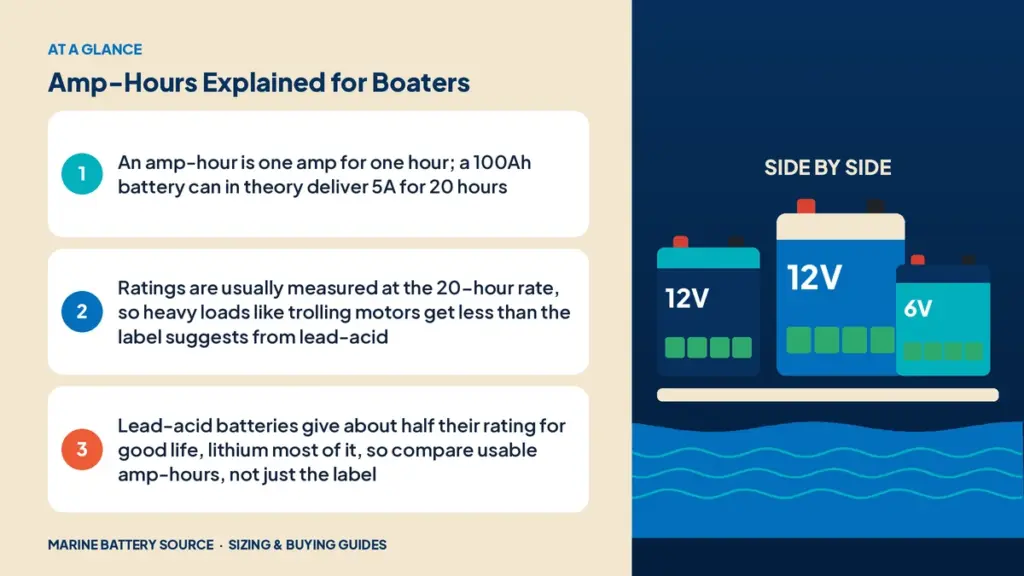
An amp-hour (Ah) is a unit of charge: one amp of current flowing for one hour. A battery rated at 100Ah can, in theory, deliver:
- 1A for 100 hours,
- 5A for 20 hours,
- 10A for 10 hours, or
- 50A for 2 hours.
In practice, it’s not quite that simple, especially for lead-acid batteries, but the basic idea is right: more amp-hours means more runtime.
How amp-hour ratings are measured
Most deep-cycle batteries are rated at the 20-hour rate. That’s the capacity the battery delivers when discharged evenly over 20 hours. A 100Ah battery at the 20-hour rate delivers 5A for 20 hours before it reaches its cutoff voltage. Trojan, for example, lists its batteries’ capacity as “20-hr rate.”
This matters because lead-acid batteries deliver less total capacity at higher currents, an effect known as Peukert’s law. A lead-acid battery rated 100Ah at the 20-hour rate might deliver noticeably less if you pull 50A from it, as a trolling motor might. Lithium batteries are much less affected, delivering close to their rated capacity across a wide range of loads.
Reserve capacity vs amp-hours
Many marine batteries list reserve capacity (RC): the minutes a fully charged battery can deliver 25A before voltage falls to 10.5V. It’s useful for comparing batteries for running loads with the engine off. You can roughly estimate the amp-hours available at 25A by multiplying RC by 25 and dividing by 60. A battery with 180 minutes RC delivers about 75Ah at 25A.
Usable amp-hours
Not all of a battery’s rated capacity should be used every time.
- Flooded and AGM lead-acid: for good cycle life, stop at about 50% state of charge. A 100Ah lead-acid battery gives about 50Ah usable.
- Lithium (LiFePO4): can routinely use 80–100% of its rating. A 100Ah lithium battery gives about 80–100Ah usable.
That’s why a 100Ah lithium battery can run a trolling motor nearly twice as long as a 100Ah lead-acid battery. See lithium vs lead-acid amp-hours and depth of discharge for more.
Estimating runtime
Runtime (hours) ≈ usable amp-hours ÷ average current (amps)
| Battery | Usable Ah | Load | Estimated runtime |
|---|---|---|---|
| 100Ah lead-acid | ~50Ah | 10A trolling | ~5 hours |
| 100Ah lithium | ~90Ah | 10A trolling | ~9 hours |
| 100Ah lead-acid | ~50Ah | 2A electronics | ~25 hours |
| 60Ah lithium | ~54Ah | 4A livewell plus graph | ~13 hours |
For lead-acid under heavy load, expect somewhat less than this estimate because of the Peukert effect.
Finding your average current
Trolling motors rarely run at full power for long. A motor that draws 40A at full speed might average 10–20A over a day of mixed use. To estimate:
- Check the motor maker’s current draw at different speeds.
- Use a battery monitor or the battery’s Bluetooth app to see real draw.
- Note how much charge you use on a typical day.
For electronics, check the manual’s current draw, often listed in amps or watts. Divide watts by 12 to get amps on a 12V system.
Amp-hours in series and parallel
- Series (for 24V or 36V): voltage adds, amp-hours stay the same. Three 100Ah 12V batteries in series make a 36V 100Ah bank.
- Parallel (for more capacity at 12V): amp-hours add, voltage stays the same. Two 100Ah 12V batteries in parallel make a 12V 200Ah bank.
Because voltage changes in series, comparing banks in watt-hours is clearer. A 36V 100Ah bank stores three times the energy of a 12V 100Ah battery. See amp-hours to watt-hours and kWh.
Sizing a battery with amp-hours
- List each load and its average current.
- Multiply by hours used per trip.
- Add them up.
- Add 20–30% margin.
- Double it for lead-acid, or divide by about 0.9 for lithium.
Example: a fish finder at 1.5A for 8 hours (12Ah), a livewell at 3A averaging 50% duty for 6 hours (9Ah), and lights at 1A for 2 hours (2Ah) total 23Ah. Add 25% for 29Ah. You’d want about 58Ah of lead-acid or 32Ah of lithium.
Amp-hours and charging time
Amp-hours also tell you how long charging will take. Charging time (hours) ≈ amp-hours to replace ÷ charger output (amps), plus extra time for the final absorption stage on lead-acid. Replacing 50Ah with a 10A charger takes roughly 5–6 hours for lead-acid, and about 5 hours for lithium, which charges efficiently right to the top.
Tracking amp-hours on the water
A shunt-based battery monitor or a lithium battery’s Bluetooth app counts amp-hours in and out. After a few trips, you’ll know exactly what a typical day uses, which makes sizing your next battery much easier.
Common amp-hour mistakes
- Comparing lead-acid and lithium labels directly. Compare usable amp-hours instead.
- Forgetting the Peukert effect. Heavy trolling loads drain lead-acid faster than simple math suggests.
- Ignoring age and temperature. Older batteries and cold weather reduce available capacity.
- Comparing banks of different voltages in amp-hours. Use watt-hours.
More reading
The marine battery buying guide puts amp-hours in context with other specs. For lithium-specific advice, read the lithium marine battery buyer’s guide. The BCI group size guide shows typical capacity by case size, and buying a marine battery online covers what to check before ordering.
Products mentioned
- EPOCH 12V 100Ah Eco
- Battle Born 100Ah
- Trojan SCS150 (100Ah, 20-hr rate)
- Browse trolling motor batteries.
Frequently asked questions
What does 100Ah mean on a battery?
It can deliver about 100 amp-hours, such as 5A for 20 hours, at its rated discharge rate.
How long will a 100Ah battery run a trolling motor?
At a 10A average, about 5 hours for lead-acid or 9 hours for lithium.
Is reserve capacity the same as amp-hours?
No. Reserve capacity is minutes at 25A. Multiply by 25 and divide by 60 to estimate amp-hours at that load.
Do batteries in series add amp-hours?
No. Series adds voltage. Parallel adds amp-hours.
Why does my lead-acid battery run out sooner than expected?
Heavy loads, age, cold weather and the Peukert effect all reduce available capacity.