


Amp-Hours to Watt-Hours and kWh: Battery Math Made Simple
Amp-hours tell you a battery’s capacity, but only at a given voltage. When you compare a 12V battery with a 36V battery, or a lead-acid bank with a lithium battery, amp-hours can mislead. Watt-hours and kilowatt-hours solve that by measuring energy directly. This guide shows how to convert and how to use the results.
The formulas
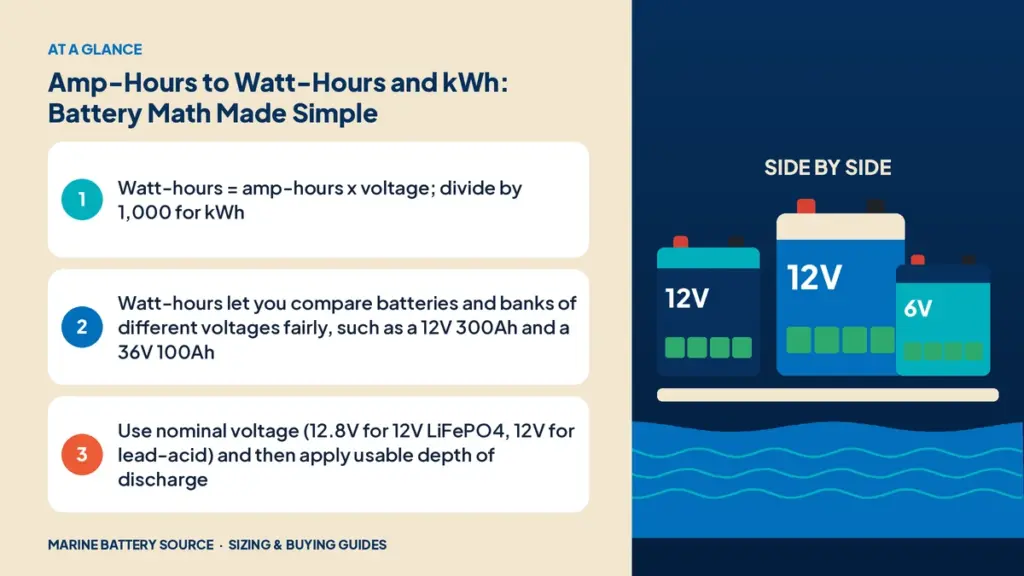
- Watt-hours (Wh) = amp-hours (Ah) x voltage (V)
- Kilowatt-hours (kWh) = watt-hours ÷ 1,000
- Amp-hours = watt-hours ÷ voltage
That’s it. The only question is which voltage to use.
Which voltage?
Use the battery’s nominal voltage:
- 12V lead-acid: 12V.
- 12V LiFePO4: 12.8V, because a LiFePO4 battery has four cells at 3.2V nominal each. That’s why EPOCH lists its 12V 100Ah Eco at 1.28 kWh.
- 24V, 36V and 48V LiFePO4: 25.6V, 38.4V and 51.2V. EPOCH’s 24V 100Ah lists 2.56 kWh, and its 36V 50Ah lists 1.92 kWh.
Some makers round to 12V, 24V and so on. The difference is small, about 7%, but it’s worth knowing when you compare listings.
Worked examples
| Battery | Calculation | Energy |
|---|---|---|
| 12V 100Ah lithium | 100 x 12.8 | 1,280 Wh (1.28 kWh) |
| 12V 300Ah lithium | 300 x 12.8 | 3,840 Wh (3.84 kWh) |
| 24V 60Ah lithium | 60 x 25.6 | 1,536 Wh (1.54 kWh) |
| 36V 100Ah lithium | 100 x 38.4 | 3,840 Wh (3.84 kWh) |
| 48V 100Ah lithium | 100 x 51.2 | 5,120 Wh (5.12 kWh) |
| 12V 105Ah lead-acid | 105 x 12 | 1,260 Wh (1.26 kWh) |
| Pair of 6V 225Ah in series | 225 x 12 | 2,700 Wh (2.7 kWh) |
Notice that a 12V 300Ah battery and a 36V 100Ah battery store the same energy. In amp-hours they look very different; in watt-hours they’re equal.
Why watt-hours matter on boats
Comparing trolling banks. A 36V trolling motor uses about one-third the current of a 12V motor for the same power. A 36V 50Ah battery (1.92 kWh) stores more energy than a 12V 100Ah battery (1.28 kWh), even though its amp-hour number is half.
Comparing lithium and lead-acid. Watt-hours of rated energy aren’t the same as usable energy. Multiply by usable depth of discharge: about 50% for lead-acid, about 80–100% for lithium.
| Battery | Rated energy | Usable fraction | Usable energy |
|---|---|---|---|
| Group 27 lead-acid 105Ah | 1.26 kWh | 50% | 0.63 kWh |
| 12V 100Ah lithium | 1.28 kWh | 90% | 1.15 kWh |
Sizing for inverters and appliances. Appliances are rated in watts. A 60W refrigerator running a 50% duty cycle for 24 hours uses 60 x 0.5 x 24 = 720 Wh. Comparing that with battery watt-hours is straightforward. Remember inverter losses, often 10–15%.
Comparing prices. Price per kWh is the fairest way to compare batteries of different voltages and chemistries. See battery price per kWh.
Converting loads from watts to amps
Amps = watts ÷ volts. A 120W fish finder and graph setup on a 12V system draws about 10A. A 1,000W inverter load draws roughly 90A from a 12V bank after losses, but only about 22A from a 48V bank. Higher-voltage banks reduce current, cable size and voltage drop.
Runtime from watt-hours
Runtime (hours) ≈ usable watt-hours ÷ load in watts.
Example: a 12V 300Ah lithium battery (3.84 kWh, about 3.4 kWh usable at 90%) running a 400W load lasts about 8.5 hours, a bit less with inverter losses.
Charging in watt-hours
Charger output is usually listed in amps at the battery voltage. A 12V 15A charger delivers about 15 x 14V ≈ 210W. Recharging 1 kWh takes about 5 hours, plus losses. A 36V 15A charger delivers roughly three times the power, about 600W, so it refills the same watt-hours in about a third of the time.
Quick conversion table for 12V batteries
| Amp-hours | Lead-acid (12V) | LiFePO4 (12.8V) |
|---|---|---|
| 50Ah | 600 Wh | 640 Wh |
| 100Ah | 1,200 Wh | 1,280 Wh |
| 200Ah | 2,400 Wh | 2,560 Wh |
| 300Ah | 3,600 Wh | 3,840 Wh |
| 460Ah | 5,520 Wh | 5,888 Wh |
A worked boat example
Say you run a center console with these house loads on an overnight trip:
| Load | Watts | Hours | Watt-hours |
|---|---|---|---|
| Electronics (two displays, radar idle) | 60W | 6 | 360 Wh |
| 12V refrigerator (50% duty) | 50W | 24 | 600 Wh |
| Anchor and cabin lights | 15W | 10 | 150 Wh |
| Phone and device charging | 20W | 4 | 80 Wh |
| Total | 1,190 Wh |
Add 25% margin to get about 1,500 Wh. For lithium at 90% usable, you’d want about 1.7 kWh of rated capacity, which is a 12V 135Ah or larger battery. For lead-acid at 50% usable, you’d need about 3 kWh rated, roughly a 12V 250Ah bank, such as a pair of 6V golf-cart batteries. That’s the difference between one 27-pound battery and two 60-plus-pound batteries.
Comparing listings that use different units
Some listings show energy in kWh, some in Wh, and some show only amp-hours. Convert everything to watt-hours using nominal voltage, then compare. If one listing rounds 12.8V to 12V, recalculate with the same voltage for every battery so the comparison is fair.
Common mistakes
- Adding amp-hours across a series bank. Three 100Ah batteries in series are 100Ah at 36V, not 300Ah. In watt-hours, it’s 3.84 kWh for lithium.
- Ignoring usable capacity. Rated watt-hours overstate what lead-acid delivers.
- Forgetting conversion losses. Inverters, DC-DC chargers and wiring all lose a little energy.
More reading
Start with amp-hours explained, then read depth of discharge to understand usable energy and battery C-rate for charge and discharge limits. The marine battery buying guide puts it all together. The BCI group size guide shows typical capacity per size, and buying a marine battery online covers ordering.
Products mentioned
- EPOCH 12V 100Ah Eco (1.28 kWh)
- EPOCH 36V 50Ah (1.92 kWh)
- EPOCH 48V 100Ah V2 Elite (5.12 kWh)
- EPOCH 12V 460Ah (5.89 kWh)
Frequently asked questions
How do I convert amp-hours to watt-hours?
Multiply amp-hours by the battery’s nominal voltage.
How many kWh is a 12V 100Ah lithium battery?
About 1.28 kWh, using LiFePO4’s 12.8V nominal voltage.
Why compare batteries in watt-hours?
Watt-hours account for voltage, so you can compare 12V, 24V, 36V and 48V batteries fairly.
Is a 36V 50Ah battery bigger than a 12V 100Ah?
In energy, yes: about 1.92 kWh versus 1.28 kWh.
How do I find usable watt-hours?
Multiply rated watt-hours by usable depth of discharge: about 50% for lead-acid, 80–100% for lithium.